Speed to lead is the time between a patient submitting an inquiry and your med spa's first real contact, and the target is under 5 minutes. The most-cited research found the odds of qualifying a web lead fell 21-fold when the first call came at 30 minutes instead of 5 (Lead Response Management Study, 2007).
That makes speed to lead a med spa operations problem more than a marketing one. Your ads already did their job when the form arrived. What happens in the next few minutes depends on who picks up the phone, and most practices have never written that down.
Example: a patient fills in a Meta lead form for lip filler at 12:40 pm on a Tuesday. The front desk is checking in two patients, the injector is mid-treatment, and the lead sits in an inbox until 3:15 pm. By then the patient has filled in two other forms and booked with whoever called first.
What is speed to lead for a med spa?
Speed to lead is a single number: minutes from form submission to the first two-way contact. The clock starts when the inquiry lands, whether that is a Meta lead ad, a website form, an Instagram DM or a missed call. It stops when a person at your practice actually talks or texts back and forth with the patient.
Three things do not stop the clock:
- An automatic "thanks, we got your request" text or email.
- A voicemail you left that nobody returned.
- A booking link sent with no reply from the patient.
Those steps are useful, but they are not contact. Count them and your speed to lead looks excellent while patients wait hours for a human.
The first two numbers come from the 2007 Lead Response Management Study. The third comes from a February 2026 NP Digital survey of 500 marketers. If you want the full picture of what happens to a lead after first contact (stages, follow-up, booked visits), read our guide on how to manage leads from Meta Ads. This article stays on the first contact window only.
What the 5-minute lead response research really found
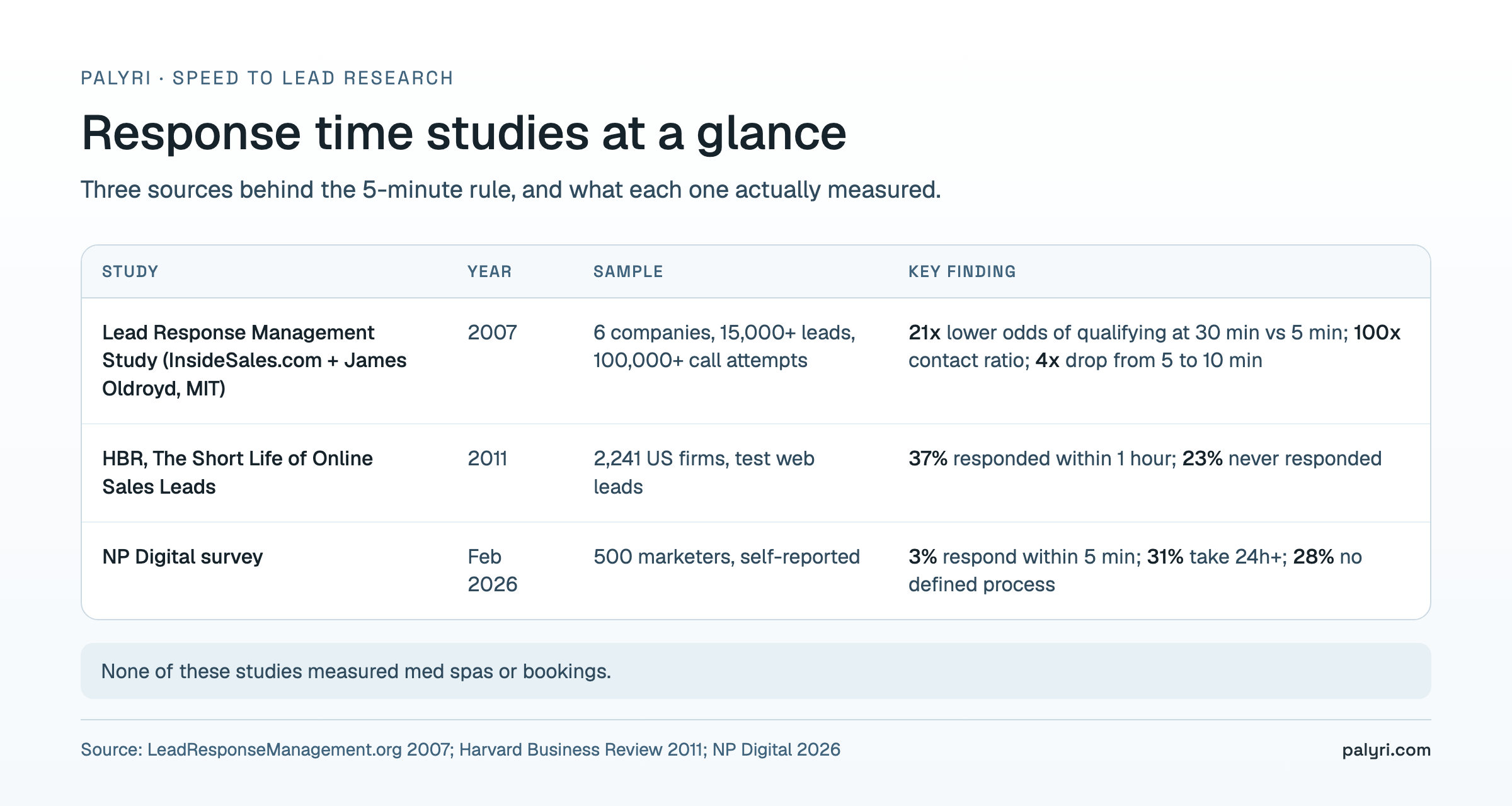
Most pages about speed to lead quote "21x" and "100x" and credit them to Harvard. Those numbers come from a different study. There are three sources worth knowing, and each measured something different.
1. The Lead Response Management Study (2007). InsideSales.com and MIT researcher James Oldroyd analyzed "three years of data from six diverse companies, analyzing over fifteen thousand leads and more than a hundred thousand call attempts" (LRM Study). The study reports a 21-fold drop in the odds of qualifying a lead when response time stretched from 5 to 30 minutes, a fourfold drop between 5 and 10 minutes, and a 100-fold difference in contact ratios. It also found that "contact success dropped more than tenfold, while qualification success fell over sixfold in the first hour."
2. The HBR audit (2011). James Oldroyd, Kristina McElheran and David Elkington published "The Short Life of Online Sales Leads" in Harvard Business Review in March 2011. Their conclusion: "most companies are not responding nearly fast enough." As widely summarized, the team submitted test web leads to 2,241 US firms; 37% responded within an hour and 23% never responded at all.
3. The NP Digital survey (2026). In a self-reported survey of 500 marketers published in February 2026, only 3% said they respond within 5 minutes, 9% within 1 hour, and 31% take 24 hours or more. Another 28% said they have no defined process at all.
How fast should a med spa respond to leads?
Under 5 minutes during business hours, by phone, with a text if the patient does not answer. That standard comes straight from the 2007 study's 5-minute window. Outside business hours, the goal changes: an instant automatic acknowledgment that sets a time, and a call at opening.
The 2007 study adds one timing detail that helps after-hours planning: the 8-9 am and 4-5 pm intervals were the best for qualifying leads, with a 164% improvement over the weakest window, 1-2 pm (LRM Study). That supports making overnight leads the first job of the morning.
Here is a response standard you can adopt as written. Times are targets, not research results.
| Situation | Target | First action | If no answer |
|---|---|---|---|
| Business hours: Meta lead ad or website form | Under 5 min | Call | Text within 1 min of the missed call, call again at 1 hour |
| Business hours: Instagram or Facebook DM | Under 5 min | Reply in the same channel, ask for the best number | Call once you have a number |
| Missed inbound call | Under 5 min | Call back | Text with a callback offer |
| Lunch and peak hours | Under 5 min | Named backup owner calls | Escalate to manager at 10 min |
| After hours (weekday) | Instant auto-text, call at opening | Auto-text that names a callback time | Call in the first hour of the day |
| Weekend | Your decision, written down | Either an on-call owner or the after-hours rule | Call first thing Monday |
Most practices skip the weekend row. "We cover Saturday until 3 pm, Sunday is after-hours" is a fine rule. "Whoever sees it" is not.
Who owns a new lead when the front desk is busy?
One named person owns new leads in every hour the practice is open, and one named backup covers them. Injectors and providers are never the default owner, because they are in treatment rooms and patient safety comes first.
The front desk is also checking in patients, taking payments and answering the phone, so write a coverage roster per day with an escalation rule: no contact within 5 minutes, the backup takes the lead; at 10 minutes, the manager is alerted.
Example: a sample coverage roster for a single-location med spa open 9 am to 7 pm on weekdays. Roles are illustrative; swap in your own staff.
| Time block | Primary owner | Backup | Escalation at 10 min |
|---|---|---|---|
| 9:00-11:00 am | Front desk A | Patient coordinator | Practice manager |
| 11:00 am-1:00 pm | Patient coordinator | Front desk A | Practice manager |
| 1:00-2:00 pm (lunch) | Front desk B | Practice manager | Owner |
| 2:00-5:00 pm | Front desk B | Patient coordinator | Practice manager |
| 5:00-7:00 pm | Front desk B | Practice manager | Owner |
| After 7:00 pm | After-hours auto-text | First owner next morning | None |
Two rules make the roster work: the owner gets alerts on a device they carry, and every attempt is logged on the lead record so the backup sees what already happened.
What to say: first call, text and voicemail scripts
The first call has one goal: confirm interest and offer a consultation time. It is not a sales pitch and not a medical consult. Keep it under three minutes, and let the provider answer clinical questions at the consultation.
If yes: "Great. What made you look into [treatment] now?" Listen. "The best next step is a consultation with [Provider name], who will look at what you want and explain your options and price range. I have [day] at [time] or [day] at [time]. Which works better?"
Before you hang up: "I'll text you the confirmation and our address now. If anything comes up, just reply to that text."
Then follow a fixed cadence instead of trying "when someone has time." The 2007 study found that "attempts to contact leads after 20 hours could be detrimental" in its dataset (LRM Study). That is why the cadence below leans on calls in the first day and shifts to texts afterward. It is a suggested cadence, not a researched optimum.
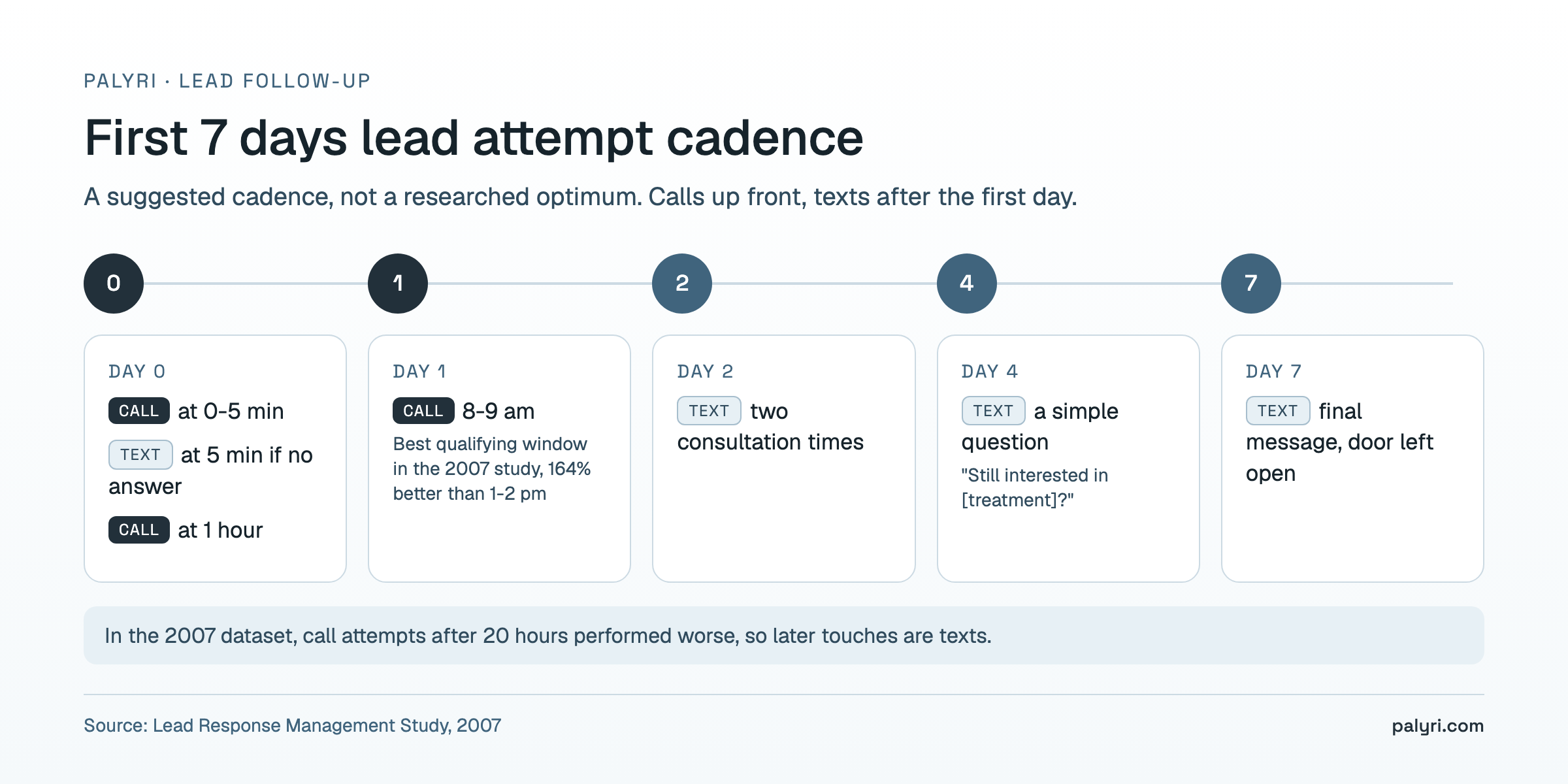
The Day 4 question is easy to answer in one word, and a "no" lets you close the lead. For choosing between text, WhatsApp and email for these touches, see our SMS, WhatsApp or email channel guide.
How to handle after-hours med spa leads
Many med spa inquiries come in the evening, after the patient has scrolled Instagram on the couch. You cannot call at 10 pm, but you can make the wait predictable. The after-hours rule has three parts: an instant automatic text, a booking link if you have one, and a call at opening.
The callback time matters most: "We'll be in touch soon" leaves the patient shopping, while "We'll call you at 9 am" gives them a reason to wait. If you add a link, our guide to online booking for aesthetic clinics covers how to set it up so patients can only pick consultation slots.
Automation fits the parts of this job that are pure routine. Our breakdown of which front-desk tasks are worth automating separates the routine messages from the conversations a person should still have.
What slow response costs: a worked example
You paid for every lead before anyone called it. A lead that is never worked is ad spend with zero chance of a return.
Example (all figures are assumptions for illustration, not benchmarks):
- 150 leads per month from Meta ads.
- $40 assumed cost per lead.
- Monthly lead spend: 150 x $40 = $6,000.
- 20% of leads assumed never to get a call: 150 x 20% = 30 leads.
- Spend on leads nobody worked: 30 x $40 = $1,200 per month, or $14,400 per year.
That $1,200 is only the direct waste. If you carry on with your own assumptions, the lost revenue is larger. Say 25% of those 30 leads would have booked a consultation (7.5), and half of those would have gone ahead with a $600 treatment: 7.5 x 50% x $600 = $2,250 in first-visit revenue per month.
The ROI calculator lets you plug in your own lead volume and cost. If you are not sure what a realistic cost per lead looks like, start with our cost per lead benchmarks for aesthetic clinics.
How to measure your med spa speed to lead
You cannot fix a number you do not track. Measure speed to lead weekly with three figures, and use the median, not the average. One lead answered three days late will drag an average up and hide the fact that most leads were handled well, or the opposite.
| Metric | How to calculate | Why it matters |
|---|---|---|
| Median minutes to first contact | Minutes from form submit to first two-way contact, middle value of the week | Your real response speed |
| % contacted within 5 minutes | Leads with first contact under 5 min / all leads in business hours | Tracks the standard you set |
| % contacted within 1 hour | Leads with first contact under 60 min / all leads in business hours | Shows whether the backup rule works |
| % never contacted | Leads with zero two-way contact after Day 7 / all leads | Direct waste of ad spend |
| After-hours callbacks on time | Overnight leads called in the first hour of opening / all overnight leads | Keeps the auto-reply promise honest |
Then test yourself the way the HBR researchers tested US firms: submit your own web form and your own Meta lead form once a month from a phone number your team does not know, at different times of day. Note how long it takes to get a real call. A test lead at 1:15 pm on a busy Thursday tells you more than any report.
In a 15-minute weekly huddle, review each lead that broke the standard and ask who owned that hour. The answer usually points to a roster gap, not a lazy employee. Once first contact is reliable, the next lever is turning consultations into treatments, covered in our guide to consultation to treatment conversion.
Tooling helps with the first two steps of this process. A CRM built for aesthetic clinics such as Palyri pulls Meta lead ads and website form leads into one pipeline, alerts the team the moment a new lead arrives, and keeps every call and text attempt on the lead record, so the backup owner and the weekly review both work from the same history. Plans are listed on the pricing page.
FAQ
How fast should a med spa respond to a new lead?
Aim for under 5 minutes during business hours. The 2007 Lead Response Management Study by InsideSales.com and MIT researcher James Oldroyd found the odds of qualifying a lead dropped 21-fold when the first call came at 30 minutes instead of 5, and fourfold between 5 and 10 minutes. It used phone data from six companies, not med spas, so treat 5 minutes as a practical standard, not a booking guarantee. After hours, send an automatic text that names a callback time and call within the first hour of opening.
Is the 21x lead response statistic from Harvard Business Review?
No. The 21x and 100x figures come from the 2007 Lead Response Management Study, run by InsideSales.com with MIT researcher James Oldroyd and based on more than 15,000 leads and 100,000 call attempts. Oldroyd later co-authored "The Short Life of Online Sales Leads" in Harvard Business Review in March 2011, which audited how quickly US firms respond to web leads. Vendor sites often merge the two; when you quote either, link the original and state the year.
Should I call or text a new med spa lead first?
Call first, then text if the patient does not answer. The strongest research on response time measured phone calls, and a live conversation lets you answer questions and offer two consultation times on the spot. Send the text within a minute of the missed call so the patient can reply when it suits them. For DM leads, reply in the same channel first and ask for the best number.
How do I handle leads that come in after hours?
Send an automatic text within minutes that thanks the patient, names a specific callback time such as 9 am, and includes a booking link if you have one. Then make overnight leads the first task of the morning. In the 2007 study, the 8-9 am window was among the best for qualifying leads. Keep medical advice out of automated messages, and write your weekend rule down so the team knows whether Saturday leads get a same-day call.
How many times should we try to reach a new lead?
There is no reliable published benchmark for med spas, so use a fixed cadence and stick to it. A practical version is three calls in the first day (within 5 minutes, at 1 hour, and the next morning), then texts on Days 2, 4 and 7. The 2007 study found that call attempts after 20 hours performed worse in its dataset, which is why later touches are texts. Log every attempt on the lead record so nobody repeats or skips a step.
Does an automated text count as speed to lead?
No. Speed to lead measures time to the first two-way contact, meaning a real conversation by phone or text with someone at your practice. An automatic acknowledgment is useful because it confirms the request and sets expectations, but the patient has not spoken to anyone yet. Track the auto-reply separately and keep the clock running until a team member actually talks or texts with the patient.
Want to implement this in your clinic?
Book a free Palyri demo. We'll show how it works on your clinic's data.
Book a demoPalyri blog author
Writes for the Palyri blog about getting clients from ads, handling leads and front-desk work in aesthetic clinics and beauty salons.