Send a med spa appointment reminder text in three steps: a confirmation right after booking, a reminder that asks for a reply 24 to 48 hours before, and a short nudge about 2 hours before (skip it for first-slot-of-the-day bookings). Keep each text under 160 characters, name the med spa, the date, time and provider, give one way to confirm or reschedule, and keep promotions out of reminders.
The evidence that texts work is solid: a Cochrane review of eight randomized trials found text reminders raised attendance compared with no reminder (risk ratio 1.14, published 2013). The exact timing is a different story. A 2018 review of 162 studies says the most effective timing and frequency still need to be determined, so the schedule below is common practice, not a proven formula.
When should a med spa send appointment reminder texts?
The schedule most US practices use has four touches. Each one has a job, and the job decides the wording.
| When | Job of the text | Ask for a reply? |
|---|---|---|
| Right after booking | Confirm date, time, provider and address | No |
| 48 hours before (72 hours for treatments with prep) | Give prep instructions and the last easy window to reschedule | Optional |
| 24 hours before | Get a clear YES or a reschedule request | Yes |
| 2 hours before | Arrival details: parking, entrance, what to bring | No |
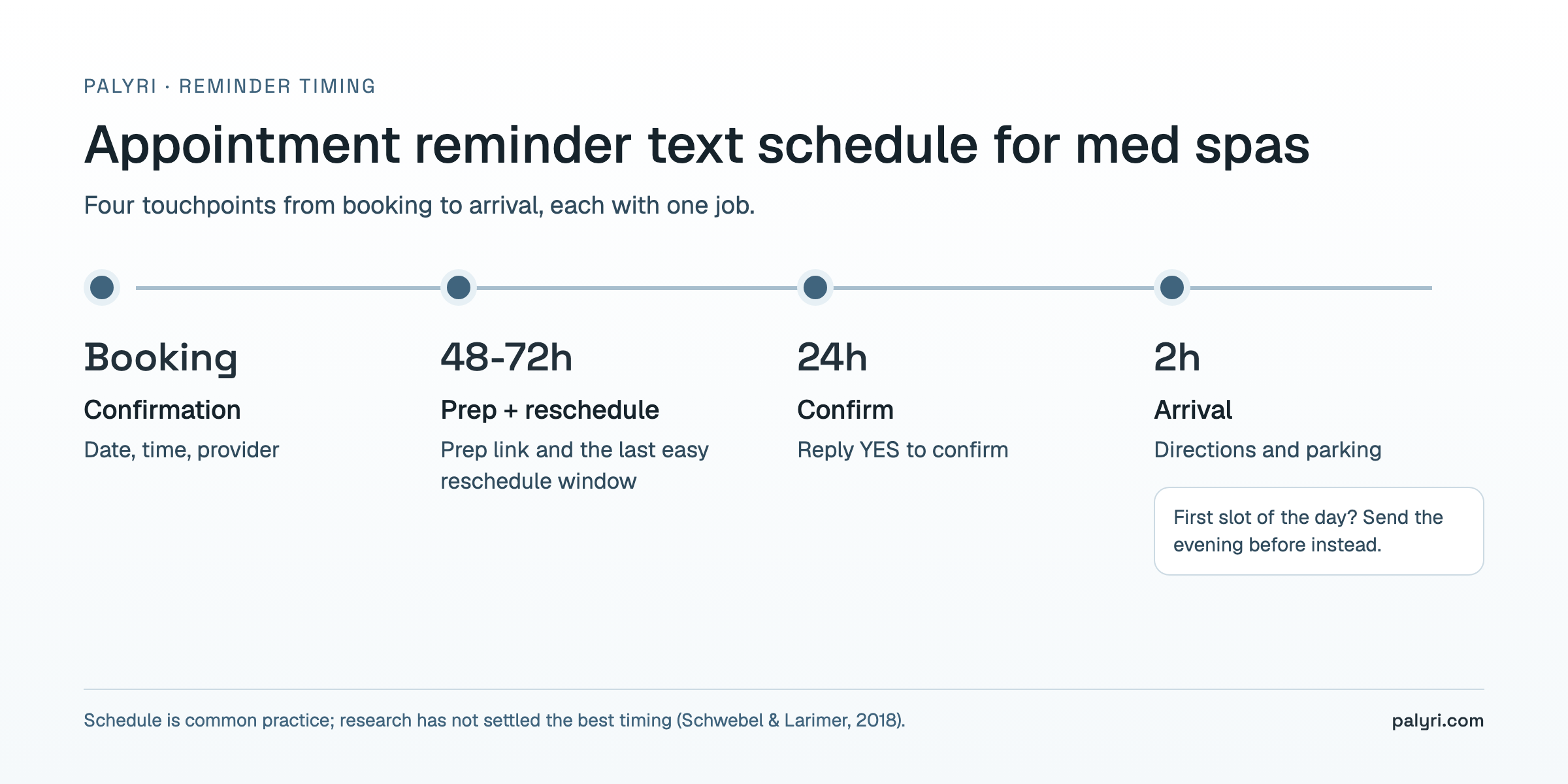
Four rules keep the schedule from misfiring:
- Skip any touch that would land before the booking itself. A client who books on Tuesday afternoon for Wednesday morning gets the booking confirmation and the 2-hour text, not a 48-hour reminder that arrives late.
- No 2-hour text for early slots. For anything before about 10 a.m., send the arrival details the evening before (template 6). A 7 a.m. text for a 9 a.m. appointment wakes people up and helps nobody.
- Send in the client's time zone. If you serve clients near a time zone line or book travelers, schedule by their local time.
- Respect quiet hours. Keep reminders out of late evening and early morning. This is a courtesy convention, not a legal threshold, so check your state's rules with counsel if you text outside normal business hours.
Treatments with prep (laser, peels, some injectables) need the earlier 72-hour touch so the client still has time to follow instructions, such as pausing a product the prep sheet names. Put the instructions behind a link; the text itself only points to them.
Do appointment reminder texts actually reduce no-shows?
Yes, with a caveat about how strong the evidence is. The Cochrane review by Gurol-Urganci and colleagues pooled eight randomized controlled trials with 6,615 participants. In seven of those studies (5,841 participants), text reminders improved attendance compared with no reminder, with a risk ratio of 1.14 (95% CI 1.03 to 1.26), rated moderate-quality evidence. In plain terms, attendance was about 14% higher relative to no reminder.
Two more findings matter for a front desk:
- Texts did about as well as phone calls. In three studies (2,509 participants), text reminders "had a similar impact to phone call reminders" (RR 0.99), according to the same Cochrane review.
- Texts cost less per attended visit. In two studies, the cost per attendance was 55% and 65% lower for texts than for phone call reminders (Cochrane, 2013).
The 2018 review in Internet Interventions screened 2,316 articles, included 162, and 56 of those looked at appointment reminders. It found that "nearly all the SMS-reminder studies" improved compliance and attendance, with minimal risks and good acceptance by participants.
The honest limits: the Cochrane authors wrote that "the current evidence therefore still remains insufficient to conclusively inform policy decisions," and both reviews cover healthcare appointments in general, not med spas specifically. Deposits, cancellation policy and waitlists are the strategy layer, covered in how to reduce no-shows at your aesthetic clinic.
Example: assume your med spa runs 200 appointments a month at a $350 average ticket. Every percentage point of no-shows you recover is 2 appointments, or 2 x $350 = $700 a month. These are assumptions, not benchmarks; plug in your own numbers or estimate what missed appointments cost you.
Appointment reminder text templates you can copy (12)
Replace the bracketed fields with your own data. Each template stays near or under 160 characters once filled in, so it sends as one SMS segment in most cases. "Informational" means the text only serves the appointment the client asked for; see the consent section for why that label matters.
| # | When | Template | Type |
|---|---|---|---|
| 1 | Right after booking | [Med Spa Name]: Hi [First name], you're booked for [Day, Date] at [Time] with [Provider]. Details: [Link]. Reply STOP to opt out. | Informational |
| 2 | Consultation, 48h before | [Med Spa Name]: Your consultation with [Provider] is [Day] at [Time]. Need a new time? Reply R or use [Link]. | Informational |
| 3 | Treatment with prep, 72h before | [Med Spa Name]: Your appointment is [Day, Date] at [Time]. Please follow the prep sheet we sent: [Link]. Questions? Reply here. | Informational |
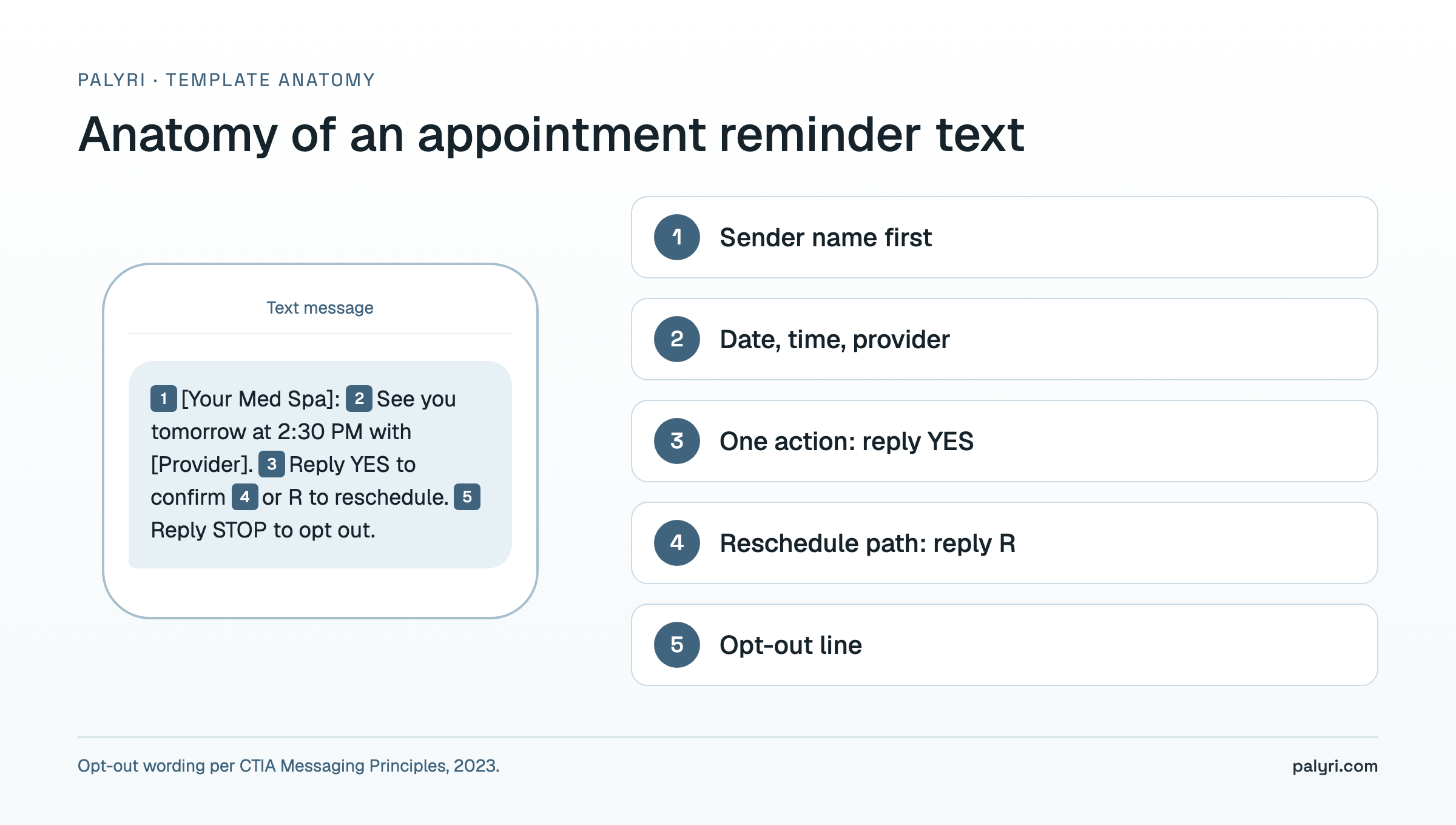
| 4 | 24h before, reply to confirm | [Med Spa Name]: See you tomorrow at [Time] with [Provider]. Reply YES to confirm or R to reschedule. | Informational |
| 5 | 2h before | [Med Spa Name]: See you at [Time] today. Parking: [short note]. Arrive 10 min early for check-in. Map: [Link] | Informational |
| 6 | Evening before a first-slot booking | [Med Spa Name]: You're our first appointment tomorrow, [Time] with [Provider]. Parking and entrance: [Link]. Reply R to reschedule. | Informational |
| 7 | Series appointment | [Med Spa Name]: Session [3] of [6] is [Day, Date] at [Time] with [Provider]. Reply YES to confirm or R to reschedule. | Informational |
| 8 | Booking held with a deposit | [Med Spa Name]: Your [Day] [Time] visit is held with your deposit. Changes made by [Day, Time] follow our policy: [Link]. Reply R to reschedule. | Informational |
| 9 | No reply 24h after template 4 | [Med Spa Name]: Hi [First name], we haven't heard back about [Day] at [Time]. Reply YES to keep it or R and we'll find a new time. | Informational |
| 10 | Earlier slot for a waitlisted client | [Med Spa Name]: An earlier time opened up: [Day] at [Time] with [Provider]. Reply YES to take it. Your current booking stays if not. | Informational |
| 11 | After a reschedule | [Med Spa Name]: Done. Your new time is [Day, Date] at [Time] with [Provider]. Details: [Link]. | Informational |
| 12 | Opt-in confirmation | [Med Spa Name] appointment texts: up to 4 msgs per booking. Reply HELP for help, STOP to opt out. Msg & data rates may apply. | Informational (required confirmation) |
Notes on the templates:
- Template 1 carries the opt-out line because it is usually the first text in the conversation. Repeat "Reply STOP to opt out" periodically if your sequences run long.
- Template 3 never names the product or the clinical instruction. The prep sheet behind the link does the work.
- Template 8 stays neutral and factual about the deposit. A threatening tone ("you WILL lose your deposit") does not belong in a reminder.
- Template 10 only goes to clients who asked to join your waitlist. Sending open slots to your whole list turns it into a marketing message.
- Template 12 follows the five items CTIA's Messaging Principles (section 5.1.2.1) list for an opt-in confirmation: program name, customer care contact or HELP instructions, how to opt out, that messages recur and how often, and any fees. Set the message count to what your sequence actually sends.
What should (and shouldn't) an appointment reminder text include?
A good appointment reminder text answers four questions in one glance: who is texting, when, with whom, and what to do next. Everything else either goes behind a link or stays out.
| Include | Leave out |
|---|---|
| Med spa name as the first words | Treatment details beyond the appointment type |
| Day, date and time | Prices and balances |
| Provider name | Offers, coupons, "book your next one at a discount" |
| Address or a single map/details link | More than one link |
| One action (YES, R, or a link) | Several questions in one text |
| Opt-out line in the first text | The word "cancel" as a reply keyword |
The offer row is the one most template libraries get wrong. Some popular sample lists put a package discount straight into a med spa reminder. CTIA's guidance says that "adding a call-to-action (e.g., a coupon code to an informational text) may place the message in the promotional category," and promotional texts need written agreement first (CTIA Messaging Principles, 2023). Keep the reminder clean and send offers only to clients who opted in to marketing.
Leaving out treatment detail is also about discretion: lock screen previews are visible to anyone nearby.
How to handle replies to reminder texts
Reminder texts invite replies, so decide in advance who handles each kind and how fast. A reply sitting unread until the next morning defeats the reason you asked.
| Client replies | What your team does |
|---|---|
| YES (or "yes", "Y", a thumbs up) | Mark the appointment confirmed. No reply needed, or a short "Thanks, see you then." |
| R or "reschedule" | Front desk calls or texts back with two open times during business hours. Send template 11 once settled. |
| A question or free text | A person answers. Never let an auto-reply guess at a clinical question. |
| No reply 24 hours after template 4 | Send template 9 once, or call. Don't stack more texts. |
| STOP, quit, end, revoke, opt out, cancel, unsubscribe | Treat as an opt-out. Stop texts, send one final confirmation, honor it within 10 business days at the latest. |
The STOP row comes from two primary sources. The FCC's TCPA rule at 47 CFR 64.1200(a)(10) says that a reply using the words "stop," "quit," "end," "revoke," "opt out," "cancel," or "unsubscribe" is a reasonable way to revoke consent, and that revocation requests "must be honored within a reasonable time not to exceed ten business days." CTIA adds that senders should acknowledge opt-outs "by sending one final opt-out confirmation message per campaign" and should accept opt-outs by phone call, email or text, not only by keyword (CTIA, section 5.1.3).
Once someone has opted out, every automated sequence for that number has to stop, including reminders for appointments already on the calendar. Confirm those by phone or email instead.
Do you need consent to send appointment reminder texts?
Yes, but the kind of consent depends on what the text says. This is general information, not legal advice; talk to counsel about your setup.
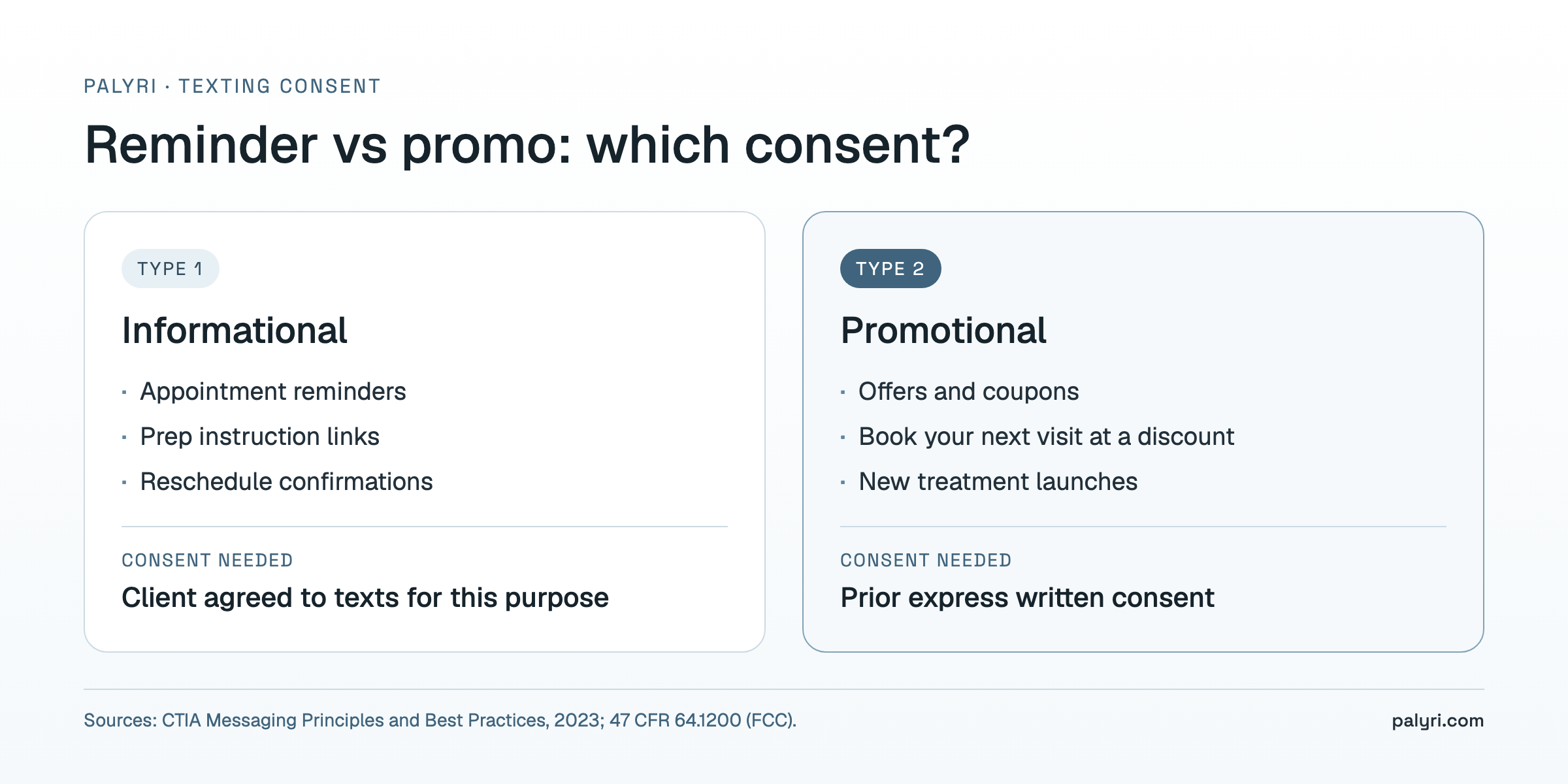
CTIA's Messaging Principles (the carrier industry guidance behind A2P 10DLC business texting) split messages into two types:
- Informational: "Appointment reminders, welcome texts, and alerts fall into this category." The client needs to agree to receive texts for that specific purpose when they give you their number.
- Promotional: a message "that contains a sales or marketing promotion." Before sending these, "the Consumer should agree in writing to receive promotional texts."
The FCC rule draws a similar line. Under 47 CFR 64.1200(a)(2), automated messages that include an advertisement or constitute telemarketing require "the prior express written consent of the called party." Reminders fall under the general prior express consent rule in (a)(1); marketing does not.
What this means in practice:
- Add a consent checkbox to your booking and intake forms. CTIA notes that businesses that already collect forms "can add a field to capture the Consumer's consent." Use two separate boxes: one for appointment texts, one for marketing texts.
- Record the proof. CTIA lists what to keep: timestamp, the medium (web form, front desk), the wording the client saw, the campaign the opt-in covers, and the phone number.
- Keep consent per purpose. "A Consumer opt-in should apply only to the campaign(s) and specific Message Sender for which it was intended or obtained" (CTIA, 5.1.2.2). A reminder opt-in does not cover your monthly promo blast.
- Send the confirmation text (template 12) when someone opts in.
How to automate reminder texts without losing the human touch
Automation handles the timing; people handle the replies. The setup that keeps both working is short.
Palyri can send reminder texts from an automation tied to the booked appointment, and records STOP replies as opt-outs. It sits alongside the lead pipeline as a CRM for med spas and aesthetic clinics, so the reminder history stays next to the client record. Plans are on the Palyri pricing page.
Two gaps reminders don't cover. Clients who call while you are with a patient need an instant text back, covered in missed call text back for med spas. Clients who prefer email or WhatsApp need a different channel mix, covered in choosing between SMS, WhatsApp and email.
Review the logs after the first month. If the 2-hour text rarely changes anything for your clients, drop it; if 24-hour replies are slow, test moving the reply request to 48 hours. Research has not settled the best timing (Schwebel and Larimer, 2018), so your own outcome log is the best guide you have.
FAQ
Is 24 or 48 hours better for a reminder text?
Research does not give a winner. The 2018 review of 162 studies says the most effective timing and frequency still need to be evaluated. In practice, many med spas use both: a 48-hour text that leaves room to reschedule and refill the slot, and a 24-hour text that asks for a YES. For treatments with prep, move the first reminder to 72 hours so clients can follow the instructions in time. Track confirmations and no-shows for a month, then drop whichever touch adds nothing for your clients.
How many reminder texts is too many?
For a single appointment, four texts (booking confirmation, 48 hours, 24 hours, 2 hours) is the usual ceiling, and many practices send three. Beyond that, extra texts start to feel like pressure and invite STOP replies, which then block your reminders for future visits. If a client has not replied to the 24-hour request, send one follow-up (template 9) or call, rather than stacking more automated texts.
Can I put a promotion in an appointment reminder text?
Keep them separate. CTIA's guidance says that adding a call to action such as a coupon code to an informational text "may place the message in the promotional category," and promotional texts need the client's written agreement first (CTIA, 2023). The FCC rule also requires prior express written consent for automated messages that include advertising. A reminder that doubles as an offer risks being treated as marketing. Send offers in a separate campaign, only to clients who ticked the marketing consent box.
Do I need written consent to send appointment reminders?
Under CTIA's categories, appointment reminders are informational: the client needs to agree to receive texts for that purpose when they give you their number, and written consent is the standard for promotional texts. The FCC's 47 CFR 64.1200 requires prior express written consent when an automated message includes advertising or telemarketing. A separate checkbox for appointment texts on your booking form, with the timestamp and wording saved, is the practical baseline. Check the details with counsel, especially if your reminders carry any marketing content.
What if a client replies STOP to a reminder?
Stop all automated texts to that number and send one final confirmation that they have been unsubscribed, as CTIA section 5.1.3 describes. The FCC rule says revocation requests must be honored within a reasonable time not exceeding ten business days, and lists "stop," "quit," "end," "revoke," "opt out," "cancel" and "unsubscribe" as valid revocation words. Upcoming appointments stay on the calendar; confirm them by phone or email instead. Don't use "Reply CANCEL" as an appointment keyword, because that word also counts as an opt-out.
Should reminder texts include the treatment name?
Usually not. The appointment type ("consultation," "your appointment with Provider]") is enough for the client to know what they booked, and lock screen previews can be seen by others. Put prep instructions, aftercare and treatment specifics behind a link or in an email, and keep the text to the med spa name, date, time, provider and one action. Series appointments are an exception where a count helps ("Session 3 of 6") without naming the treatment. For more on picking the right channel for longer instructions, see [choosing between SMS, WhatsApp and email.
Want to implement this in your clinic?
Book a free Palyri demo. We'll show how it works on your clinic's data.
Book a demoPalyri blog author
Writes for the Palyri blog about getting clients from ads, handling leads and front-desk work in aesthetic clinics and beauty salons.