Missed call text back is an automation that texts a caller automatically when nobody at the med spa answers, so the conversation continues by SMS instead of voicemail. To run it legally in the US you need a registered A2P 10DLC number, a non-promotional first message with opt-out wording, and consent before anything marketing goes out.
Below: three setup routes, what A2P 10DLC registration asks for, how the TCPA and CTIA treat a text sent after a call, and six scripts to paste in today.
What is missed call text back and how does it work?
A patient calls, the call rings out or hits voicemail, and that event triggers an SMS from the same number they dialed. Replies land in a shared inbox for the front desk.
Onvert's med spa page promises "within 60 seconds", a vendor promise rather than a measured standard. More important: the text must come from the number the patient recognizes.
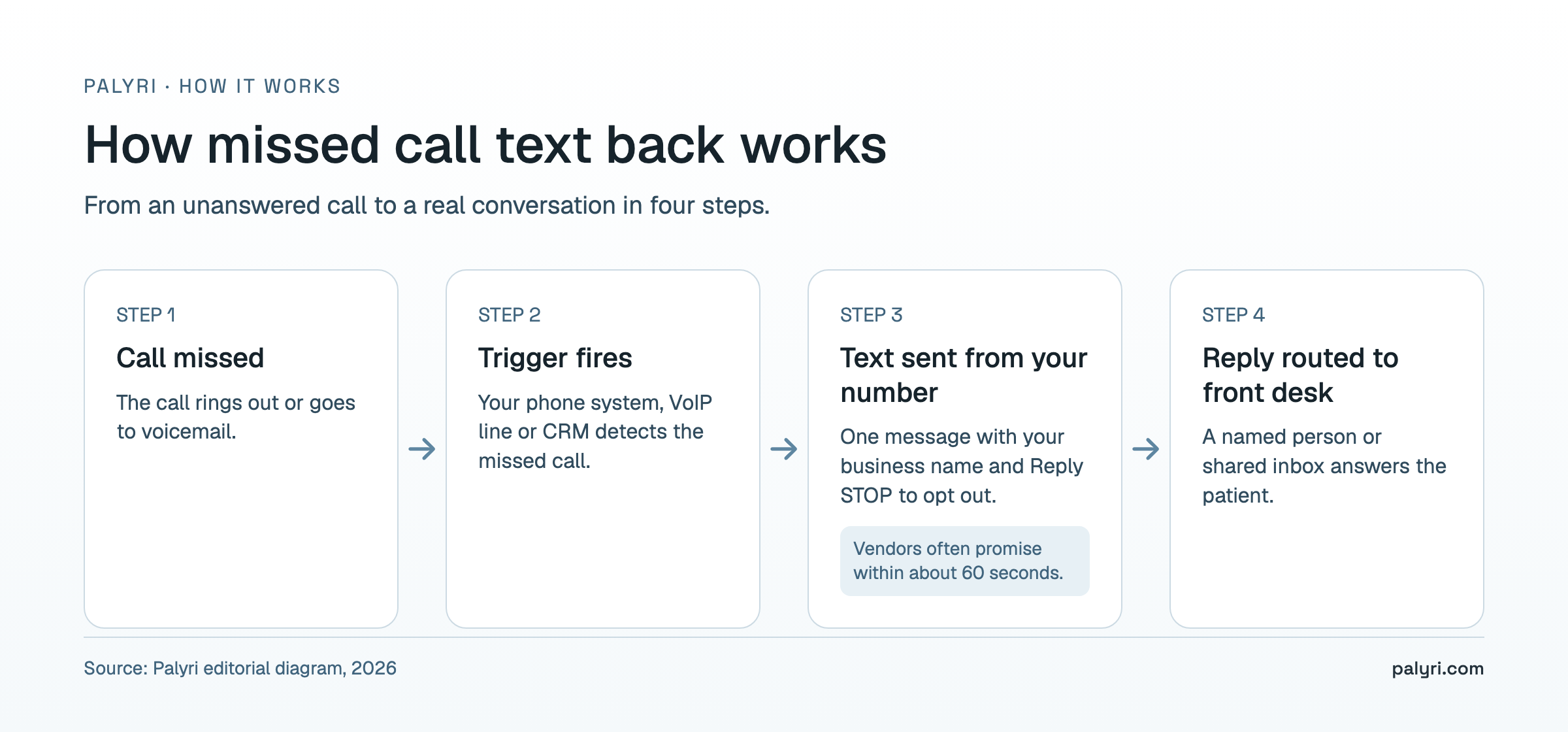
Four parts have to work together:
- Call missed. The call is not answered after a set number of rings, or it is sent to voicemail.
- Trigger. Your phone system, VoIP provider or CRM fires an event for that missed call.
- Text sent from your number. One short message, identifying your med spa, with an opt-out line.
- Reply routed. The reply goes to a named person at the front desk, not to a mailbox nobody checks.
How many calls does a med spa actually miss?
There is no public, med spa specific figure for missed calls. The best recent dataset is the Invoca Lead Conversion Benchmarks Report 2026, published July 2026. It states: "Across all industries, 56% of calls to businesses are answered by a person." The report is based on 70M+ calls across 10 industries.
By our arithmetic (100% minus 56%), that leaves 44% of calls not answered by a person. That 44% includes calls that went to voicemail or an automated phone menu, so it is not the same as "lost". It also comes from Invoca's own customers, businesses that pay for call tracking, not from med spas specifically.
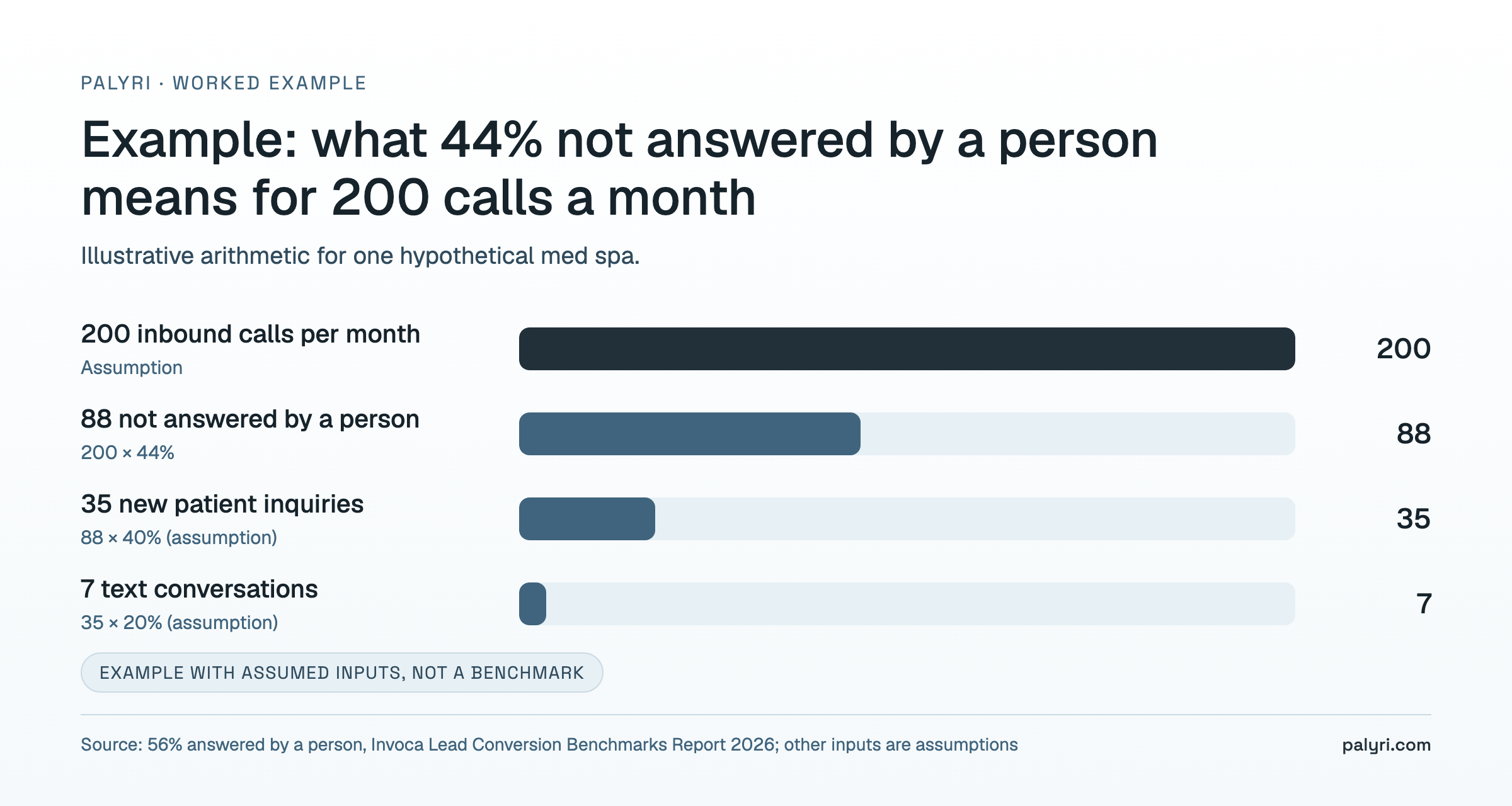
Example: this is a worked calculation with stated assumptions, not a benchmark. Assume a med spa receives 200 inbound calls a month. If 44% are not answered by a person, that is 200 × 0.44 = 88 calls. Assume 40% of those are new patient inquiries rather than existing patients or vendors: 88 × 0.40 = about 35 calls. Assume one in five of those callers replies to a missed call text: 35 × 0.20 = 7 text conversations a month that would otherwise depend on a voicemail.
Swap in your own call log numbers. To put a dollar value on recovered inquiries, use the aesthetic clinic ROI calculator with your own lead volume and consult value.
How to set up missed call text back (step by step)
Three common routes; the right one depends on where your number lives and who reads replies.
| Criteria | Built into your phone system or VoIP | CRM or practice software with texting | No-code (Twilio webhook + Zapier or Make) |
|---|---|---|---|
| Texts from the same number patients call | Usually yes, if the provider supports SMS on that number | Only if the number is ported or text-enabled in the CRM | Yes, if your calling number is on Twilio |
| Who handles A2P 10DLC registration | Your phone or VoIP provider | The CRM's messaging provider | You, through your Twilio account |
| Where replies land | Provider app or desk phone inbox | CRM inbox, linked to the patient record | Wherever you route them (email, Slack, CRM) |
| Business hours vs after hours logic | Varies by provider | Usually built into automation rules | You build it in the workflow |
| Cost type | Add-on to phone plan | Part of the software plan plus message fees | Per-message fees plus automation tool plan |
Setup checklist
Before you switch it on:
- Use the same number for calls and texts. Patients reply to the number they called. A second number splits the conversation.
- Set a ring delay before the trigger. Fire the text only after the call has rung out or reached voicemail, not while staff might still pick up.
- Build two branches: business hours and after hours. Different wording, different reply promise (see the scripts below).
- Skip numbers that have opted out. Anyone who replied STOP before must not get a new automated text after their next call.
- De-duplicate repeat calls. If the same number calls three times in ten minutes, send one text, not three. Set a window, for example one text per caller per 24 hours.
- Route replies to a named person. Decide who owns the inbox in each shift and who covers lunch.
- Log every text and reply. Store the missed call, the text, the reply and the outcome in the record you use to track inquiries.
- Paste your final scripts into the 10DLC campaign. The sample messages you register should match what you actually send.
- Test with a staff phone. Call, let it ring out, confirm the text arrives, reply, confirm the reply reaches the right person, then reply STOP and confirm the opt-out works.
Do you need A2P 10DLC registration for missed call texts?
Yes, if you text from a standard local 10-digit number. A2P (application to person) means software-sent messages; 10DLC (10-digit long code) is the ordinary local number format for US business texting. Vendasta's guide puts it plainly: "registration is mandatory before the first text leaves a standard local number" (Vendasta).
Registration happens through your messaging provider with The Campaign Registry, the registry where brands and campaigns are verified before carriers let them send 10DLC traffic. You register two things:
- A brand: your legal business details.
- A campaign: what you will send and why, with sample messages and a description of how people come to receive your texts.
Unregistered traffic is filtered more heavily and draws extra carrier fees, according to Twilio's A2P 10DLC guide, so an unregistered text may never arrive. Check fees and approval times with your provider; they change.
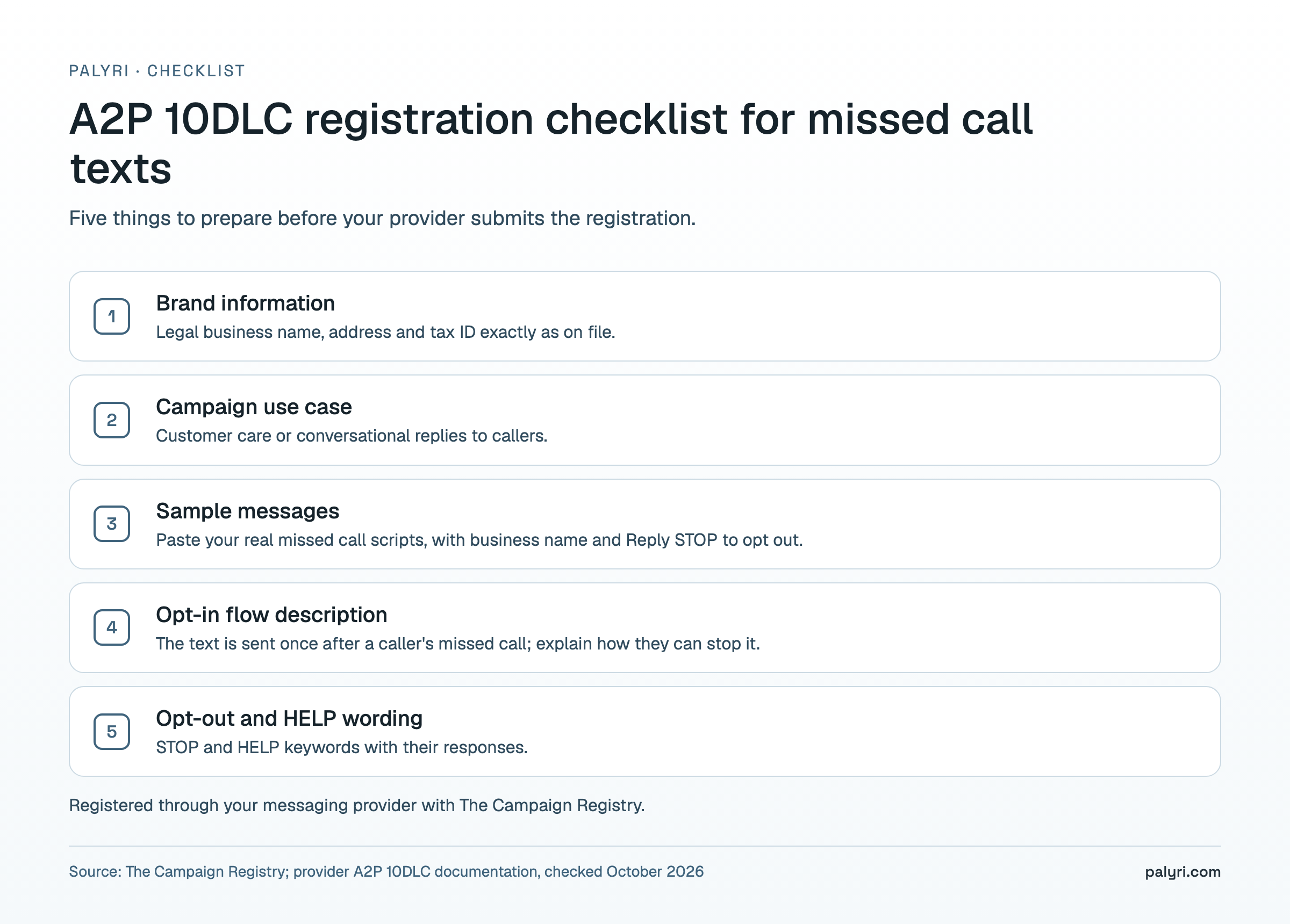
In the opt-in description, state the flow honestly: the patient called, the call was missed, one text goes to that number with a reply option and an opt-out. It is not a marketing list.
Is missed call text back legal? TCPA consent explained
It can be, if the first text stays narrow. Two rule sets apply: the FCC's TCPA rules (Telephone Consumer Protection Act) and the CTIA Messaging Principles carriers enforce.
The FCC rule at 47 CFR 64.1200(a)(1) restricts calls to cell phones made with an automatic telephone dialing system unless made "with the prior express consent of the called party". Texts count too: FCC rules ban text messages "sent to a mobile phone using an autodialer unless the phone owner previously gave consent".
The CTIA Messaging Principles and Best Practices (May 2023) sort messages into three types, each with a different consent level:
| CTIA message type | CTIA definition (quoted) | Consent expected | Missed call text back fit |
|---|---|---|---|
| Conversational | "If the Consumer initiates the conversation and the Non-Consumer simply responds, then no additional permission is expected." | Implied consent, defined for a consumer who texts first | Close, but a call is not a text (see below) |
| Informational | "Informational messaging is when a Consumer gives their phone number to a Non-Consumer and asks to be contacted in the future." | Express consent, given over text, on a form, on a website or verbally | Fits replies after the patient asks you to follow up |
| Promotional | "Adding a call-to-action (e.g., a coupon code to an informational text) may place the message in the promotional category." | Express written consent | Never in the first text |
The nuance most guides skip: a call is not a text
CTIA's implied consent label reads: "If the Consumer initiates the text message exchange and the Non-Consumer only responds with relevant information, then no verbal or written permission is expected." That describes a patient who texts you first. A missed call text back answers a call, which is a different trigger. As Vendasta notes: "No FCC order states that a consumer's call to your business is, by itself, consent to an automated text."
The practical rule that follows: keep the first text to a single message that only responds to the call. Identify your med spa, offer a reply, include "Reply STOP to opt out", and stop there. No second automated message unless the patient replies.
Opt-outs: what the FCC rule requires
Section 64.1200(a)(10) sets the revocation rules:
- A patient can revoke consent "by using any reasonable method".
- Replies using "stop," "quit," "end," "revoke," "opt out," "cancel," or "unsubscribe" are a reasonable means per se.
- Other wording counts too "if a reasonable person would understand those words to have conveyed a request to revoke consent". "Please don't text me" is an opt-out.
- Requests "must be honored within a reasonable time not to exceed ten business days from receipt".
Under (a)(12), you may send one confirmation text if it "merely confirms the text recipient's revocation request and does not include any marketing or promotional information". A confirmation sent within five minutes "will be presumed to fall within the consumer's prior express consent". CTIA's section 5.1.3 says the same in industry terms: one final confirmation, then nothing.
Promotional texts are a separate category. They need "prior express written consent", which the rule at (f)(9) defines as "an agreement, in writing, bearing the signature of the person called". A missed call does not give you that.
Missed call text back scripts for med spas (copy and paste)
Each script below is a single SMS: it names the business, responds to the call, and ends with an opt-out line. None contains a price, offer or treatment detail, which keeps it out of the promotional category. Character counts assume a 15-character business name, an 8-character first name, a 22-character link and a 14-character phone number. Stay at or under 160 characters so the message is sent as one SMS segment. Use straight apostrophes; curly quotes or emoji switch the text to Unicode, where one segment holds 70 characters.
| Situation | Script | Characters |
|---|---|---|
| A. Business hours, front desk busy | Hi, this is [Med Spa Name]. Sorry we missed your call. How can we help? Reply here and our front desk will text you back shortly. Reply STOP to opt out. | 153 |
| B. After hours | Hi, this is [Med Spa Name]. We're closed and missed your call. Reply with what you need and we'll text you back after 9 a.m. Reply STOP to opt out. | 148 |
| C. Provider with a patient or team at lunch | Hi, it's [Med Spa Name]. Our team is with patients right now. Text us your question and we'll reply as soon as we're free. Reply STOP to opt out. | 146 |
| D. Returning patient (number already in your records) | Hi [First Name], it's [Med Spa Name]. Sorry we missed you. Reply with your question or a good time to call you back. Reply STOP to opt out. | 136 |
| E. With booking link (informational only) | Hi, this is [Med Spa Name]. Sorry we missed your call. Book a consult here: [short link] or reply with your question. Reply STOP to opt out. | 151 |
| F. STOP confirmation (one time only) | [Med Spa Name]: you're unsubscribed and will get no more texts from us. You can still call us at [phone number] anytime. | 121 |
- A and C are daytime defaults; B runs outside opening hours (use your real opening time).
- D needs caller matching to an existing record. Never name the patient's treatment.
- E only if the link opens a plain booking page, not a promotion.
- F goes once, within five minutes of the opt-out, and nothing follows.
Once a patient replies with a question, staff answer it directly; the rule covers the automated first message. For picking the follow-up channel, see choosing between SMS, WhatsApp and email.
What happens after the text: replies, follow-up and handoff
Who answers and how fast. Assign one person per shift to the reply inbox, with lunch backup. A reply that waits until tomorrow undoes the fast text. The reasoning is in why the first five minutes after an inquiry matter.
When an AI receptionist answers instead. That is a different tool with different trade-offs; see what an AI receptionist can and can't handle. Missed call text back is the lighter option.
Log the reply and the outcome. Each text conversation is an inquiry; keep it with your ad leads and web forms so you see which booked. A CRM pipeline for aesthetic clinics is built for exactly that path from inquiry to booked consult, and managing ad leads in one pipeline shows how to keep sources visible together.
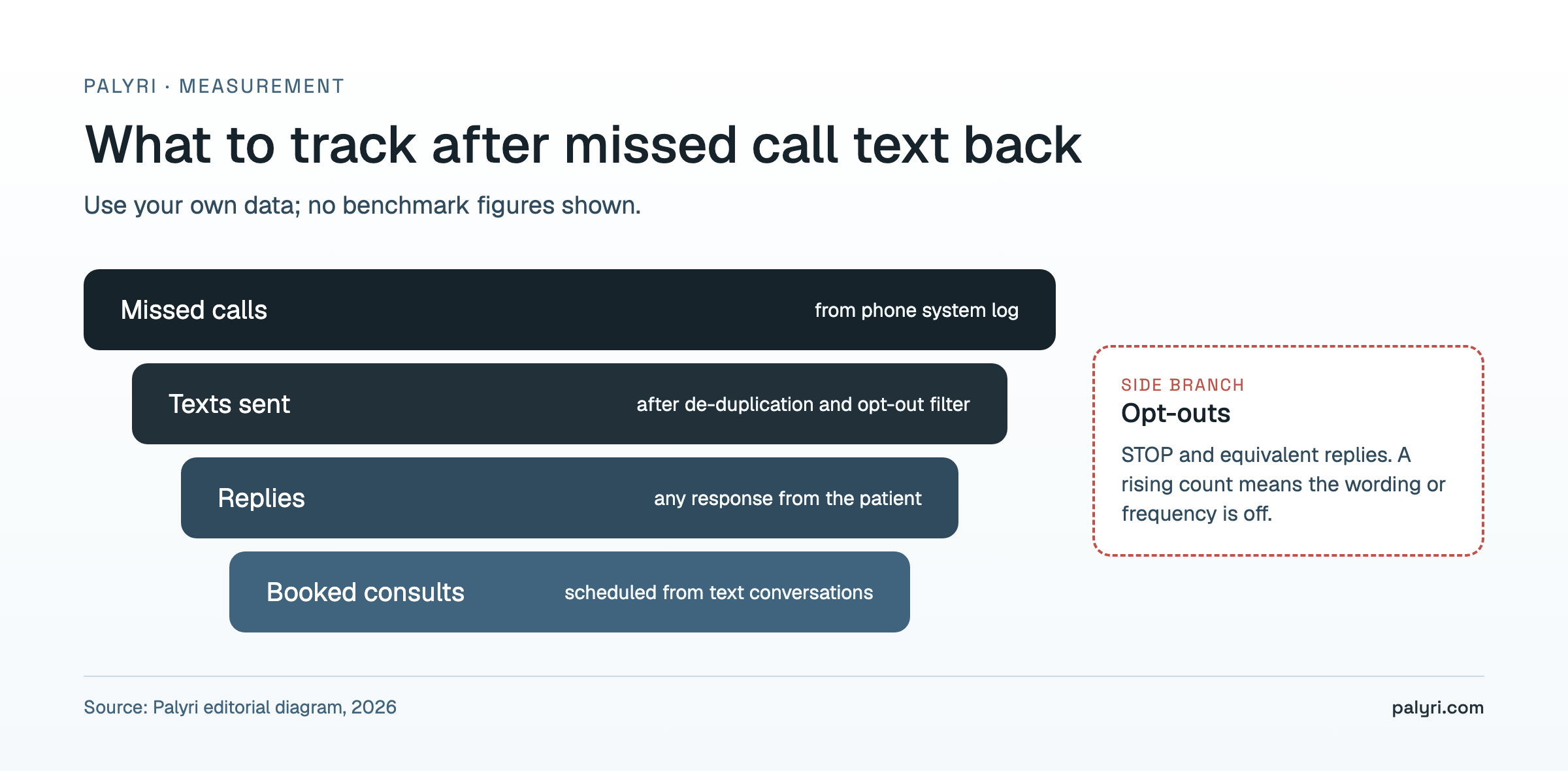
What to measure. Define these, then track your own numbers:
- Missed calls: calls not answered by a person, from your phone system log.
- Texts sent: missed call texts actually delivered (after de-duplication and opt-out filtering).
- Replies: texts that got any response from the patient.
- Booked consults from replies: consults scheduled from those conversations.
- Opt-outs: STOP and equivalent replies, which tell you if the wording or frequency is off.
Once consults are booked, the next leak is attendance; reducing no-shows once the consult is booked picks up from there. If you are comparing tools to run the whole inquiry pipeline, see how Palyri pricing works.
FAQ
Is missed call text back legal in the US?
It can be, if the first message is narrow. Send one text from a registered A2P 10DLC number that names your business, responds to the call and says "Reply STOP to opt out". Leave out prices, offers and coupon codes, which can push the text into CTIA's promotional category, where CTIA expects written consent. Honor opt-outs within ten business days, as 47 CFR 64.1200(a)(10) requires. State laws can add rules, so have counsel review your flow.
Does a missed call count as consent to text someone?
Not clearly. CTIA's implied consent category covers a consumer who texts a business first, and a missed call is a different trigger. Vendasta's guide notes that no FCC order states a call to your business is, by itself, consent to an automated text. The safest design is one non-promotional reply to the call with an opt-out line, and no further automated messages unless the patient replies.
Do I need A2P 10DLC registration to send missed call texts?
Yes, when you text from a standard local 10-digit number, which most med spas use. You register a brand and a campaign through your provider, pasting your real missed call scripts as samples. Unregistered traffic is filtered more heavily and draws extra carrier fees.
How fast should a missed call text go out?
While the patient still has the phone in hand. Vendors such as Onvert promise a text within 60 seconds. No regulation sets a timing requirement for the first text. Set a short ring delay so the text fires only after the call is truly missed, not while staff are about to pick up. Then read replies quickly.
Can a missed call text include a booking link or a special offer?
A booking link is generally fine if it opens a plain booking page and the text carries no price or promotion. An offer is different: CTIA says adding a call to action such as a coupon code may make a message promotional, and CTIA says the patient should agree in writing before receiving promotional texts. Share offers only with patients who opted in to marketing texts.
What should a med spa do when someone replies STOP?
Stop all automated texts to that number and record the opt-out. Under 47 CFR 64.1200(a)(12) you may send one confirmation text with no marketing; sent within five minutes, it is presumed to be within the patient's prior consent. Then send nothing else. Treat other clear wording, such as "please stop texting me", the same way. Make sure the opt-out also blocks future missed call texts after the patient's next call.
Want to implement this in your clinic?
Book a free Palyri demo. We'll show how it works on your clinic's data.
Book a demoPalyri blog author
Writes for the Palyri blog about getting clients from ads, handling leads and front-desk work in aesthetic clinics and beauty salons.