An AI receptionist for med spas (a voice agent that answers your phone line) can handle the routine calls a practice gets: hours, location, service and price questions, booking or rescheduling into your calendar, and capturing new-patient details after hours. It should not give clinical advice, screen candidacy or contraindications, handle complications or complaints, or take payments without your booking system, and at two vendors' published rates it costs roughly $100 to $500 a month for 75 to 300 calls (as listed on 2026-10-23 by Smith.ai and My AI Front Desk).
Below: sourced missed-call numbers, a "hand to AI / keep human" list, cost by call volume, and the FCC rule on AI callbacks. If you want the wider picture of what to automate at the front desk (texts, forms, reminders), read which front-desk tasks are worth automating first. This article stays on the phone.
What is an AI receptionist for a med spa?
An AI receptionist is software that picks up your practice phone, talks to the caller in a synthetic voice, understands free speech, and either answers, books, takes a message or transfers the call to a person. It is not the same as voicemail, a human answering service or the chat widget on your website, even though vendors often bundle them.
| Option | Who answers | Hours | Books into your calendar | Handles nuance | Typical pricing model |
|---|---|---|---|---|---|
| Voicemail | Nobody, the caller records | 24/7 | No | No | Included with your phone line |
| Human answering service | Remote receptionist | Depends on plan | Sometimes, via your software | Yes | Per call or per minute |
| AI receptionist (voice agent) | Software, synthetic voice | 24/7 | Yes, if it integrates | Limited to what you script | Per call or minutes bundle |
| Website chatbot | Software, text only | 24/7 | Yes, if it integrates | Limited | Monthly subscription |
A useful way to think about it: the AI receptionist replaces voicemail and the "we'll call you back" gap, not your best front-desk person.
How many med spa calls go unanswered?
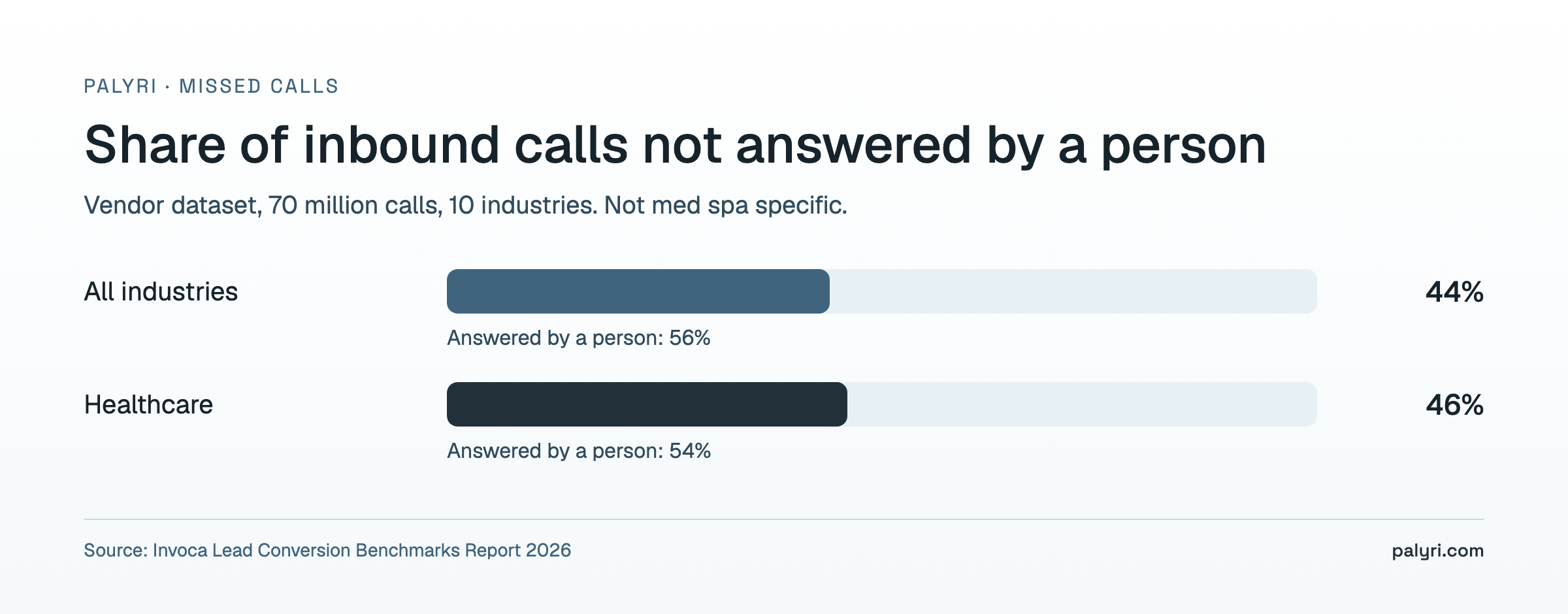
Nobody publishes a missed-call rate for med spas specifically. The best large dataset available is the Invoca Lead Conversion Benchmarks Report 2026, built on 70 million calls across 10 industries. In it, 44% of inbound calls were missed across all industries, and healthcare businesses missed 46%, with only 54% answered by a person.
Two caveats before you use those numbers. First, healthcare in that dataset is broader than aesthetics. Second, as JustCall points out in its review of missed-call statistics, vendor datasets measure vendor customers: a business already paying for call tracking pays attention to calls, so the true rate is "very likely" worse than 44%.
You will also see "62% of calls go unanswered", "80% of callers won't leave a voicemail" and "missed calls cost $126,000 a year" on almost every vendor page. The same JustCall analysis traces the 62% figure to a 2016 study of 85 businesses, finds no identifiable primary source for the $126,000 figure, and states that no measured figure exists for how many callers leave a voicemail. We do not use them here, and you should not use them in a business case either.
The practical takeaway does not need a precise number. Check your own phone system's call log for one normal week: count calls that rang out or went to voicemail during business hours, and separately after hours. That is your baseline, and it tells you whether you need overflow coverage, after-hours coverage, or both.
What can an AI receptionist handle?
The calls an AI receptionist does well are the predictable ones, where the right answer already exists in writing at your practice. In a med spa that is a long list:
- FAQs: hours, parking, directions, which providers work which days, whether you offer a treatment, and prices exactly as published on your own menu.
- New-patient intake: name, phone number, treatment interest, preferred times and how they heard about you, captured in the same format every time.
- Booking, rescheduling and cancelling, but only if the tool integrates with your calendar or booking software. Without integration it takes a message, which is still better than voicemail.
- After-hours and overflow: calls that come in while the front desk is checking out a patient, on lunch, or closed.
- Routing by call type: existing patient with a question about an appointment goes to the front desk queue, a vendor or sales call goes nowhere, a provider question gets flagged.
- Call records: transcripts and summaries the team can scan. Smith.ai, for example, lists "Recording, transcription & summaries" and "Lead qualification & call routing" even on its free tier (Smith.ai pricing, as listed on 2026-10-23).
Booking is where most of the value sits, so check integration before anything else. If your patients already book online, an AI line adds less; see online booking that takes load off the phone for that side.
What should an AI receptionist not handle?
Anything that needs clinical judgment, empathy under pressure or a decision about money should go to a person. Even vendors selling AI receptionists draw this line: Zenoti writes that "complex, sensitive, or clinical consultation requests are always routed to a human" (Zenoti).
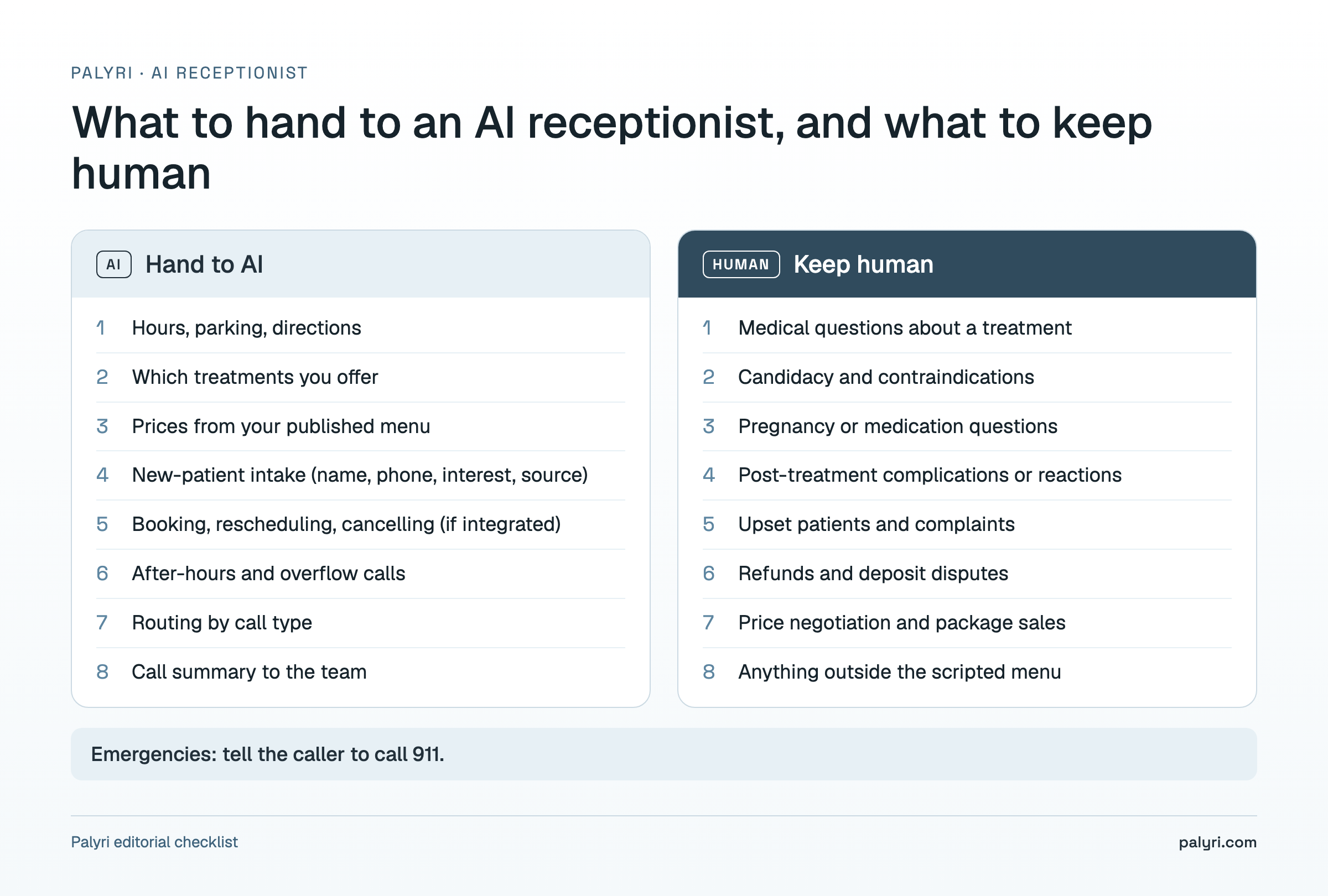
Keep human, always:
- Medical questions about a treatment: "Is filler safe for me?", "How many units will I need?" The AI can book a consult; it should not answer.
- Candidacy and contraindications: skin conditions, recent procedures, allergies. That is a provider's assessment.
- Pregnancy and medication questions: route to a provider without exception.
- Post-treatment complications or reactions: swelling, pain, skin changes after a treatment. These follow your on-call protocol, and anything that sounds like an emergency gets "hang up and call 911".
- Upset patients and complaints: a voice agent repeating policy to an angry patient turns a complaint into a review.
- Refunds and deposit disputes: money decisions need someone with authority to make them.
- Price negotiation and package sales: discounts and memberships are a sales conversation, not an FAQ.
- Anything outside the scripted menu: if the AI has to improvise, it should transfer or take a message instead.
Five escalation rules to set before go-live
Each rule has a trigger, an action, who is notified and a maximum response time. The response times are your decision as the owner; the AI should only enforce them.
- Trigger: caller mentions a reaction, pain, swelling, infection or "after my treatment". Action: stop the script, give the on-call instruction (and 911 for emergencies), transfer live if possible. Notify: on-call provider by text and call. Max response: set by your medical director.
- Trigger: clinical question (dosage, safety, candidacy, pregnancy, medication). Action: say a provider will answer, offer a consult slot or callback. Notify: provider queue. Max response: same business day is a common target; pick yours.
- Trigger: caller is upset, uses complaint words, or asks for a manager. Action: apologize once, transfer live to a named person, or take a message marked urgent. Notify: practice manager. Max response: your choice, written into the rule.
- Trigger: refund, deposit, chargeback, cancellation fee dispute. Action: no commitments, take details, transfer or message. Notify: practice manager or owner. Max response: your choice.
- Trigger: the AI fails to understand twice, or the caller says "person", "human" or "representative". Action: transfer live during hours, callback promise after hours. Notify: front desk. Max response: your choice, ideally the next opening hour.
Test each rule with a staff member pretending to be a patient before any real call reaches the agent.
How much does an AI receptionist cost?
Vendors price AI receptionists in two main ways: per call or a monthly bundle of minutes plus overage. Here are one vendor of each, from their own pricing pages, as listed on 2026-10-23. We are not ranking them; they simply show the two models clearly.
- Smith.ai AI Receptionist (pricing page): Free plan at $0 with 25 calls a month, then $3.00 per call. Pro at $150 a month for 75 calls ($2.00 per call), with 150-call ($1.80) and 300-call ($1.67) tiers. Enterprise at $500 a month for 300 calls ($1.67 per call), larger tiers custom.
- My AI Front Desk (pricing page): $99 a month, or $79 a month billed annually, including 200 voice minutes plus a pool of 1,000 overage credits a month. One credit is $0.01 and a voice minute costs 25 credits, which works out to $0.25 per extra minute. Partner and Enterprise tiers are custom, quote only.
Setup fees, integrations, phone numbers and add-ons differ between vendors and plans, so treat the table below as the call-handling cost only.
Example: we assume an average call of 3 minutes, monthly billing, and the plan rules exactly as listed. The volumes are illustrative, not data from any practice.
| Calls per month | Minutes (3 min avg) | Smith.ai (per call) | My AI Front Desk (minutes bundle) |
|---|---|---|---|
| 75 | 225 | 75 x $2.00 = $150 | 200 included + 25 extra min = 625 credits, inside the 1,000 pool: $99 |
| 150 | 450 | 150 x $1.80 = $270 | 250 extra min x 25 = 6,250 credits, minus 1,000 = 5,250 x $0.01 = $52.50: $151.50 |
| 300 | 900 | 300 x $1.67 = $501 (Enterprise lists $500 for 300 calls) | 700 extra min x 25 = 17,500 credits, minus 1,000 = 16,500 x $0.01 = $165: $264 |
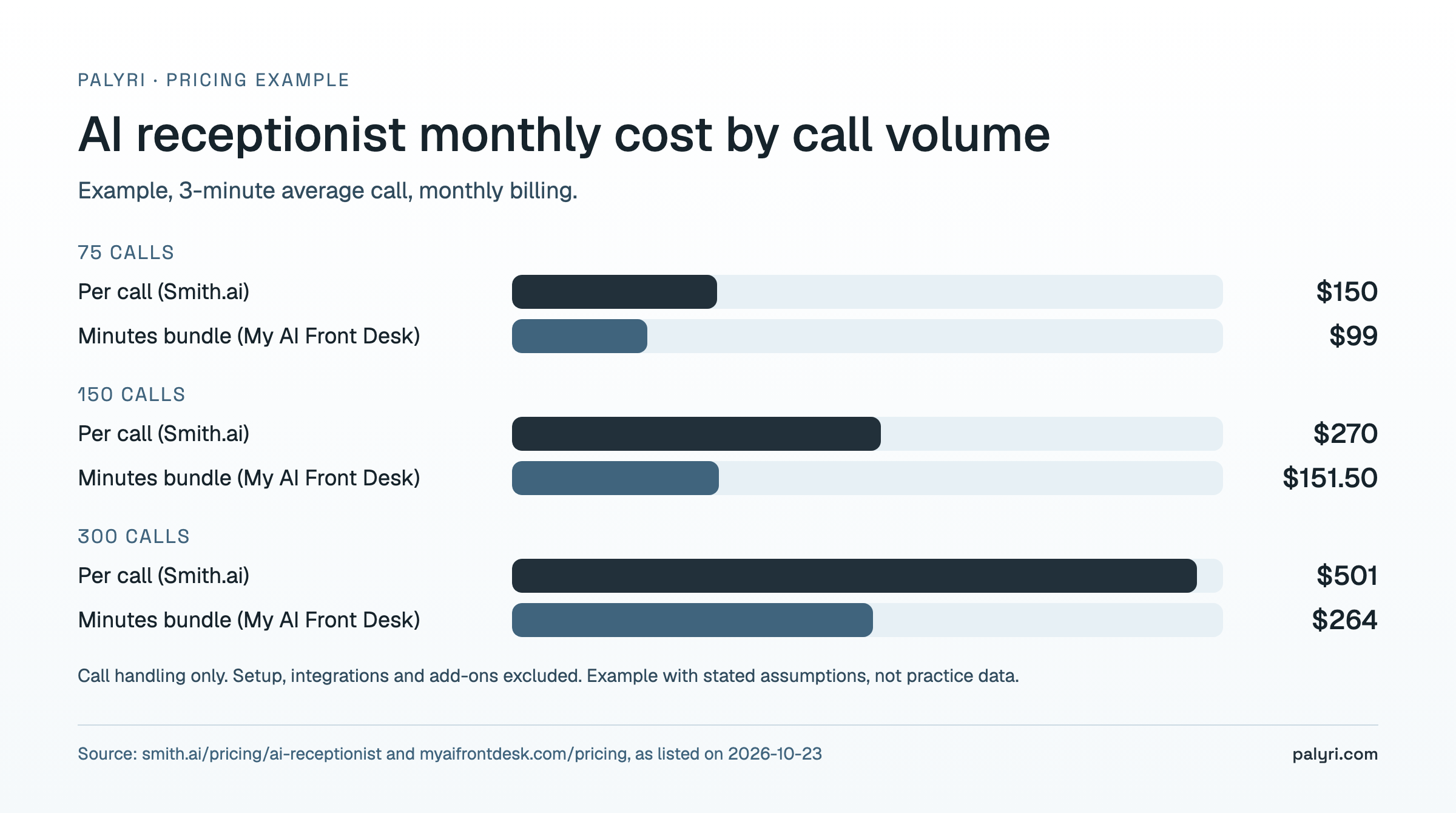
What the arithmetic shows:
- Per-minute plans punish long calls. Same example at a 5-minute average: 150 calls = 750 minutes, 550 extra x 25 = 13,750 credits, minus 1,000 = 12,750 x $0.01 = $127.50, so $226.50 instead of $151.50.
- Per-call plans punish many short calls. A 40-second "are you open Sunday?" costs the same as a 6-minute booking.
- Pull your own numbers first: total calls per month and average call length from your phone system. Pick the pricing unit that matches your call mix, not the lowest headline price.
The cost only means something next to what a booked consult is worth to you. Put your average first-visit value and rebooking rate into the ROI calculator to estimate what a recovered consult is worth, then compare it with the monthly figure above.
Can an AI receptionist call patients back?
Answering a call and placing one are different situations legally. In its Declaratory Ruling of February 8, 2024, the FCC confirmed that AI-generated voices count as an "artificial or prerecorded voice" under the TCPA (the federal law on telemarketing calls), so calls made with them need the called party's prior express consent unless an emergency purpose or exemption applies (FCC-24-17, para. 2 and para. 9).
The ruling is about calls you initiate. In practice that means:
- Inbound answering (a patient calls you, the AI picks up) is not what this text addresses.
- Outbound AI calls (missed-call callbacks, appointment reminders, reactivation campaigns to past patients) fall under it, so collect documented consent before the AI dials anyone.
- Texting consent is a separate question. If your AI tool also sends texts, set that consent up on its own terms.
- Outbound "AI callback" features are your decision to turn on, and the consent record is yours to keep.
-
This is a summary of a public document, not legal advice; check how it applies to your workflows with counsel.
How to evaluate and roll out an AI receptionist
A demo call always sounds good. These questions decide whether it works on a busy Saturday.
Rollout checklist:
- Booking integration: does it write appointments into your booking or practice software, or does it only take messages? Ask for the list of supported systems in writing. Our med spa software comparison helps if you are choosing both at once.
- Live transfer to a named person: during hours, can it transfer to a specific phone, and what happens if nobody picks up?
- Editable escalation rules: can you change triggers and destinations yourself, without a support ticket?
- Your menu, your prices: it should answer price questions only from a menu you upload, and say "a provider will confirm" for everything else.
- Test calls before go-live: run your five escalation rules and 10 common questions through it. Some vendors offer test or simulated calls; use them.
- Where transcripts land: summaries should arrive where the team works (CRM, shared inbox, team chat), not in a separate dashboard nobody opens.
- Pricing unit vs your calls: per call or per minute, matched to your average call length from the step above.
- Contract terms: monthly or annual, minimums, cancellation notice, setup fees, and how you export call records if you leave.
- Data handling: where recordings are stored, who on your team can access them, and how to export or delete them.
- Disclosure: decide how the agent introduces itself. Telling callers they are speaking with an automated assistant avoids surprises when it transfers them.
After the call: where the lead goes
An AI receptionist ends its job when it hangs up. A new-patient inquiry captured at 9 p.m. is worth nothing if it waits until Monday in a transcript, which is why the first five minutes after an inquiry matter as much as answering. The lead needs an owner, a follow-up sequence and a booked visit, and the booked visit needs reminders; see reducing no-shows.
That part is what Palyri does. It does not answer your phone. It is a lead pipeline built for aesthetic clinics: Meta lead ads intake, follow-up, visit outcomes and reactivation, and it scores your team's calls with AI so you can coach the front desk. You can see the plans on Palyri pricing.
FAQ
How much does an AI receptionist cost for a med spa?
At published rates as listed on 2026-10-23, entry plans start at $0 for 25 calls a month on Smith.ai's free tier and $99 a month on My AI Front Desk's Business-in-a-Box plan. In our worked example with a 3-minute average call, 75 to 300 calls a month came to about $99 to $501 depending on the pricing model. Per-call plans cost more when you get many short calls, and per-minute bundles cost more when calls run long. Add setup, integrations and add-ons, which differ by vendor. Enterprise tiers are often quote only, so ask for a written quote at your real call volume before signing.
Can an AI receptionist book appointments into my existing software?
Only if the vendor integrates with the booking or practice software you already use. Some tools write appointments directly into supported calendars; others take the request and send it to your team, which then books it by hand. Smith.ai, for example, lists AI scheduling with Calendly and other tools on its pricing page. Ask each vendor for the exact list of supported systems and test a booking end to end during the trial, including rescheduling and cancelling. If your software is not supported, the AI still helps after hours, but the booking step stays manual.
Can an AI receptionist take deposits over the phone?
It depends on the vendor and on whether it connects to a payment system you already use. Neither of the two pricing pages reviewed here lists card capture over the phone, so check the vendor's own documentation before assuming it. Many med spas collect deposits through a payment link sent by text or through their booking software after the appointment is created, which keeps card details out of the voice call entirely. Disputes about deposits, refunds or cancellation fees should always go to a person with authority to decide, not to the AI.
Is an AI receptionist better than a human answering service?
They solve different problems. A human answering service handles nuance, upset callers and unusual requests better, and patients often cannot tell it apart from your own front desk. An AI receptionist is available 24/7, answers several calls at once, and is usually cheaper per call at published rates. Many practices use a hybrid: the AI takes overflow and after-hours calls, books routine appointments, and hands anything clinical, emotional or money-related to a person. Decide based on your call log: if most missed calls are simple booking requests, AI covers them well.
Is it legal to use an AI voice to call patients back?
The FCC's February 2024 Declaratory Ruling confirmed that AI-generated voices count as an "artificial or prerecorded voice" under the TCPA. Calls you initiate with them, such as callbacks, reminders or reactivation campaigns, need the patient's prior express consent unless an emergency purpose or exemption applies. The ruling text addresses calls a business places, not answering inbound calls. Collect and store consent before any AI voice dials a patient, keep texting consent as a separate step, and confirm your specific workflows with counsel. Read the ruling itself at docs.fcc.gov.
Will patients know they are talking to AI?
Modern voice agents sound natural, so some callers will not notice unless told. The practical recommendation is to disclose it in the greeting, for example "You've reached the automated assistant for the practice", and to offer a person on request. Disclosure sets expectations and makes the handoff to a human feel normal. Keep the greeting short, follow it with the most common options, and make "talk to a person" work every time it is said.
Want to implement this in your clinic?
Book a free Palyri demo. We'll show how it works on your clinic's data.
Book a demoPalyri blog author
Writes for the Palyri blog about getting clients from ads, handling leads and front-desk work in aesthetic clinics and beauty salons.