UK aesthetics clinics can market fillers, skin and laser treatments and consultations in the normal way, as long as the ads are truthful, evidenced and not aimed at under-18s, but they cannot advertise botulinum toxin to the public in any form, including "anti-wrinkle injections" with a price or a celebrity in the chair. What works is a consultation-led funnel built around the client's concern, measured from lead to booked consultation rather than from impressions or clicks.
Everything else in aesthetics clinic marketing UK operators run day to day follows from those two points. Below, each channel is mapped to the rule or ruling that governs it, with copy swaps, a funnel and a checklist. It is not legal advice; check CAP Advice Online or a specialist before you publish anything borderline.
Can you advertise Botox in the UK?
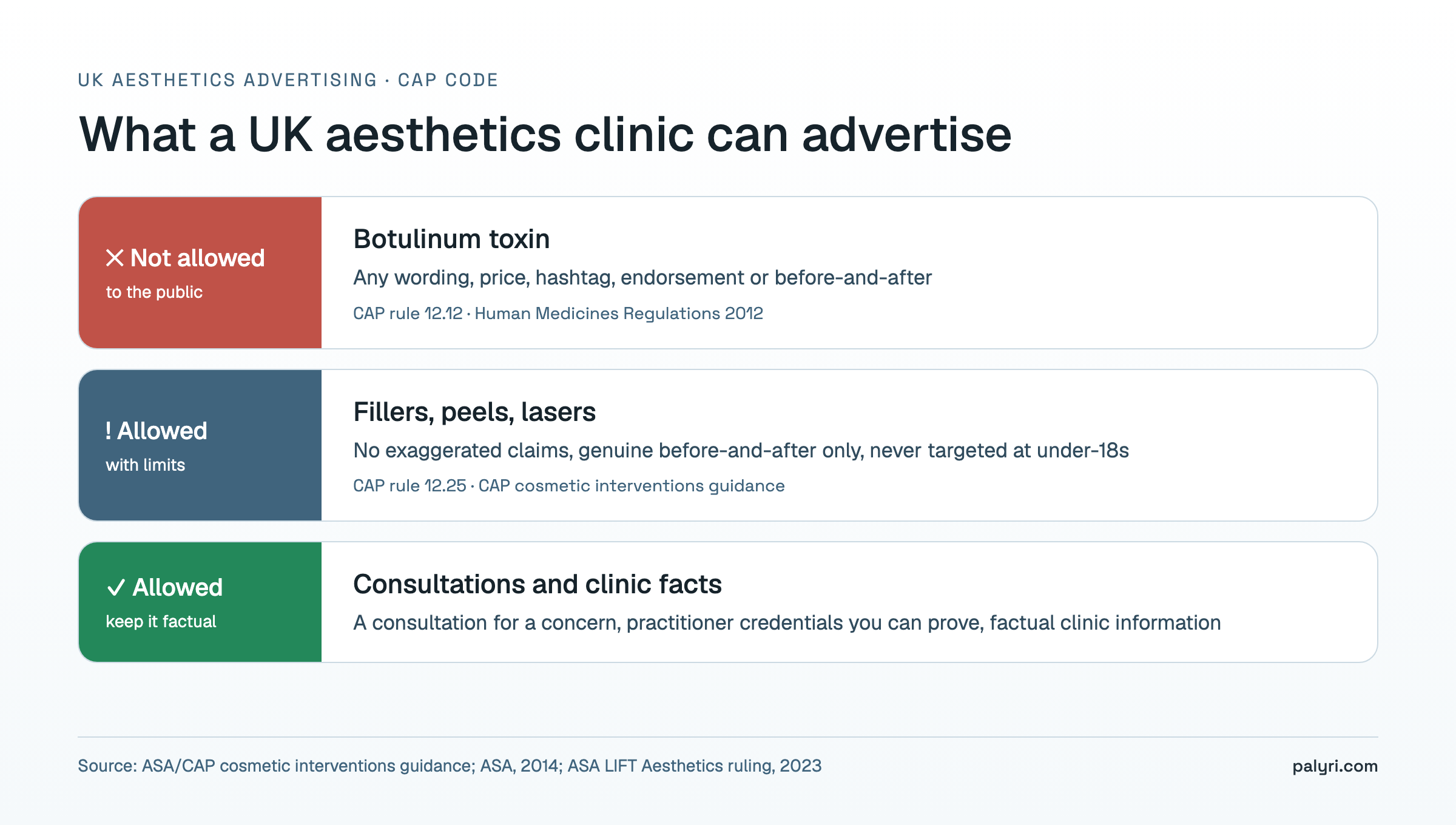
No. Botulinum toxin is a prescription-only medicine (POM), and the ASA states plainly that "it is prohibited by law from being advertised to the public, either directly, as a product for sale or indirectly, as part of a service offering to treat consumers with a POM" (ASA, 2014). The legal basis is the Human Medicines Regulations 2012, which the CAP Code reflects in rule 12.12 (ASA ruling on LIFT Aesthetics, 2023). The MHRA sets out the wider medicines advertising law on GOV.UK.
"Botox" is a brand name, so say "botulinum toxin" when you name the medicine factually. The ban covers the service as well as the product: a menu line, price, hashtag or before-and-after that points to toxin still advertises the POM.
Fillers, chemical peels and lasers sit in a different place. They are not prescription-only medicines, so you can advertise them, but the CAP guidance on cosmetic interventions still applies to them. That guidance covers "exaggerated or unrealistic claims, including through the use of before and after images", the "trivialisation of such treatments" and targeting. Status words such as "specialist" or "leading" must also be justified.
Factual information is the one narrow opening for toxin. The ASA allows references online "only if they're presented in both a factual and balanced way", reflecting the medicine's Summary of Product Characteristics (SPC) (ASA, 2014). In 2014 the ASA noted that the product's licensed cosmetic use at the time was glabellar lines; check the current SPC on the MHRA or eMC before referring to any indication.
What the ASA has ruled on anti-wrinkle and "cosmetic injections" ads
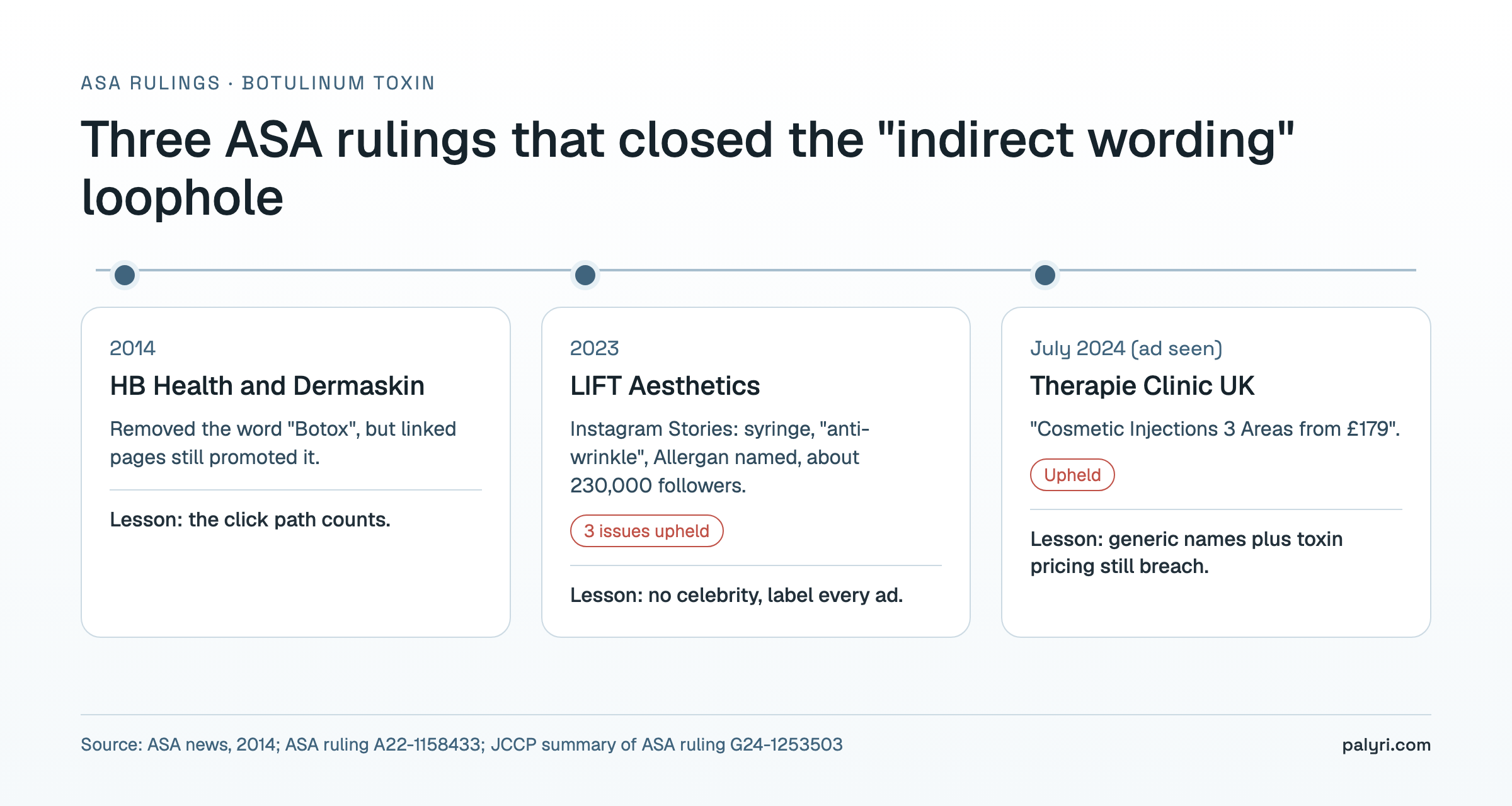
Three published cases show that indirect wording does not get a clinic out of the ban.
2014, HB Health of Knightsbridge and Dermaskin Clinics. Both clinics removed the word "Botox" from their home pages, but "the removal of the word itself did not resolve the issue", because visitors who clicked through "were then connected directly to extra content about Botox" (ASA, 2014). Lesson: the whole click path counts.
2023, LIFT Aesthetics. Six Instagram Stories showed a reality TV personality being injected with a syringe and talking about results in two weeks. The Stories never said "Botox", but they mentioned "Allergan" and "anti-wrinkle injection". The ASA upheld all three issues: promoting a POM, using a celebrity to endorse a medicine (he had "approximately 230,000 followers on Instagram") and failing to label the posts as ads (ASA ruling). Lesson: a syringe, a supplier name and a slang term together are enough.
A Facebook ad seen in July 2024, Therapie Clinic UK (Valterous Ltd). The ad offered "Cosmetic Injections 3 Areas from £179". The clinic argued it never mentioned botulinum toxin, yet the complaint, brought by the JCCP and Laser Clinics UK, was upheld because consumers would associate "3 areas" with anti-wrinkle treatment (JCCP summary). The ASA found that the clinic's own site described anti-wrinkle injections as "also known as botulinum toxin injections", and that the offer applied only to those treatments (ASA ruling). Lesson: a generic label plus a toxin-style price structure is still toxin advertising.
Copy that breaches vs copy that works (aesthetics clinic marketing UK)
The table below turns the rulings into wording patterns. The left column lists patterns the ASA has ruled against or that its guidance flags. The right column gives example rewrites that move the ad from the medicine to the client's concern and the consultation. The rewrites are examples written for this article, not ASA-approved text, so read them against CAP Advice Online before you use them.
| Breach pattern | Why it breaches | Example rewrite |
|---|---|---|
| "Anti-wrinkle injections from £150" | Reads as botulinum toxin, priced as an offer | "Worried about frown lines? Book a consultation to discuss your options" |
| "Cosmetic injections, 3 areas from £179" | "3 areas" pricing reads as toxin (Therapie ruling) | "Consultation with a nurse prescriber: assessment, treatment options discussed, no obligation" |
| #botox or #antiwrinkle on a clinic post | Hashtag promotes the POM directly | Concern-led tags such as #skinconsultation, with no medicine named |
| Story of a syringe going into a forehead | Shows the toxin treatment being given (LIFT ruling) | Video of the consultation room and the practitioner explaining the assessment |
| Influencer: "just had my anti-wrinkle done" | Endorsement of a medicine, often unlabelled | Labelled "ad" content about a skin or filler treatment, without exaggerated claims |
| Before-and-after of a toxin result | Promotes the POM through its outcome | Genuine, unedited filler or skin before-and-after with the treatment named |
| Home page cleaned of "Botox", links to a toxin page | The click path still promotes it (2014 rulings) | A consultation page about lines and wrinkles with no offer for the medicine |
| "Leading specialist injector" | Comparative and status claims must be justified (CAP guidance) | "Treatments by [name], registered nurse prescriber" with the registration you can prove |
For the Meta side of before-and-after content, including image rules and ad review, see our guide to before-and-after ads on Facebook and Instagram.
Instagram and influencer rules for aesthetics clinics
Stories and reposts count as much as paid ads. The LIFT ruling covered organic Stories, and the ASA told both the clinic and the personality "to ensure that their ads were obviously identifiable as marketing communications, for example by including a clear and prominent identifier, such as 'ad'" (ASA ruling).
The endorsement rule is separate from the POM ban. In the same ruling the ASA restated that "marketers must not use health professionals or celebrities to endorse medicines".
The third rule is age. Under CAP rule 12.25, in force since May 2022, cosmetic interventions advertising, which includes fillers, peels and non-ablative lasers, must not be targeted at under-18s (CAP guidance). Set paid audiences to 18+ and pick creators with adult audiences. For the commercial side of creator deals, see influencer rules and ROI for aesthetic clinics.
- No medicine named, hashtagged, shown being injected or priced, in posts, Stories, Reels or reposts.
- Paid, gifted or controlled creator content carries a clear "ad" label at the start.
- No celebrity or health professional endorsing a medicine.
- Before-and-after images are genuine, unedited and not of toxin results.
- Paid audiences set to 18+; creators with adult audiences only.
- Every claim about results or your credentials can be evidenced.
- The link in bio and the landing page pass the same test as the post.
Google Ads healthcare policy in the UK
Google adds its own layer on top of CAP. Its policy says "Google restricts the use of prescription drug terms in ads, landing pages and keywords" (Google Ads Healthcare and medicines policy). Google's UK table allows only two categories: GPhC-registered online pharmacies and LegitScript-certified telemedicine providers, both also certified with Google. Even they "can't promote prescription drugs in their ads and landing pages".
An aesthetics clinic is neither, so the answer for toxin search terms is simple: do not build campaigns around them. The policy page does not name botulinum toxin specifically, but it does not need to, because the CAP ban already applies to the ad and the page behind it.
What remains: searches for concerns, for fillers and skin treatments, and for clinics nearby. Build around those, keep the landing page free of toxin promotion, and set a bid you can afford per booked consultation. The method for that number is in finding your break-even bid on Google Ads.
| Keyword theme (examples) | Status | Why |
|---|---|---|
| "botox near me", "botox price london" | Avoid | Prescription drug term; CAP 12.12 bans the ad anyway |
| "anti wrinkle injections offer" | Avoid | Treated as toxin advertising in the Therapie ruling |
| "lip filler [town]", "dermal filler cost" | Workable | Not a prescription-only medicine; CAP guidance still applies |
| "skin consultation [town]", "frown lines treatment consultation" | Workable | Concern and consultation, no medicine promoted |
| "chemical peel", "laser skin treatment" | Workable | Advertisable cosmetic interventions, adult targeting |
Your website and Google Business Profile count as advertising
The ASA has covered "claims on companies' own websites" since 2011 (ASA, 2014), and the 2014 rulings show it follows the links from one page to the next. A treatment page for fillers, peels or lasers can sell. A page about lines and wrinkles can invite a consultation. Anything about botulinum toxin should read as factual information drawn from the SPC, without an offer or a booking button for the medicine.
Price lists are a grey area that clinics often get wrong. The ASA publishes Botox FAQs that cover what a price list can and cannot do; read them before you put any toxin line on your site, and never share that list on social media as a promotion.
Google Business Profile follows the same logic. The ASA's online remit covers "claims on companies' own websites" (ASA, 2014), and our reading is that GBP posts, offers and photos are space under your control, so treat them as ads: a "3 areas" offer in a GBP post breaches exactly as it would in a Facebook ad. Keep services and posts to advertisable treatments and consultations. For the rest of the profile, work through our Google Business Profile audit.
A consultation-led funnel that stays compliant (and how to measure it)
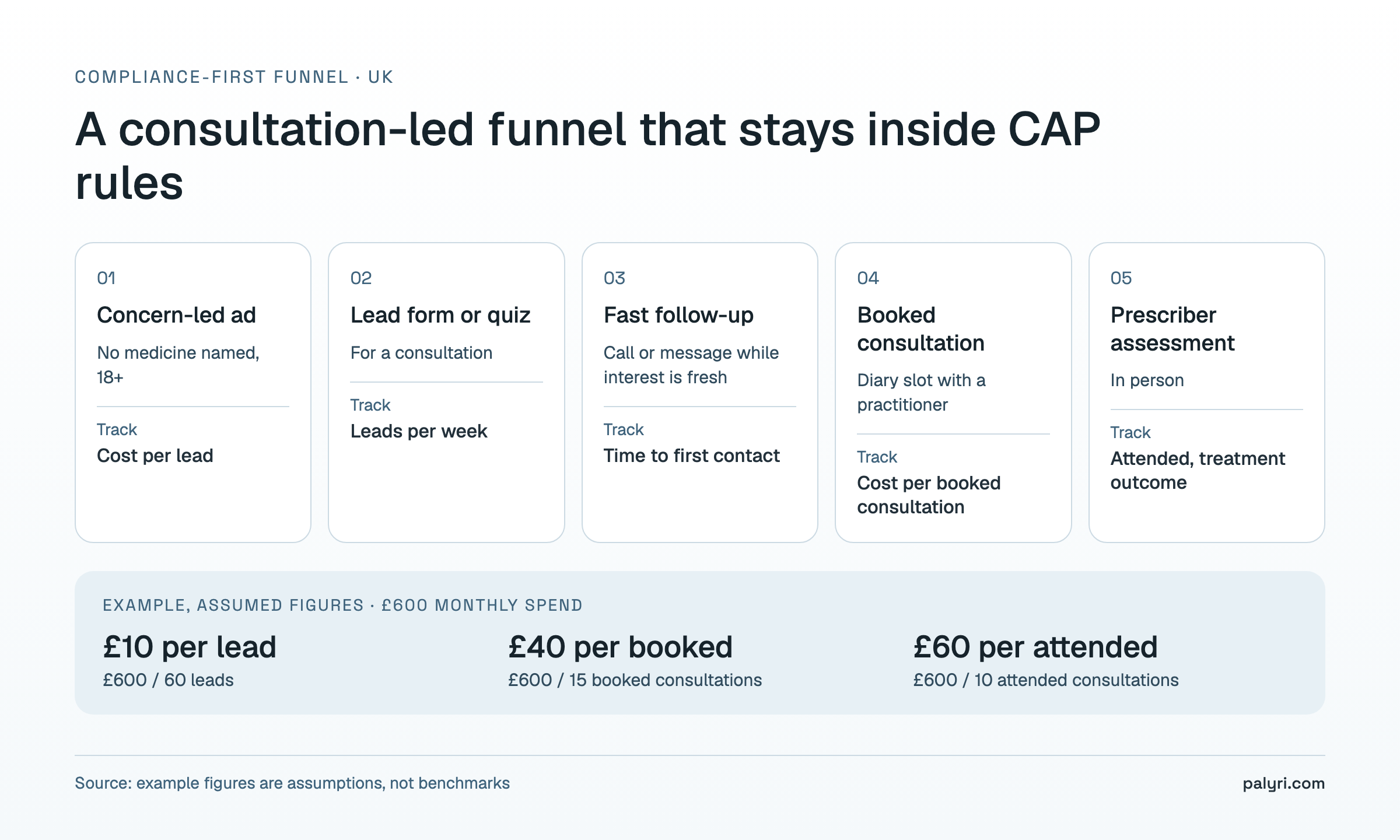
The rules point to one structure: sell the consultation, not the medicine. The prescriber decides on treatment face to face, which is also where the legal decision belongs. In practice the funnel has five steps.
- Concern-led ad. A concern or a named filler or skin treatment. Adult audience, no medicine named.
- Lead form or quiz for a consultation. Ask about the concern, timing and preferred location. Capture consent for follow-up.
- Fast follow-up. A call or message from the front desk while interest is fresh, with a reminder sequence if there is no answer.
- Booked consultation. A diary slot with a practitioner, confirmed by message.
- Prescriber assessment in person. Treatment options discussed, including prescription treatment where clinically appropriate, with the outcome recorded.
Measure the funnel by cost per booked consultation, not cost per lead.
Example: assume a clinic spends £600 a month on concern-led Meta ads and gets 60 leads. That is £600 / 60 = £10 per lead. If 15 of those leads book a consultation, the cost per booked consultation is £600 / 15 = £40. If 10 attend, the cost per attended consultation is £600 / 10 = £60. These figures are assumptions for the arithmetic, not benchmarks. Run your own numbers through the calculator for your cost per booked consultation.
Palyri is built for this shape of funnel. It takes Meta lead ads and an embeddable lead form on your own site into a CRM pipeline, runs quiz funnels and follow-up sequences, records the consultation outcome with any objections, and shows how each ad creative performs from lead to booked consultation. It does not review your ads for ASA or CAP compliance; that stays with you. See how it works as a CRM for aesthetics clinics, or compare plans on the pricing page. For the campaign build itself, our Meta ads campaign guide covers structure and creative.
Regulators and what is changing: CQC, MHRA, JCCP and the licensing scheme
Several bodies touch an aesthetics clinic's marketing, and they do different jobs.
| Body | Role in marketing | What it means for you |
|---|---|---|
| ASA / CAP | Writes (CAP) and enforces (ASA) the advertising code, including rules 12.12 and 12.25 | Rulings are published with your clinic's name; online and own-site content is covered |
| MHRA | Regulates medicines, including the law on advertising medicines | The POM ban comes from medicines law, not only the ad code |
| JCCP | Practitioner register and standards body; can bring complaints | It co-filed the complaint in the Therapie ruling |
| CQC | Registers and inspects providers of regulated health activities in England | Registration is a separate question from advertising; only claim a status you hold |
| Government (licensing) | Section 180 of the Health and Care Act 2022 gives a power to license non-surgical cosmetic procedures in England | Check GOV.UK for the current status before you describe it in marketing |
Any future licence is something you must not imply before you hold it. Describe only the registrations and qualifications you can prove today.
Use this pre-publish checklist for every ad, post, page and profile update:
- No botulinum toxin, brand name, supplier name or slang term ("anti-wrinkle", "3 areas") in promotional content.
- No toxin price, offer, discount or hashtag anywhere promotional, including GBP posts.
- Links from the ad and from the page lead nowhere that promotes the medicine.
- Any toxin reference on the website is factual, balanced and based on the SPC.
- No celebrity or health professional endorses a medicine.
- Paid, gifted or controlled creator content is labelled "ad" up front.
- Audiences are 18+ and the media or creator is not aimed at under-18s.
- Before-and-after images are genuine, unedited and not of toxin results.
- Status words ("specialist", "leading", "qualified") are backed by evidence you hold.
- The ad sells a consultation or an advertisable treatment, and the funnel is tracked to booked consultations.
Frequently asked questions
Can I advertise Botox if a doctor or nurse prescriber administers it?
No. The ban attaches to the medicine, not to who administers it. Botulinum toxin is a prescription-only medicine, and the ASA says it cannot be advertised to the public either directly or "as part of a service offering to treat consumers with a POM". You can name the prescriber who runs your consultations and state their real qualifications. You cannot promote toxin treatment, its price or its results. Promote a consultation for the concern instead, and let the prescriber discuss options in person.
Is "anti-wrinkle injections" a safe alternative term?
Not if it points to toxin. In the Therapie Clinic UK ruling, the ASA noted that the clinic's own website described anti-wrinkle injections as "also known as botulinum toxin injections" and found that the "3 areas from £179" offer applied only to its anti-wrinkle treatments (ASA ruling). The LIFT Aesthetics Stories that said "anti-wrinkle injection" were also upheld. The ASA Botox FAQs accept the phrase only as a collective term when you also offer non-prescription treatments and nothing implies toxin alone. Safer: name the concern (frown lines) and offer a consultation, without naming or pricing a medicine.
Can I post filler before-and-after photos on Instagram?
Yes, with conditions. Dermal fillers are not prescription-only medicines, so they can be advertised, but the CAP guidance on cosmetic interventions flags "exaggerated or unrealistic claims, including through the use of before and after images". Use genuine, unedited photos showing typical results. Do not target under-18s, and do not post toxin results under a filler caption. Meta adds its own rules on top.
Can I run Google Ads for Botox in the UK?
Not as an aesthetics clinic. Google restricts prescription drug terms, and its UK table lists only two allowed categories, GPhC-registered online pharmacies and LegitScript-certified telemedicine providers, both also certified with Google. Even they cannot promote prescription drugs in ads or landing pages, and CAP rule 12.12 bans the ad anyway. Build campaigns around concerns, consultations, fillers and skin treatments, and measure cost per booked consultation.
Can an influencer promote my aesthetics clinic?
Yes, for advertisable treatments, with three conditions. The content must be clearly labelled as an ad, for example with "ad" at the start, because the ASA ruled against unlabelled Instagram Stories in the LIFT Aesthetics case. The creator must not promote a prescription-only medicine, and no celebrity or health professional may endorse a medicine; the personality in that ruling had about 230,000 followers and was treated as a celebrity. The creator's audience should be adult, because cosmetic interventions ads must not be targeted at under-18s. Fillers, skin and laser treatments and consultations are the safe subjects.
Does the under-18 rule apply if my followers include teenagers?
It can. CAP rule 12.25 prohibits cosmetic interventions advertising from being targeted at under-18s, and that covers fillers, peels and non-ablative lasers as well as surgery. For paid social, set the audience to 18+. For organic posts and creators, check who the account actually reaches, because a young following is a targeting risk. For audience thresholds, see the ASA's targeting rules announcement and the CAP guidance it links to.
Want to implement this in your clinic?
Book a free Palyri demo. We'll show how it works on your clinic's data.
Book a demoPalyri blog author
Writes for the Palyri blog about getting clients from ads, handling leads and front-desk work in aesthetic clinics and beauty salons.