Start with a Higher Intent instant form when the offer is simple and lower-ticket (a consult, injectables, facials) and your front desk can call within minutes; send traffic to a landing page or quiz when the treatment is high-ticket or needs price and education before contact (body contouring, laser packages). Whichever route you pick, judge Facebook lead ads and landing pages by cost per booked consult, never by cost per lead.
Instant forms almost always produce cheaper leads because they open inside Facebook or Instagram with the patient's details pre-filled. Landing pages ask for more effort, and that effort filters out some of the people who were never going to book. The rest of this guide shows how to choose by treatment, how to set up each route for lead quality, and how to compare them with real arithmetic.
This is not a campaign setup guide. For audiences, budgets and creative, see the full Meta ads campaign setup for aesthetic clinics. Here we only answer one question: where should the click go?
Facebook lead ads vs landing page: which should a med spa use?
Facebook lead ads (Meta calls the form an "instant form") keep the patient on the platform. A landing page sends them to your website, where your own form, pricing and proof do the work. Both can feed the same CRM. The difference is how much friction you add and how much context the patient sees before handing over a phone number.
One technical difference matters more than most guides admit. Meta's CRM-driven optimization goal, Conversion Leads, is currently only compatible with Lead Ads using Instant Forms. If you ever want Meta to optimize toward patients who actually book, the instant form route is the one that qualifies.
| Factor | Instant form (lead ad) | Landing page or quiz |
|---|---|---|
| Friction | Very low: a few taps | Higher: page load, scroll, type |
| Where it opens | Inside Facebook or Instagram | Your website or quiz funnel |
| Pre-filled contact data | Yes, from the profile (can be outdated) | Browser autofill only |
| Room for price and education | Short intro screen | As much as the offer needs |
| Typical lead intent | Mixed: easy to submit on impulse | Higher: effort filters some browsers |
| Setup effort | Low: built in Ads Manager | Medium to high: page, form, speed, tracking |
| Tracking needs | Leads arrive in Meta; CRM sync needed | Pixel plus Conversions API on your site |
| Conversion Leads optimization | Eligible (Instant Forms only) | Not eligible |
| Best-fit treatments | Consults, neurotoxin, fillers, facials, peels | Body contouring, laser packages, multi-session plans |
If you cannot decide, run both for the same offer with the same creative and let booked consults pick the winner. The cost per booked consult section below shows how to do that math.
What the data says about instant forms vs landing pages
There is very little public test data on this, and almost none from med spas. The most cited test comes from WordStream's 2019 comparison of Facebook lead ads and landing pages, built on B2B and small business advertisers, not aesthetics.
In that test, campaigns using lead ads had an average conversion rate of 12.54% and an average cost per action of $17.98. Campaigns using landing pages converted at 10.47% at $13.26 per action. Further down the funnel, the landing page route had what WordStream calls a "5.7% higher conversion rate" to a qualified lead and a 1.4% higher rate to a demo (the article does not say whether these are percentage points or a relative lift), according to the same WordStream analysis.
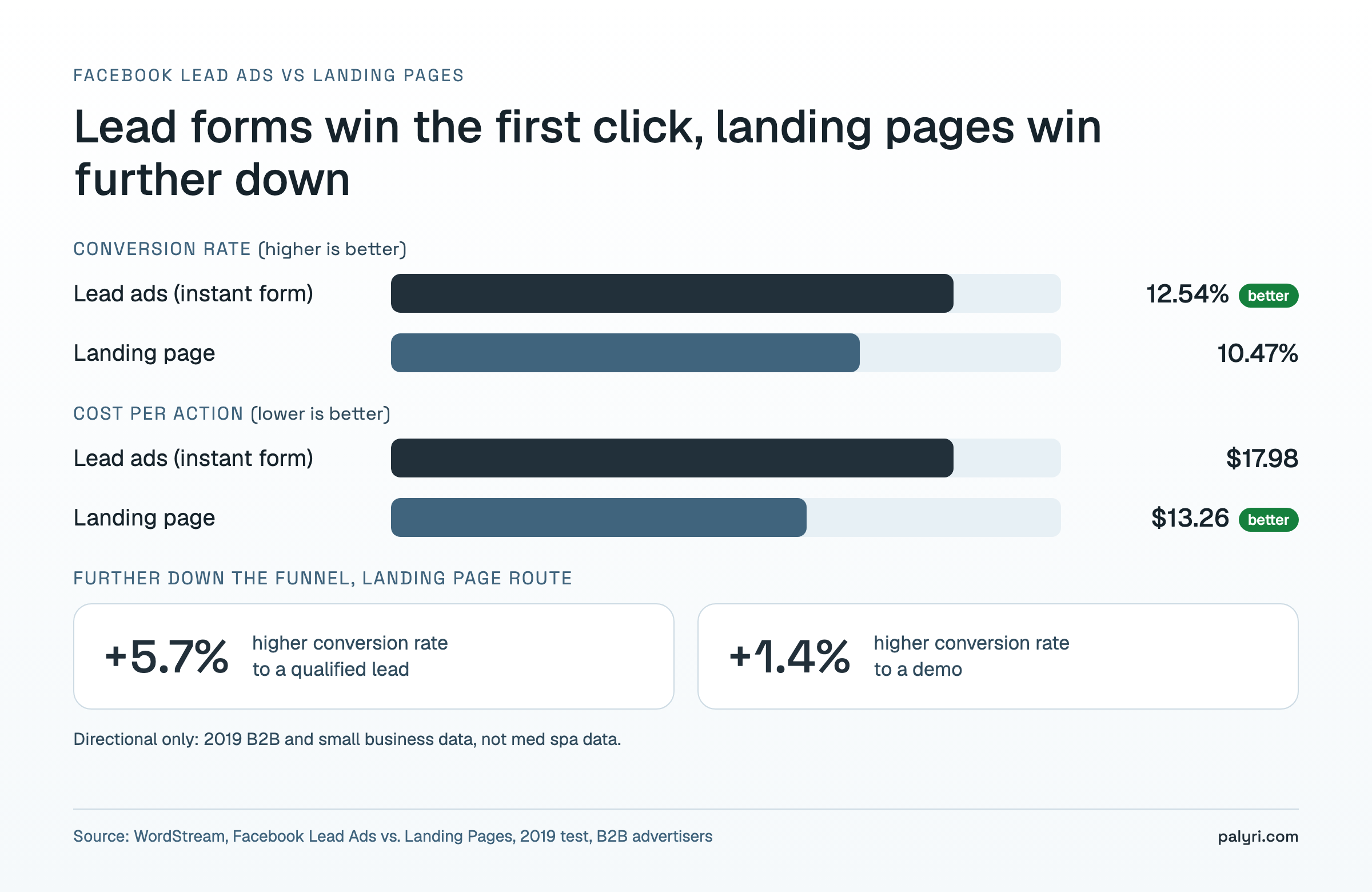
Treat those numbers as directional. They are from 2019, from a different industry, and Meta's forms have changed since. What still holds is the pattern: the easiest form wins the first metric and can lose the one that pays the bills. As OnePPC Agency puts it, "A low cost per lead can become expensive once uncontactable, ineligible and unqualified enquiries are removed."
You will see vendor claims that lead ads are a fixed percentage cheaper per lead. None that we found cite a source, so we do not repeat them here. Your own booked consult numbers after a few weeks are worth more than any of them.
How to set up a Higher Intent instant form
Meta offers several instant form types. According to Jon Loomer's walkthrough of instant forms, "More Volume" is selected by default and is built to be quick to fill out and submit. "Higher Intent" adds a review step to confirm sending info, and "Rich Creative" (formerly Custom) adds visual content. OnePPC notes that the options available can vary by account.
For med spas, switch from More Volume to Higher Intent on day one. The review screen gives the patient a moment to check their phone number and confirm they meant to submit. That alone removes some accidental taps. WordStream describes the same mechanism: Facebook achieves higher intent by adding a review step that lets prospects confirm their information before they submit it.
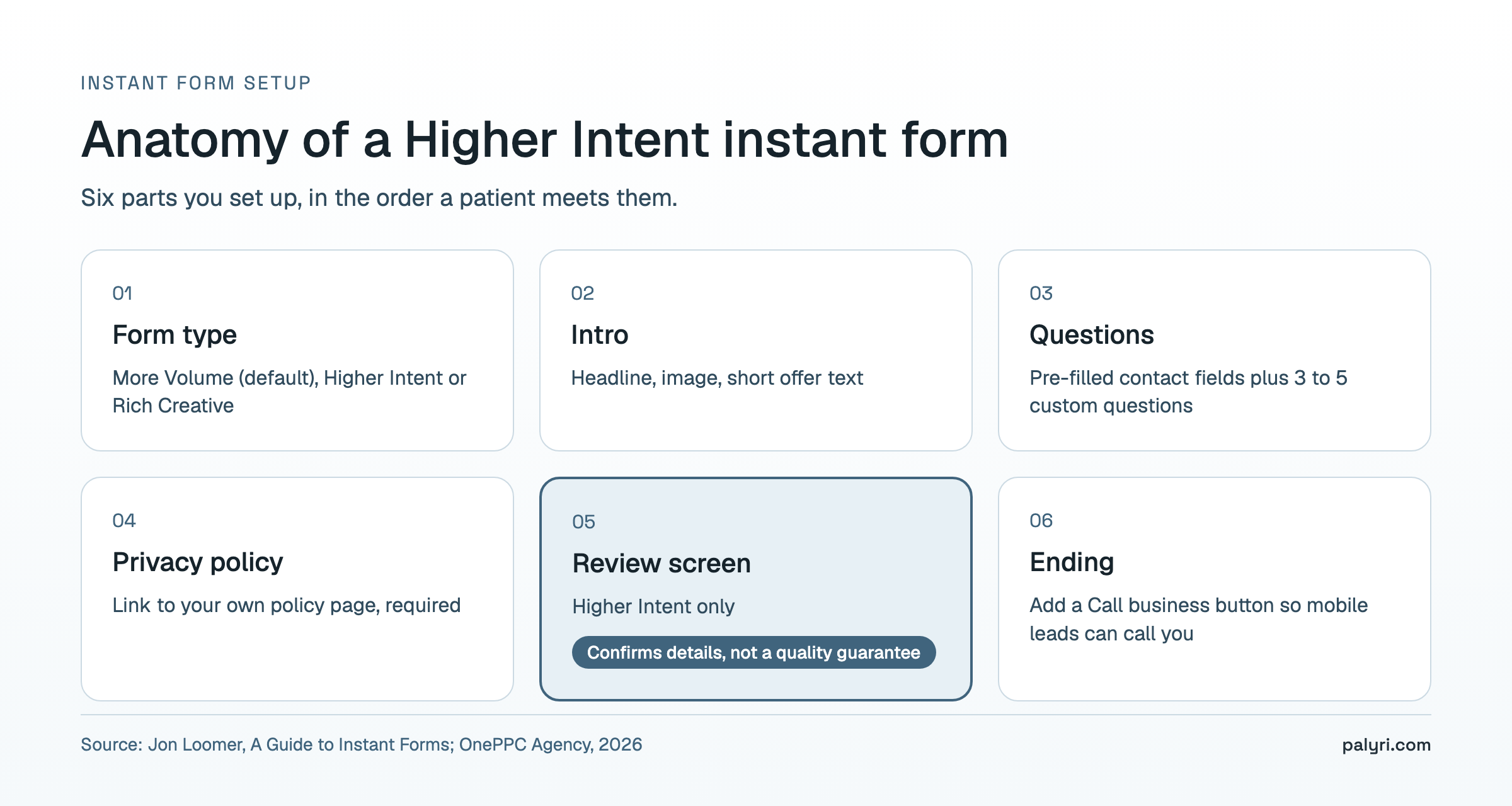
Setup checklist for a med spa Higher Intent form:
- Form type: Higher Intent. The review screen only appears with this type.
- Intro: name the treatment and the next step in one line, for example "Book a lip filler consult. A provider calls you to confirm a time."
- Pre-filled fields: full name, phone number, email. Keep it to these three.
- Custom questions: 3 to 5 from the set in the next section.
- Conditional logic: on, if you want non-fits routed to a separate ending.
- Privacy policy: link to your own policy page. Meta requires one.
- Ending: add the "Call business" button so mobile leads can tap to call you straight away.
- Test: submit a test lead and confirm it lands in your CRM before spending a dollar.
Which instant form questions filter out low-quality leads?
Custom questions do the real filtering. Meta supports multiple choice, short answer and conditional questions. Multiple choice is the workhorse: it is fast on a phone and gives your front desk structured data to sort by.
Copy-paste question set for a med spa instant form:
| Question | Type | Answer options | Why it helps |
|---|---|---|---|
| Which treatment are you interested in? | Multiple choice | Lip filler / Neurotoxin / Skin booster / Not sure yet | Routes the lead to the right provider and script |
| When would you like to start? | Multiple choice | This month / In 1-3 months / Just researching | Separates ready-to-book patients from browsers |
| Consults start at $X and are credited toward treatment. Does that work for you? | Multiple choice | Yes / I'd like to know more first / No | Sets price expectations before the call (replace $X with your real price) |
| Which location is closest to you? | Multiple choice | One option per location / None of these | Removes patients outside your area |
| Best time to call you? | Multiple choice | Morning / Afternoon / Evening | Raises contact rate on the first attempt |
Turn on conditional logic to send "No" on price, "Just researching" or "None of these" on location to a separate ending. With conditional logic, you get two Ending pages: one for leads and one for non-leads. The non-lead ending can thank them and link to your treatment page, so you keep goodwill without filling the call list. Note one catch: you can't make questions optional when conditional logic is on, which is why the table uses only multiple choice.
When a landing page or quiz funnel beats an instant form
An instant form has a short intro screen and little else. Some offers need more than that before a patient is ready to talk. The extra effort of visiting a website and completing a form can filter out some low-intent users, but only when the page is relevant, persuasive and technically sound. A slow, generic page loses on both volume and quality.
- The treatment is high-ticket or multi-session (body contouring, laser hair removal packages).
- Price needs context: packages, financing or a range by area treated.
- Patients need proof before contact, such as results galleries (check what before-and-after creative Meta allows).
- You run several locations and want patients to pick one with full details.
- You want web events (pixel plus Conversions API) from your own site to train campaigns.
A quiz funnel sits in the middle. It feels as light as an instant form, a few taps on multiple choice screens, but it runs on your page, so you can show prices, education and results along the way. It also qualifies by design: the answers tell you which treatment fits and how ready the patient is.
Palyri supports both web routes: quiz funnels and an embeddable lead form for the clinic's own site, each sending leads with their ad attribution into the CRM pipeline. See how that fits a practice in the CRM for aesthetic clinics overview.
How to connect Facebook lead ads to your CRM
Instant form leads sit in Meta until you move them. Meta's developer docs describe four ways to get leads into a CRM:
- Partner integration: a CRM from Meta's list of available CRM integrations for lead ads. The simplest route.
- Webhooks: your CRM receives each lead in near real time. Needs developer resources, an endpoint, a Meta developer app and an app subscription linked to your Page.
- Graph API bulk read: your system pulls leads in batches. Also needs developer resources, and leads arrive later.
- Manual download: a CSV export. Meta does not recommend it beyond a temporary fix.
Speed matters here because a lead downloaded tomorrow morning is a cold lead. Read how fast to call a new lead before you choose a slow route. If you have no developer, a no-code Make.com connection is a workable bridge.
Once leads flow into the CRM, you can send outcomes back to Meta. That is what Conversion Leads optimization uses, and Meta's fit guidelines are strict:
Meta also lists a total time to value of about 3-4 weeks, and recommends storing the 15-17 digit Meta Lead ID in your CRM, or sending customer parameters such as phone or email if you do not have it.
Be honest about the first number. Many single-location med spas will not generate 200 leads a month for one offer. If that is you, still send downstream events (lead, booked, paid) back through the Conversions API as signals, keep the campaign on a standard lead goal, and judge quality yourself with the method in the next section.
Palyri receives instant form leads through Meta's lead webhook straight into the pipeline, and sends Lead, Schedule (when the patient pays a deposit) and Purchase (with value) events back to Meta through the Conversions API. For what to do with Meta leads once they land, see our lead handling guide.
How to judge lead quality: cost per booked consult, not cost per lead
Cost per lead tells you which route is cheapest to fill a list. Cost per booked consult tells you which route fills your treatment rooms. The American Med Spa Association suggests tracking cost per lead, click-through rate and lead form completion rate. Add one more line under them: booked consults, from your CRM.
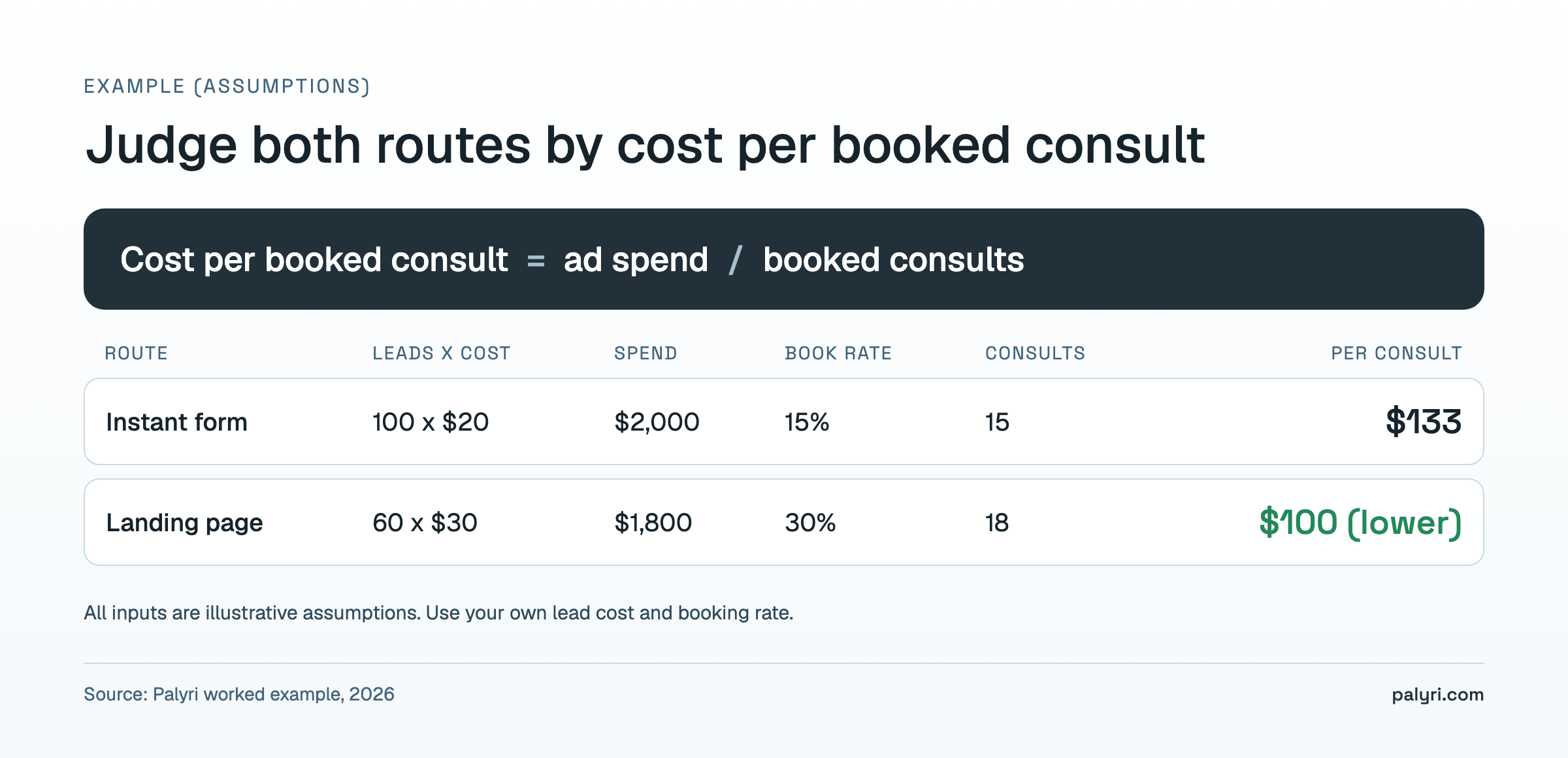
Example: a med spa tests both routes on the same lip filler offer for one month. All four inputs below are assumptions for illustration, not benchmarks.
- Instant form: 100 leads at $20 each = $2,000. 15% book a consult = 15 consults. $2,000 / 15 = $133 per booked consult.
- Landing page: 60 leads at $30 each = $1,800. 30% book a consult = 18 consults. $1,800 / 18 = $100 per booked consult.
The instant form "wins" on cost per lead by $10 and loses on cost per booked consult by $33. Put another way, the landing page delivers more consults for every dollar spent:
Flip the assumptions and the answer flips too. If your front desk calls instant form leads within five minutes and lifts their booking rate to 25%, the same $2,000 buys 25 consults at $80 each, and the instant form wins. That is why the comparison has to use your numbers.
To set this up:
- Tag every lead with its source (instant form or landing page) in your CRM.
- Record "consult booked" as a stage, not a note.
- Compare after at least a few weeks, so a slow-booking week does not decide for you.
Use the ROI calculator to work out your cost per booked consult with your own spend and booking rates, and check your lead costs against cost per lead benchmarks for aesthetic clinics. CRMs that record a "consult booked" stage per lead source make this a two-minute report (Palyri pricing shows what that costs).
FAQ
Are Facebook lead ads better than landing pages?
Neither is better across the board. Instant forms usually produce more leads at a lower cost per lead because they open inside Facebook or Instagram with details pre-filled. Landing pages add friction that can filter out low-intent people, and they give room for prices and proof. In WordStream's 2019 B2B test, lead ads converted more often but landing pages cost less per action. For a med spa, compare cost per booked consult on the same offer.
What is a Higher Intent form on Facebook?
A Higher Intent form is an instant form type that adds a review screen where the patient confirms their pre-filled details before submitting, which reduces accidental submissions. More Volume is the default, so you switch manually; the review step only appears with this form type. It does not guarantee lead quality on its own, so pair it with filter questions and conditional logic.
Why are my Facebook lead ads leads low quality?
The usual causes are a More Volume form with no custom questions, an intro that skips price or the next step, and slow follow-up. Pre-filled forms make impulse submissions easy, and people forget a form they filled days ago. Switch to Higher Intent, add filter questions, and call within minutes (see how fast to call a new lead). Then judge changes by booked consults, not lead count.
How do I connect Facebook lead ads to my CRM?
Meta documents four routes: a partner integration, webhooks, a Graph API bulk pull and manual CSV download. Pick the fastest one your setup allows, because a lead that waits overnight goes cold. Without a developer or a listed partner, a no-code automation tool can bridge the gap. Always send a test lead and confirm the form answers arrive before launch.
How many questions should a Facebook lead form have?
For a med spa, three pre-filled contact fields (name, phone, email) plus three to five custom questions is a sensible range. Fewer questions bring more leads; more questions bring fewer but more qualified ones. Multiple choice suits a phone screen best. The highest-value topics are treatment of interest, timing, price fit and nearest location.
Do Facebook lead ads work for med spas?
Yes, especially for simple, lower-ticket offers such as consults, neurotoxin, fillers and facials, where a short form and a fast phone call are enough to book. They are weaker for high-ticket, multi-session treatments that need price and education first; a landing page or quiz funnel usually fits those better. For the wider campaign picture, see the full Meta ads campaign setup for aesthetic clinics.
Want to implement this in your clinic?
Book a free Palyri demo. We'll show how it works on your clinic's data.
Book a demoPalyri blog author
Writes for the Palyri blog about getting clients from ads, handling leads and front-desk work in aesthetic clinics and beauty salons.