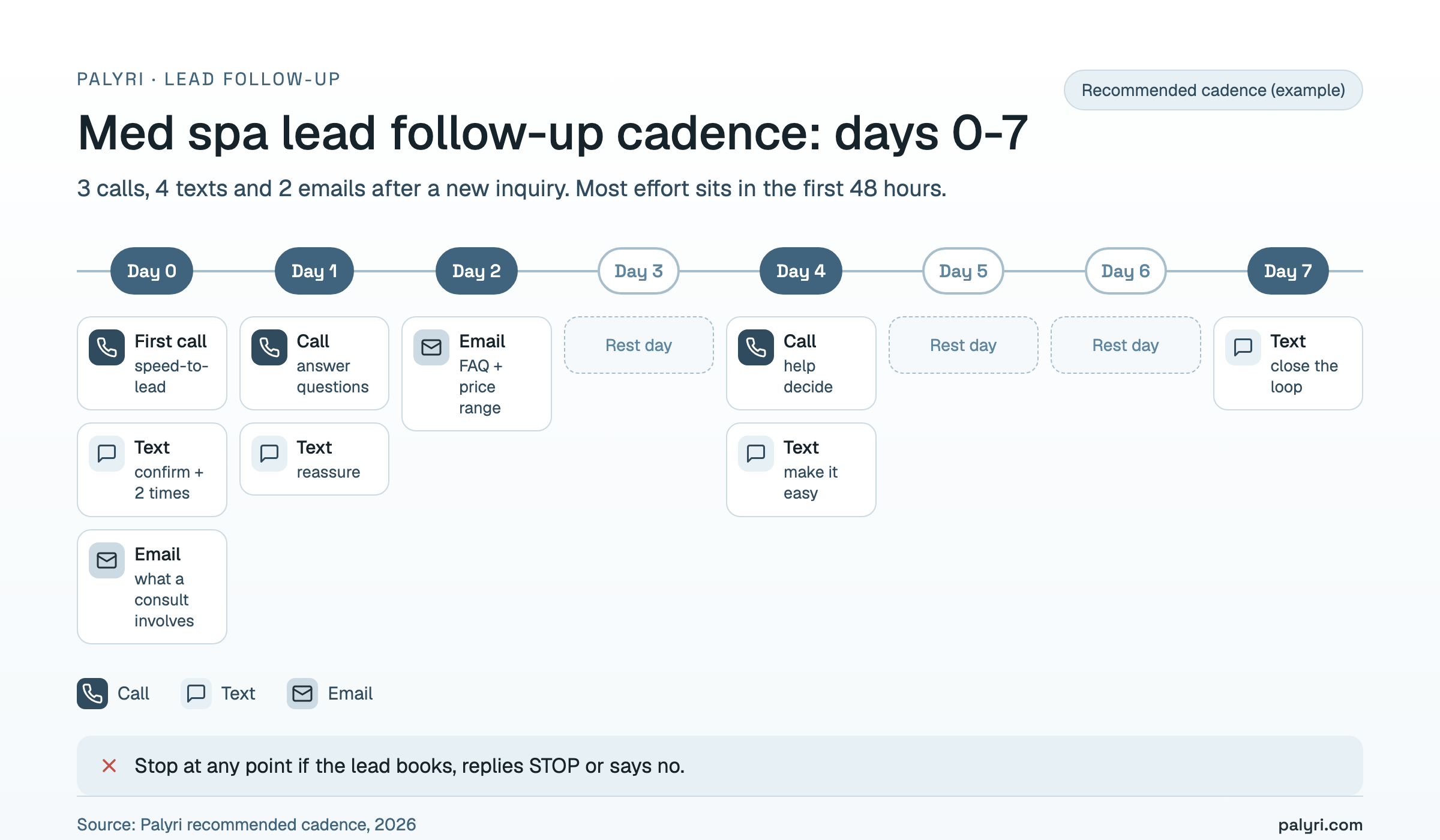
A working med spa lead follow-up cadence is about 8 touches over 7 days after the first call: texts, calls and emails on days 0, 1, 2, 4 and 7, each with a different job. It stops the moment the lead books, replies STOP or says no.
This is a recommended design, not an industry statistic. It picks up after the first response, which belongs to why the first five minutes matter. From that point the cadence has one goal: a booked consult. Everything below is built around that goal, with copy-paste scripts, stop rules and the opt-out rules quoted from primary sources.
What is a good med spa lead follow-up cadence?
A good cadence is short, front-loaded and varied. Most of the effort sits in the first 48 hours, when the inquiry is fresh, and each touch does a different job instead of repeating "just checking in."
The recommended plan below assumes your first call went out within minutes of the inquiry. If that call connected and the lead booked, the cadence never starts. If it did not, the lead enters this sequence.
| Touch | When | Channel | Job |
|---|---|---|---|
| 1 | Day 0, right after the missed first call | Text | Confirm who you are, offer two times |
| 2 | Day 0 | Set expectations: what a consult involves | |
| 3 | Day 1 | Call | Answer questions live |
| 4 | Day 1 | Text | Reassure, re-offer times |
| 5 | Day 2 | FAQ, price range, what to expect | |
| 6 | Day 4 | Call | Help them decide |
| 7 | Day 4 | Text | Make the decision easy |
| 8 | Day 7 | Text | Close the loop |
That is 3 call attempts in total (the first speed-to-lead call plus days 1 and 4), 4 texts and 2 emails. Spacing gets wider as the week goes on, so a lead who is busy, not ignoring you, still has room to reply.
What to say on each follow-up call, text and email
Every touch follows the same pattern: the lead's name, the treatment they asked about, one question, and either a booking link or two specific time slots. Two time slots beat "let me know when works," because the lead only has to pick one.
The first text must identify your med spa and include "Reply STOP to opt out." The scripts below are templates. Replace everything in brackets, and keep each text under about 300 characters so it does not split into many segments.
| Day | Channel | Job | Script (template) |
|---|---|---|---|
| 0 | Text | Confirm | Hi [Name], this is [Your name] from [Med Spa]. Thanks for asking about [treatment]. I just tried calling. Would [Tue 4:30] or [Wed 11:00] work for a free consult? Reply STOP to opt out. |
| 0 | Set expectations | Subject: Your [treatment] consult at [Med Spa]. Hi [Name], here is what a consult looks like: [length] minutes with [provider title], we look at your goals, talk through options and give you a price before anything is done. Book here: [link]. Questions? Just reply. | |
| 1 | Call | Answer | "Hi [Name], it's [Your name] from [Med Spa]. You asked about [treatment] yesterday. What made you start looking into it?" Listen, answer, then: "I have [time] or [time] this week. Which is better?" Voicemail: "Hi [Name], [Your name] from [Med Spa] about your [treatment] question. I'll text you two times. Talk soon." |
| 1 | Text | Reassure | Hi [Name], [Your name] at [Med Spa] again. Most people have the same first question: does it hurt and how long does it take? Happy to answer here. Still have [Thu 5:00] open if you'd like it. |
| 2 | Inform | Subject: [Treatment]: price range and 4 common questions. Hi [Name], [treatment] at [Med Spa] usually runs [your price range], depending on [factor]. Answers to the questions we hear most: [Q1], [Q2], [Q3], [Q4]. When you're ready: [link]. | |
| 4 | Call | Help decide | "Hi [Name], [Your name] from [Med Spa]. I wanted to check if anything is holding you back on [treatment]: timing, price, or just wanting more information?" No voicemail on this attempt; send the text instead. |
| 4 | Text | Make it easy | Hi [Name], no pressure at all. If it helps, the consult is free and you decide afterward. Want me to hold [Sat 10:00] for you? Just reply YES. |
| 7 | Text | Close the loop | Hi [Name], I don't want to keep messaging if now isn't the right time. Should I close your [treatment] request, or would you like a time next week? Either answer is fine. |
The day 7 "close the loop" text often gets a reply because it gives the lead a polite way to say no. Any answer, including "not now," tells you which stop rule applies. If a lead calls back while you are mid-cadence and nobody picks up, your missed call text back setup and scripts should take over that touch.
How long to wait between follow-ups (and what time to send)
Wait about 24 hours between touches on days 0 to 2, then two to three days before day 4 and day 7. The front-loaded spacing matches how inquiries behave: interest is highest right after the form, and the later gaps keep the cadence from feeling like pressure.
Time of day matters too. The FCC rule on telephone solicitations bars calls to residential subscribers "before the hour of 8 a.m. or after 9 p.m. (local time at the called party's location)" (47 CFR 64.1200(c)(1), eCFR). That rule targets solicitations, but using the same window for every call and text is a simple house rule that keeps you clear of edge cases. Always go by the lead's time zone, not yours.
Leave a voicemail on the first and second call attempts only. By the third attempt a voicemail adds little, and a short text is easier for the lead to answer.
These are rule markers from the eCFR text, not performance benchmarks.
Can you text a lead who filled out your form? Consent and opt-out rules
Yes, if the form captured consent to receive texts and you can prove it. The rules below are summarized from primary text as of October 2026. This is not legal advice; check the details with your counsel.
Consent on the form. For marketing messages sent with an autodialer or a prerecorded voice, the FCC requires "prior express written consent," defined as "an agreement, in writing, bearing the signature of the person called that clearly authorizes the seller to deliver" those messages, along with the phone number they apply to (47 CFR 64.1200(f)(9)). In practice that means a clear checkbox, not pre-ticked, with text naming your med spa and the kind of messages you will send.
Keep the record. CTIA, the wireless industry group whose guidelines carriers enforce, lists what a consent record should capture: the language and action used to secure consent, the specific campaign, the IP address, the phone number and the identity of the person who consented (CTIA Messaging Principles and Best Practices, May 2023). CTIA also says consent "should apply only to the campaign(s) and specific Message Sender for which it was intended or obtained," so consent given to one business does not carry over to another.
Register your number. If you text US leads from a regular 10-digit number, A2P 10DLC registration applies: "Registration is required for all customers sending messaging traffic to the United States using long code numbers" (Twilio Help Center). Twilio lists a Low Volume Standard Brand tier for senders with an EIN sending fewer than 6,000 segments per day, which fits most single-location med spas.
Honor STOP and plain-language opt-outs. The FCC rule treats "stop," "quit," "end," "revoke," "opt out," "cancel" or "unsubscribe" as a valid revocation, and any other reply "a reasonable person would understand" as a request to stop must be treated the same way (47 CFR 64.1200(a)(10)). CTIA adds that senders "should support multiple mechanisms of opt-out, including phone call, email, or text." So "please stop texting me" in an email counts.
One confirmation, no marketing. You may send one text confirming the opt-out, as long as it "merely confirms" the request, contains no marketing, and is the only further message. Sent within five minutes, it is presumed to fall within the lead's consent (47 CFR 64.1200(a)(12)). The rule allows up to ten business days to honor a revocation; the safer practice is to stop immediately.
When should you stop following up with a lead?
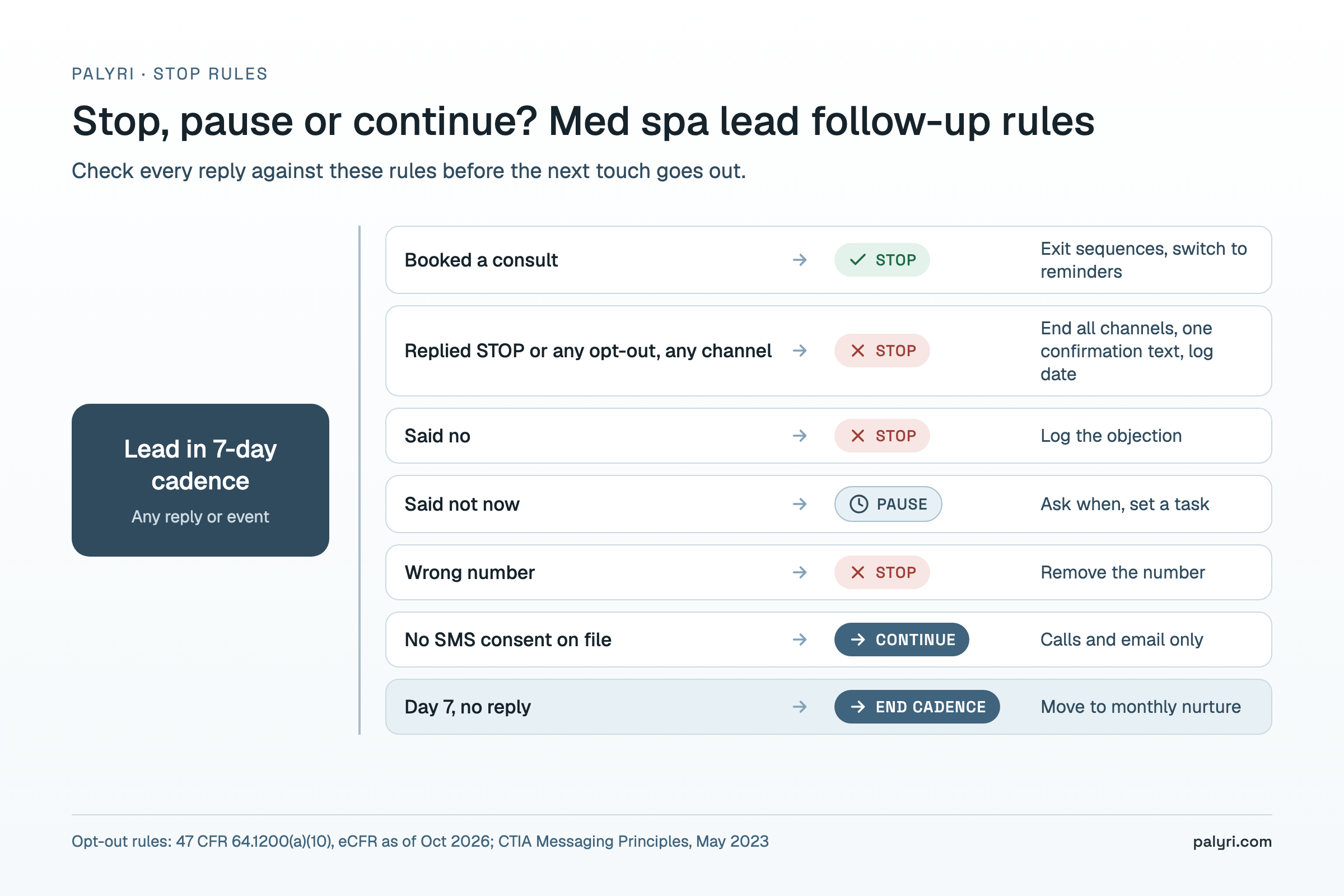
Stop as soon as the lead gives you an answer, and pause instead of pushing when the answer is "not now." A cadence that ignores replies turns a warm inquiry into a complaint.
Use these six rules:
- Booked. Exit every follow-up sequence and switch to appointment reminders. A lead who books on day 1 should never receive the day 4 text.
- STOP or any opt-out wording, on any channel. End texts, calls and marketing emails for that lead, send one confirmation text, and log the date.
- Explicit "no." Stop the cadence and record the objection (price, timing, fear, chose another provider). Objections are the most useful data a front desk collects.
- "Not now." Stop the cadence, ask when to check back, and set a task for that date.
- Wrong number. Stop immediately and remove the number from the record.
- No SMS consent on file. Run the cadence with calls and email only.
If none of these apply and day 7 passes with no reply, the cadence ends and the lead moves to monthly nurture. Your pipeline should show which rule closed each lead; see managing Meta ads leads in a pipeline for a status structure that supports this.
What the cadence costs your front desk (worked example)
A full cadence takes real staff time when every touch is manual. Here is an example with stated assumptions, not measured data.
Example assumptions: 40 new leads per week enter the cadence. Each call attempt takes 2 minutes including notes. Each manually typed text takes 1 minute. Each lead gets 3 call attempts and 4 texts; emails are templated and left out of the count.
- All manual: 40 x (3 x 2 + 4 x 1) = 40 x 10 = 400 minutes, about 6.7 hours per week.
- Texts and emails automated, calls kept human: 40 x (3 x 2) = 240 minutes, 4 hours per week.
The difference is 160 minutes a week, which the front desk can spend on the calls themselves. Keep calls human: a live conversation is where questions get answered and objections surface. To see what those consults are worth to your business, plug your own numbers into the ROI calculator.
Day 8 and beyond: where unbooked leads go
After day 7, an unbooked lead moves to long-term nurture, not back to day 0. Restarting the full cadence on someone who already went quiet reads as spam and burns the consent you have.
Nurture means one useful message a month at most: a new treatment, a seasonal reason to book, an answer to the objection they gave. A lead who replies to a nurture message gets a single personal call or text, not a new eight-touch sequence. Once someone becomes a client and later goes inactive, a different playbook applies; see how to win back inactive clients.
If you want this to run without spreadsheets, Palyri's automation builder can start a sequence when a new contact or form submission arrives, with delays, conditions and wait-for-event steps. Steps can send SMS, email or WhatsApp, create a "call this lead" task for staff, change the lead's status and stop other sequences. When a lead revokes SMS consent, for example by replying STOP, all of that lead's active sequences exit. See how it fits in the CRM for med spas and aesthetic clinics, or compare plans on the pricing page.
FAQ
How many times should you follow up with a med spa lead?
A practical target is about 8 touches over 7 days after the first call: 3 call attempts in total, 4 texts and 2 emails, spread across days 0, 1, 2, 4 and 7. This is a recommended design rather than a proven industry number, so treat it as a starting point and adjust to your volume. What matters more than the exact count is that every touch has a different job (confirm, answer, inform, help decide, close the loop) and that the sequence stops as soon as the lead books, opts out or says no. After day 7, move unbooked leads to monthly nurture instead of continuing.
Is it better to call or text a new lead?
Use both, because they do different jobs. A call is the fastest way to answer questions and hear objections, while a text gives the lead an easy way to reply when they cannot talk. In the cadence above, each call attempt is paired with a text the same day, so a missed call never leaves the lead with nothing. Texting requires SMS consent captured on your form and a number registered for A2P 10DLC. If a lead has no texting consent on file, run the same cadence with calls and email only.
How long should you wait before following up again?
Wait about 24 hours between touches on days 0, 1 and 2, then leave two to three days before the day 4 and day 7 touches. The early touches catch the lead while interest is fresh; the wider gaps later give busy people room to reply without feeling chased. Send everything between 8 a.m. and 9 p.m. in the lead's local time. The FCC sets that window for telephone solicitations in 47 CFR 64.1200(c)(1), and applying it to every call and text is a simple house rule for any med spa.
What should a first follow-up text say?
Keep it short and specific: the lead's first name, your name and your med spa's name, the treatment they asked about, and two concrete time slots or a booking link. End with "Reply STOP to opt out." For example: "Hi [Name], this is [Your name] from [Med Spa]. Thanks for asking about [treatment]. I just tried calling. Would [Tue 4:30] or [Wed 11:00] work for a free consult? Reply STOP to opt out." Avoid offers or discounts in the first text; its only job is to confirm who you are and make booking easy.
What happens if a lead replies STOP?
Stop all texts and calls to that lead and remove them from every active sequence. Under 47 CFR 64.1200(a)(10), "stop," "quit," "end," "revoke," "opt out," "cancel" and "unsubscribe" all revoke consent, and so does any reply a reasonable person would read as a request to stop. You may send one confirmation text with no marketing in it; sent within five minutes, it is presumed to be within consent. The rule allows up to ten business days to honor the request, but stopping immediately is the safer practice. Rule text is as of October 2026; check with your counsel.
When should you give up on a lead?
End the active cadence when the lead books, opts out, says no, gives a wrong number, or reaches day 7 without replying. "Giving up" does not mean deleting the lead. Unbooked leads with consent on file move to monthly nurture, where they get one useful message a month at most, such as a new treatment or a seasonal reason to book. If they reply, follow up personally once. Leads who said "not now" get a task for the date they named. Never restart the full day 0 cadence on someone who already went quiet.
Want to implement this in your clinic?
Book a free Palyri demo. We'll show how it works on your clinic's data.
Book a demoPalyri blog author
Writes for the Palyri blog about getting clients from ads, handling leads and front-desk work in aesthetic clinics and beauty salons.