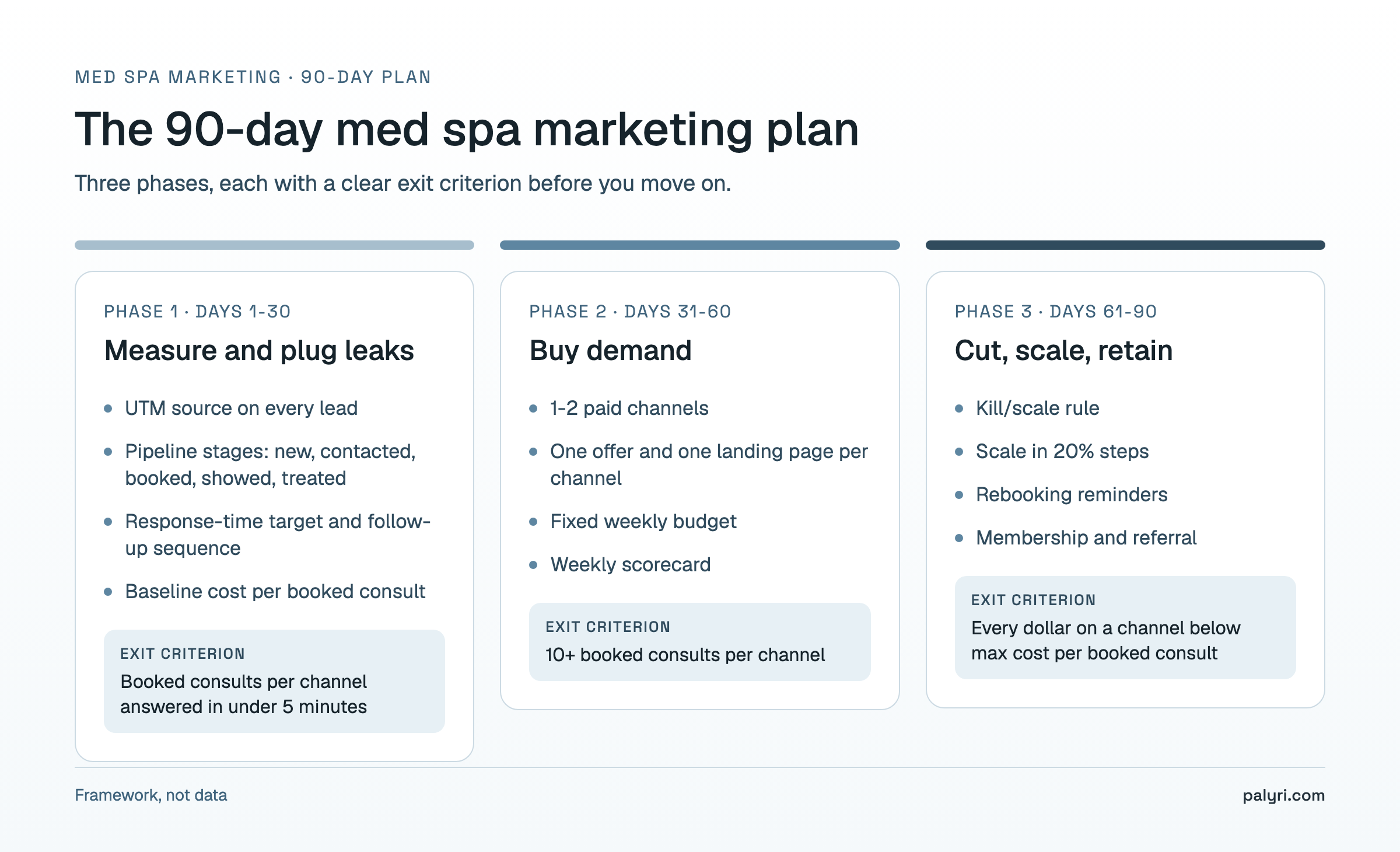
Med spa marketing works when you set the budget from revenue (about 7% on average, within a 2% to 15% range, according to AmSpa's 2024 State of the Industry Report as summarized on AmSpa's site), spend it in a fixed order, and judge every channel by cost per booked consult instead of cost per lead or likes. The 90 days split into three phases: days 1-30 measure and plug leaks, days 31-60 buy demand on one or two paid channels, and days 61-90 cut what does not book and add retention.
Most medical spa marketing advice is a list of channels. A list does not tell you what to do first, how much to spend, or when to stop a campaign. This plan does: a budget table, one scoreboard metric with its formula, a 30-day setup checklist, a kill/scale rule and a weekly scorecard you can copy into a spreadsheet today.
The competition is real. AmSpa describes a medical aesthetics industry that has passed $17 billion in revenue and is growing by more than $1 billion per year. More money flowing into the category means more practices bidding for the same patients, so the practice that measures better spends better.
How much should a med spa spend on marketing?
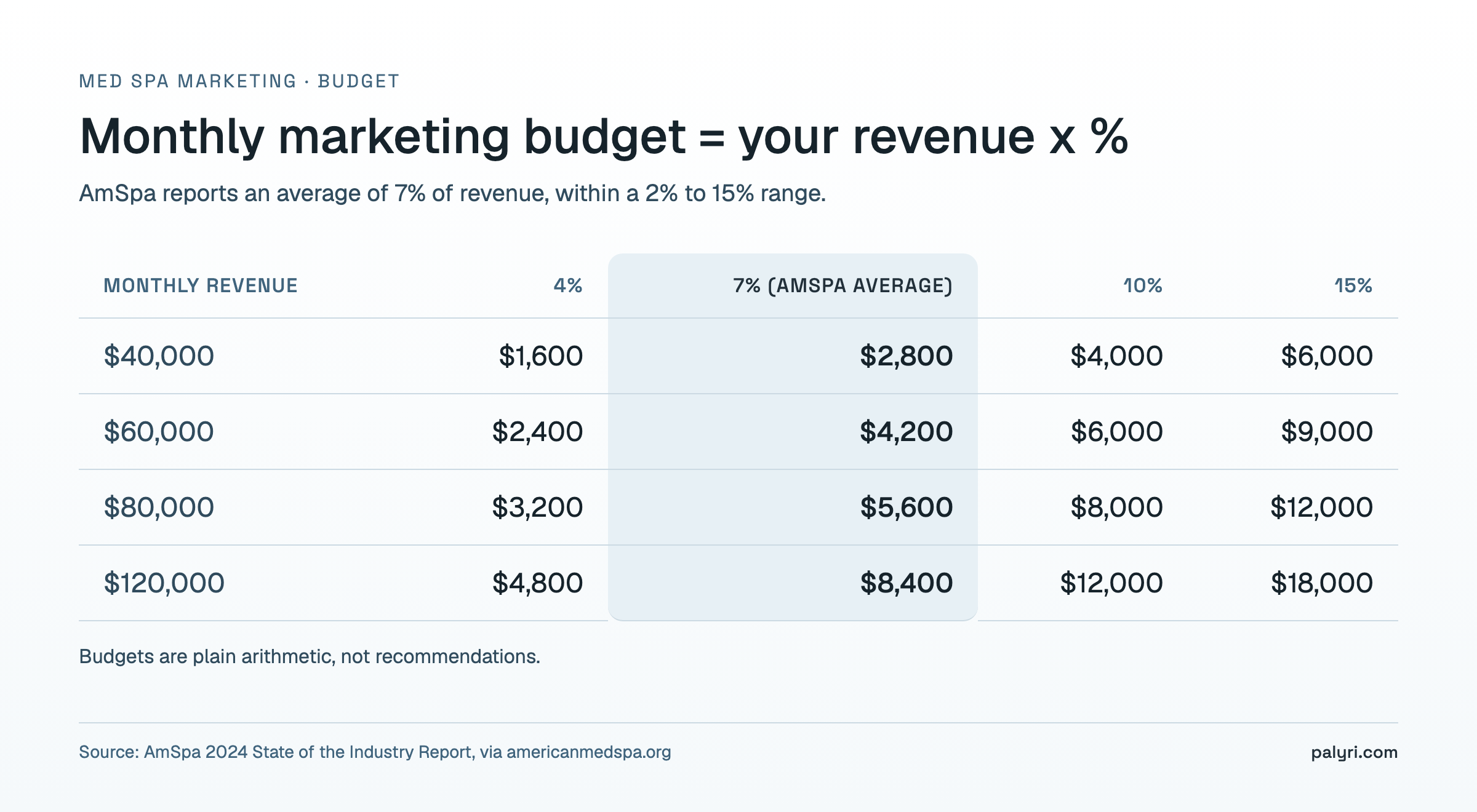
AmSpa's figure is the best public anchor: on average a med spa invests about 7% of revenue in marketing, and budgets range from 2% to 15% depending on the size of the business, local competition and how fast the owner wants to grow (AmSpa). The same article suggests investing at least 7% to 10% of revenue to maintain steady growth.
Where you land inside that range depends on three inputs the AmSpa article uses:
- Average spend per visit. Higher spend per visit means each new patient can carry a higher acquisition cost.
- Patient retention. The share of new patients who return within three to six months for further treatment. Strong retention means a new patient is worth more than one visit.
- Utilization. The share of treatment room and provider capacity booked each week.
Read them together. Low utilization plus good retention means you have empty chairs and patients who come back: that is room to spend toward the top of the range. A full calendar means more ads will mostly create a waitlist. In that case spend on retention, rebooking and pricing, not on more traffic.
The table below is plain arithmetic: your monthly revenue multiplied by a budget percentage. Pick your row, then pick the column that matches your growth goal.
The one number that matters in med spa marketing: cost per booked consult
Leads, clicks and followers are inputs. The output you pay for is a patient in the chair. So the scoreboard metric for every channel is:
Cost per booked consult = channel spend ÷ booked consults from that channel.
One step further down the funnel:
Cost per treated patient = channel spend ÷ patients from that channel who paid for a treatment.
Cost per lead alone misleads, because a cheap lead that never books costs more than an expensive one that does. The cost per lead benchmarks for aesthetic clinics post covers lead costs in detail; this plan uses them only as an early warning, never as the verdict.
To know whether a cost per booked consult is good, compute the most you can afford:
Max affordable cost per booked consult = first-visit gross profit × show rate × show-to-treatment rate.
Example (every number below is an assumption, replace it with your own):
- First-visit revenue: $600
- Product and provider cost: 40%, so first-visit gross profit = $600 × 0.6 = $360
- Show rate: 80%
- Show-to-treatment rate: 50%
- Value of one booked consult on the first visit: $360 × 0.8 × 0.5 = $144
In this example, paying more than $144 per booked consult loses money on visit one. It can still make sense if you count repeat visits, but then you have to measure retention, not assume it. The same logic gives a ceiling of $360 per treated patient on first-visit profit alone.
To lift that ceiling without spending more, work on the conversion step: the consultation to treatment conversion guide covers it. To run the formula with your own prices and rates, use the ROI calculator for aesthetic clinics.
Days 1-30: fix tracking and follow-up before buying more traffic
Spending more before you can measure booked consults per channel just buys data you cannot read. The first month is setup. Use this checklist:
- Source on every lead. Every lead form, landing page and ad link carries UTM parameters or a lead form source, so each lead arrives labeled with its channel and campaign.
- One pipeline with fixed stages. New, contacted, booked, showed, treated. Every lead sits in exactly one stage, and the front desk moves it the same day.
- A response-time target. Write down the target and who owns it during and after business hours. The speed to lead guide for med spas explains why minutes matter.
- A follow-up sequence for non-responders. A fixed number of call and text attempts over a fixed number of days, with written consent on file before the first text.
- Local basics. Google Business Profile complete, current hours, treatment list, photos, and a routine for asking treated patients for reviews. The Google Business Profile audit for aesthetic clinics is a step-by-step check.
- A baseline. Calculate last month's cost per booked consult per channel, even if the data is rough. It is the number days 31-90 have to beat.
- A max affordable number. Run the formula from the previous section with your real prices.
A CRM built for this job makes the checklist hold up under a busy week. Palyri, for example, pulls Meta lead ads and website form leads (with UTM attribution) into one pipeline, and sends a "Schedule" event to Meta when a consult is booked, so Meta can optimize toward bookings instead of form fills. See how it works for med spas and aesthetic clinics.
Exit criterion for phase 1: you can answer "how many booked consults did each channel produce last week?" in under five minutes.
Days 31-60: buy demand on one or two paid channels
With tracking in place, buy demand. Pick one or two channels, not five, so each gets enough budget to produce a readable number of booked consults within the month.
- Meta (Facebook and Instagram) suits visual, impulse-friendly treatments where the patient was not searching yet. Setup, audiences and creative are in the Meta ads guide for med spas.
- Google Search catches patients who are already looking, such as searches for a treatment plus "near me". The break-even bid for Google Ads post turns your max affordable cost into a bid ceiling.
Three rules for this phase:
- One offer per channel. If the offer changes every week, you cannot tell whether the channel or the offer moved the number.
- One landing destination per offer. A lead form or a single page, tagged with the channel source.
- A fixed weekly budget. Divide the month's paid budget from the table above by four and leave it alone until the review.
| Channel | Patient intent | What to measure weekly | When to cut |
|---|---|---|---|
| Meta lead ads | Low to medium: discovers the treatment in the feed | Leads, contact rate, booked consults, show rate | Cost per booked consult above your max for 2 weeks after 10+ bookings |
| Meta traffic to landing page | Medium: clicks through to read | Form completions, booked consults | Same rule; also if form completions stay near zero after 2 weeks |
| Google Search | High: already searching for the treatment | Calls and forms, booked consults, cost per treated patient | Cost per booked consult above your max, or bids above the break-even bid |
| Google Business Profile | High: local search, ready to compare | Calls, direction requests, booked consults tagged "Google profile" | Never cut; improve reviews and photos instead |
Exit criterion for phase 2: each paid channel has at least 10 booked consults, or a clear reason why it never got there.
Days 61-90: cut, scale and add retention
Now the scorecard has enough rows to make decisions. The rule below is a rule of thumb for this plan, not an industry benchmark. Adjust the threshold to your volume.
Why 20% steps: a large jump in budget can change who sees your ads and how the platform's delivery behaves, so the cost you measured at the old budget may not hold. Small steps let the scorecard catch the change within a week.
Retention is the second half of this phase, because the max affordable formula only counts the first visit. Every patient who returns raises what a booked consult is worth, which lets you outbid competitors without losing money. Three levers:
- Rebooking reminders timed to each treatment's natural interval.
- A membership for treatments patients repeat. The membership program guide covers pricing and terms.
- A referral program with a reward tied to a treated patient, not a sign-up. See how to build a referral program.
Exit criterion for phase 3: every marketing dollar sits in a channel that books below your max affordable cost per booked consult, and at least one retention lever is live.
Weekly med spa marketing scorecard (template)
Copy these columns into a spreadsheet. Fill one row per channel per week, every Monday, from the pipeline stages set up in days 1-30.
| Column | What goes in it |
|---|---|
| Week | Week start date |
| Channel | Meta, Google Search, Google profile, referral, email/SMS, organic |
| Spend | Ad spend for the week in USD (organic channels: 0 or staff cost) |
| Leads | New leads tagged with this channel |
| Contacted within target % | Share of leads reached within your response-time target |
| Booked consults | Consults booked from this week's leads |
| Showed | Booked consults who attended |
| Treated | Patients who paid for a treatment |
| Revenue | First-visit revenue from treated patients |
| Cost per booked consult | Spend ÷ booked consults |
| Cost per treated patient | Spend ÷ treated |
| Decision | Hold, scale 20%, cut, or change offer (per the kill/scale rule) |
Two habits make it work. Leads booked late still count for the week they arrived, so update the last two weeks' rows each Monday. And the decision column is filled in the same meeting, so nobody adjusts budgets between reviews on a hunch.
Palyri's statistics view shows spend, leads and revenue per Meta campaign in one place, which covers several of these columns for Meta without manual exports; other channels still go in by hand.
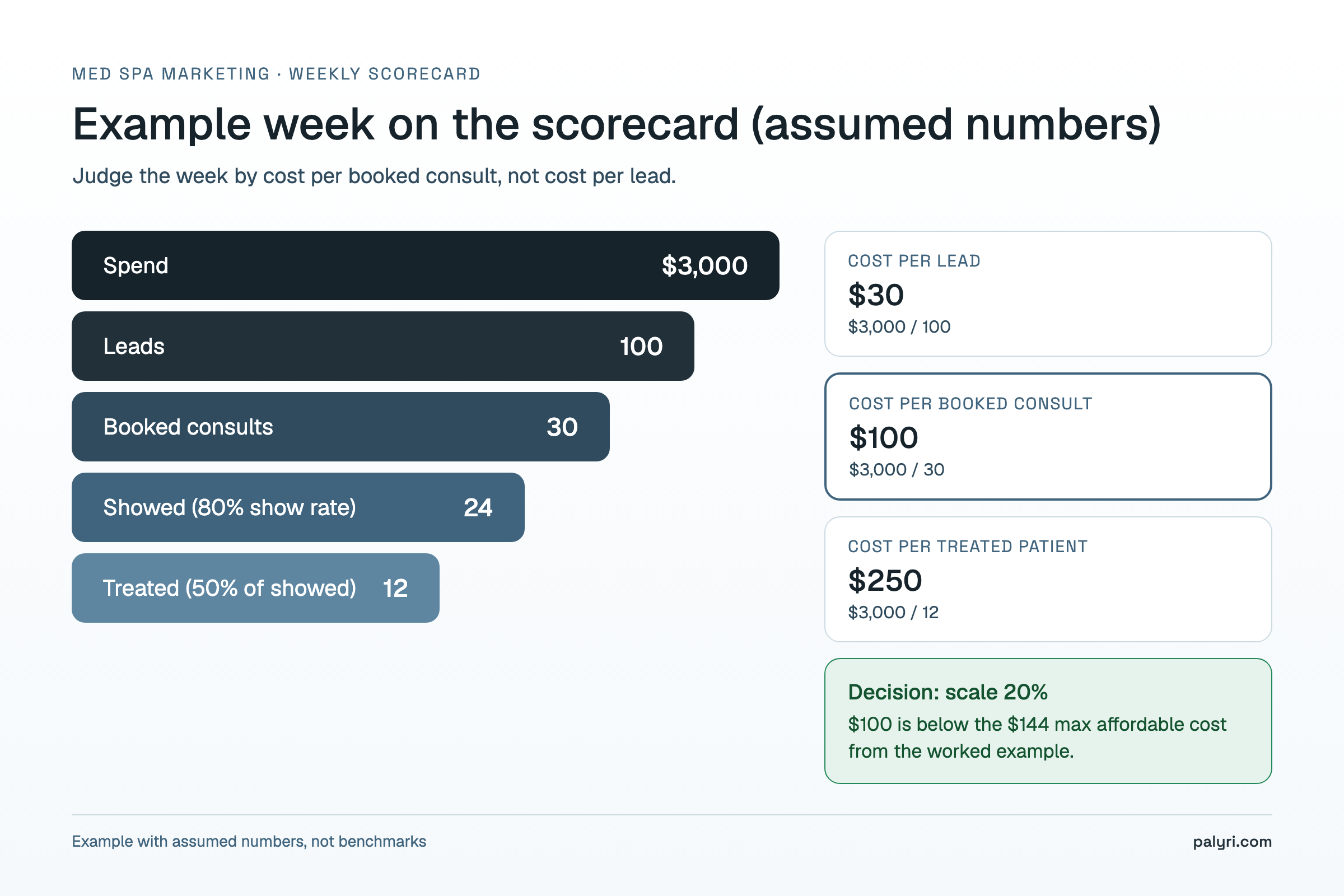
Example reading of the funnel above: $3,000 of spend produced 30 booked consults, so cost per booked consult is $100. That is below the $144 ceiling from the worked example, so the decision is to scale 20% next week. Cost per lead was $30, which on its own says nothing about whether the week made money.
Which med spa marketing channels are worth it in 2026?
Every channel is worth exactly what the scorecard says it is worth in your market. What differs is how fast you can judge it and whether you pay per patient or build an asset.
- Paid (Meta, Google Search). Fastest to read. Pabau, a software vendor, writes that Google Ads can generate bookings within days while SEO and organic social usually take three to six months to show consistent results. That is a vendor view, but the mechanism holds: paid channels give you weekly scorecard rows from day one.
- Local (Google Business Profile, reviews). Low cost, high intent, slow to build. Track it as its own channel.
- Owned (email and SMS list). Your cheapest repeat bookings. The email marketing guide for aesthetic clinics covers automation.
- Referral. Tied to treated patients, so cost per treated patient is known in advance.
- AEO and FAQ content. AmSpa's 2026 marketing plan guide recommends making answer engine optimization (being the answer AI assistants and search features quote) a top priority, calling it fast becoming the biggest factor in digital visibility. Treat it like SEO: a months-long asset, measured by booked consults tagged "organic".
The split between paid and retention spend follows from the worked example. If a booked consult is worth $144 on the first visit and the same patient returns once with the same gross profit, the booking is worth twice as much.
That gap is why days 61-90 add retention before adding a third paid channel. When you are ready to put the whole pipeline in one system, Palyri pricing is public.
FAQ
How much should a med spa spend on marketing?
On average, about 7% of revenue, according to AmSpa's 2024 State of the Industry Report as summarized on AmSpa's site. Budgets range from 2% to 15%, depending on the size of the business, local competition and the growth goal. A practice with $60,000 in monthly revenue would spend $4,200 a month at 7%. Move toward the top of the range when utilization is low and patients return; move down when the calendar is already full and put the difference into retention. Then judge the spend by cost per booked consult, not by the percentage.
How long does med spa marketing take to work?
It depends on the channel. Paid search and Meta ads produce leads within the first week, so you can judge them within a few weeks, once each channel has around 10 booked consults on the scorecard. Pabau, a software vendor, puts SEO and organic social at three to six months to show consistent results. That is why this plan spends the first 30 days on tracking: without it, even fast channels cannot be judged, and slow channels look like failures before they have had time to work.
What is a good cost per booked consult for a med spa?
There is no universal good number, because it depends on your prices, costs and conversion rates. Compute your own ceiling: first-visit gross profit × show rate × show-to-treatment rate. In the worked example above ($360 gross profit, 80% show rate, 50% treatment rate), the ceiling is $144 per booked consult on the first visit. Anything below your ceiling is profitable on visit one; anything above it needs proven repeat visits to pay off. The ROI calculator runs the same math with your inputs.
What KPIs should a med spa track weekly?
Per channel: spend, leads, share contacted within your response-time target, booked consults, shows, treated patients, first-visit revenue, cost per booked consult and cost per treated patient. The scorecard template above lists every column. Add a decision column so each weekly review ends with hold, scale, cut or change offer. For a wider set of practice metrics beyond marketing, such as rebooking and provider utilization, see the 10 KPIs for aesthetic clinics.
Should a new med spa spend more on marketing?
Often yes, but the reason matters more than the percentage. The AmSpa article ties spend to business size, competition and the desire for growth, and a new practice usually has low utilization: empty chairs that a booked consult can fill. Use the higher columns of the budget table only after tracking is in place, and keep the kill/scale rule. Spending heavily before you can count booked consults per channel is how new practices burn their launch budget.
Is cost per lead a good metric for med spa marketing?
Not on its own. Cost per lead tells you how cheaply a channel produces names, not how many of them book, show and pay. In the example scorecard week, a $30 cost per lead turned into a $100 cost per booked consult and a $250 cost per treated patient. Use cost per lead as an early warning inside a channel, and decide budgets on cost per booked consult. The cost per lead benchmarks post explains where lead costs fit.
Want to implement this in your clinic?
Book a free Palyri demo. We'll show how it works on your clinic's data.
Book a demoPalyri blog author
Writes for the Palyri blog about getting clients from ads, handling leads and front-desk work in aesthetic clinics and beauty salons.