A med spa can charge a no-show fee when the patient agreed to a written policy (the notice window, the amount and how it will be charged) before booking, and the practice keeps a record of that agreement. The setup is a notice window, often 24 to 48 hours, backed by either a deposit taken at booking or a card on file that is charged only if the policy is broken.
This post covers the policy and the enforcement side: the template, the card-on-file wording, the staff scripts and the evidence you need if a patient disputes the charge. For cutting missed appointments in the first place, read how to reduce no-shows at your aesthetic clinic first.
What is a fair no-show fee for a med spa?
There is no single correct number. A fair no-show fee is one the patient saw before booking, that is proportionate to what the empty slot cost you, and that you apply the same way every time. Practices typically pick one of three structures:
- Flat fee. One amount per appointment type. Easy to explain and enforce.
- Percentage of the service. Scales with the ticket. Harder to explain at the front desk.
- Deposit forfeited. Paid at booking; kept instead of applied after a no-show or late cancellation.
Set the window and charge per treatment tier: long, high-cost appointments that are hard to refill justify a longer window and a deposit. As one reference point, Pabau's treatment-tier matrix suggests 24 hours' notice for consultations and neurotoxin, 48 hours for filler and lasers, and 72 hours for body contouring. That is one vendor's suggestion, not an industry standard.
| Treatment tier | Notice window (starting point to adapt) | Charge method | Why |
|---|---|---|---|
| Consultation | 24 hours | Card on file, flat fee | Short slot, low ticket, deposit adds friction for new leads |
| Neurotoxin | 24 hours | Card on file, flat fee | Short appointment, returning patients, easier to refill |
| Filler | 48 hours | Deposit applied to treatment | Longer slot, higher ticket, product may be prepared |
| Laser / device | 48 hours | Deposit applied to treatment | Device and room blocked, hard to refill same day |
| Body contouring / packages | 72 hours | Deposit, transferable once | Longest slots, package scheduling |
Deposit or card on file: which should a med spa use?
Use a deposit for high-ticket and first-time patients, and a card on file for consults and returning neurotoxin patients. The difference is timing. A deposit is money taken at booking and applied to the treatment, so when a patient no-shows, the money is already in your account. A card on file is charged only after the policy is broken, so collection happens after the miss, and that is exactly where declines and disputes start.
The trade-off: a deposit adds friction at booking, while a card on file adds dispute exposure later.
Example (assumed prices, not real data): a 60-minute filler appointment priced at $700. The patient no-shows.
- With a $100 deposit collected at booking: $100 is already in hand. Nothing to chase, no new charge for the patient to dispute.
- With a card on file and a 50% no-show fee: $700 × 0.50 = $350, attempted after the fact. The card may decline. If the patient disputes it, Stripe notes that disputes incur a dispute fee that still applies if you accept the dispute, so a lost or conceded $350 charge costs you the fee on top of the empty slot.
To see what an empty chair actually costs your schedule over a month, estimate what empty chair time costs you with the ROI calculator.
Med spa cancellation policy template (copy and paste)
Replace everything in [brackets]. Keep the deadline wording exact: "48 hours before your scheduled start time" is clear; "two days' notice" invites arguments about weekends.
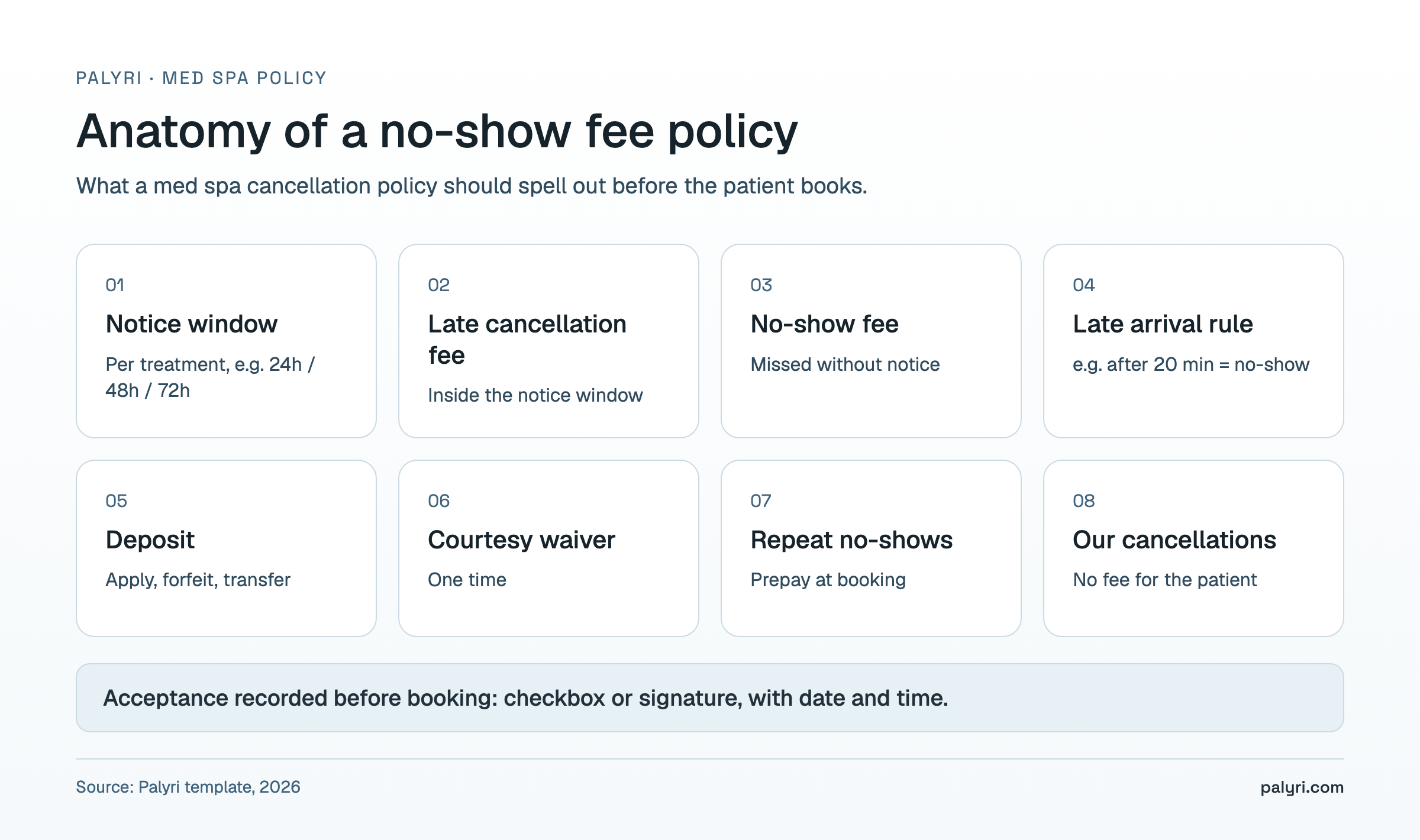
1. Notice window. We reserve time, staff and product for every appointment. Please give at least [24] hours' notice for consultations and neurotoxin, [48] hours for filler and laser treatments, and [72] hours for body treatments and package sessions. Notice is counted from your scheduled start time.
2. Late cancellation. Cancelling or rescheduling inside the notice window results in a late cancellation fee of [$__ / __% of the booked service].
3. No-show. Missing your appointment without notice results in a no-show fee of [$__ / __% of the booked service].
4. Late arrival. If you arrive more than [15] minutes late, we may shorten or reschedule your treatment. Arrivals after [20] minutes are treated as a no-show.
5. Deposits. [Treatments] require a deposit of [$__] at booking. The deposit is applied to your treatment. It is forfeited for a no-show or late cancellation, and may be moved once to a new date if you give notice within the window.
6. Courtesy waiver. We waive the fee once per [12 months] for a first late cancellation or no-show. Medical emergencies are reviewed case by case.
7. Repeat no-shows. After [two] no-shows, future appointments require full prepayment at booking.
8. Our cancellations. If we cancel or reschedule your appointment, no fee applies and any deposit is refunded or moved to your new date, your choice.
9. Packages and memberships. A no-show or late cancellation on a package or membership session counts as a used session [or: incurs the fee above instead].
10. How to cancel. Call [phone], text [number] or use [online booking link]. Your cancellation time is the time we receive your message.
Acceptance. By booking, I confirm I have read and agree to this cancellation and no-show policy.
Short version for the booking confirmation or text (under 160 characters):
Reminder: changes need [48] hrs notice. Late cancel or no-show: [$__] fee charged to card on file. Reply or call [phone] to reschedule.
Show the full policy inside the booking flow itself, right above the confirm button, not on a separate page the patient never opens. If you are setting that up, our guide on showing the policy inside online booking covers where it fits.
Card on file authorization: wording that holds up
The card-on-file authorization is the separate consent that lets you charge a patient later without them present. Keep it as its own checkbox or signature line, not a sentence buried in intake.
Stripe's documentation on saving a customer's payment method lists what your terms must include before you charge a customer who is offline:
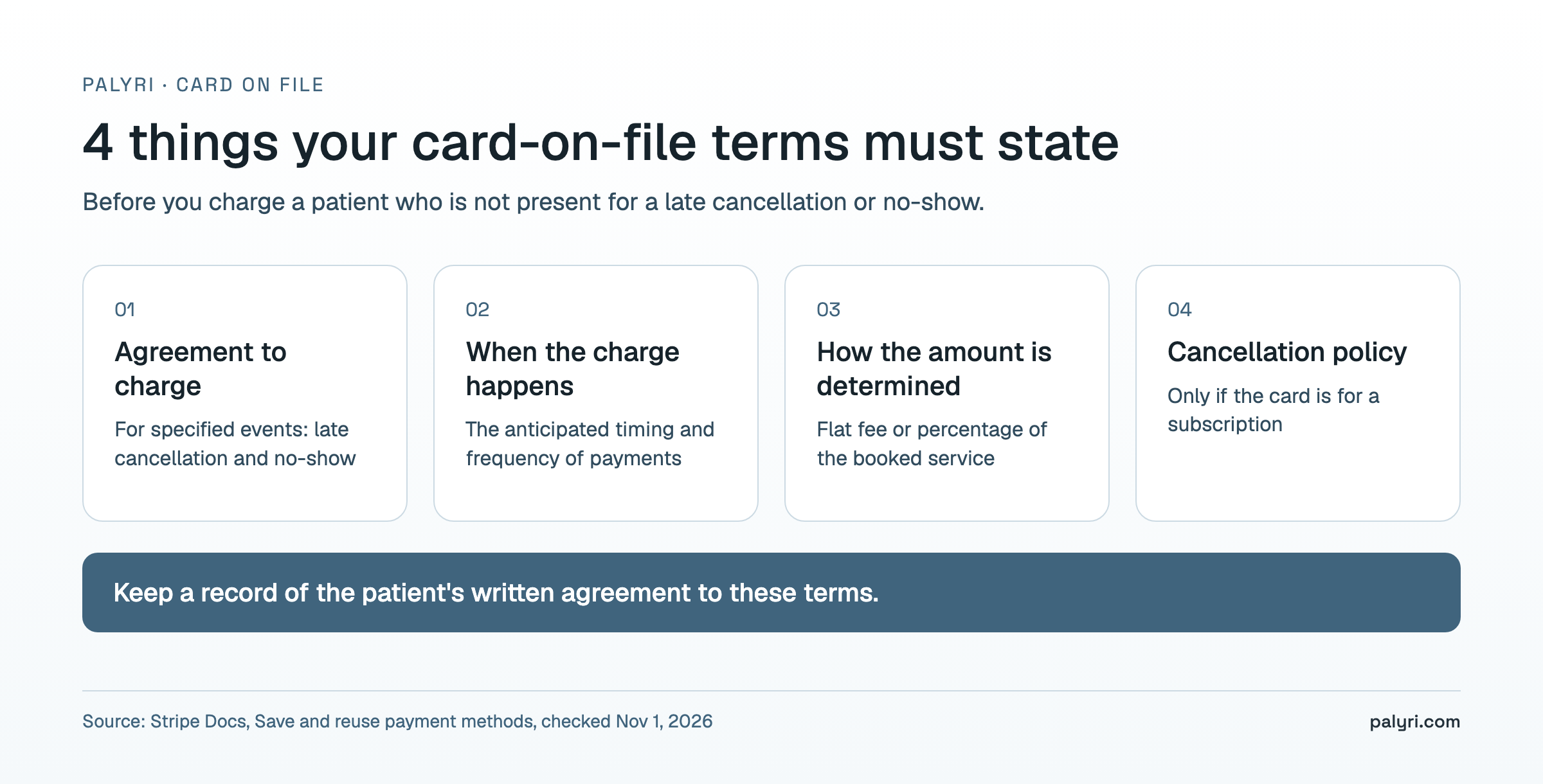
- The customer's agreement to you initiating a payment, or a series of payments, on their behalf for specified transactions (here: late cancellation and no-show).
- The anticipated timing and frequency of those payments (when the charge happens).
- How the payment amount is determined.
- For subscriptions only, your cancellation policy.
The same page says to keep a record of the customer's written agreement to those terms, that a saved payment method may only be used for the specific use stated in your terms, and that when saving payment details you are responsible for complying with all applicable laws, regulations and network rules. Other processors have their own rules; read yours too.
Never write card numbers or CVV codes in notes, texts, emails or spreadsheets. Use your processor's or booking system's card-on-file flow, which stores the card on its side.
How to enforce a no-show fee without losing the patient
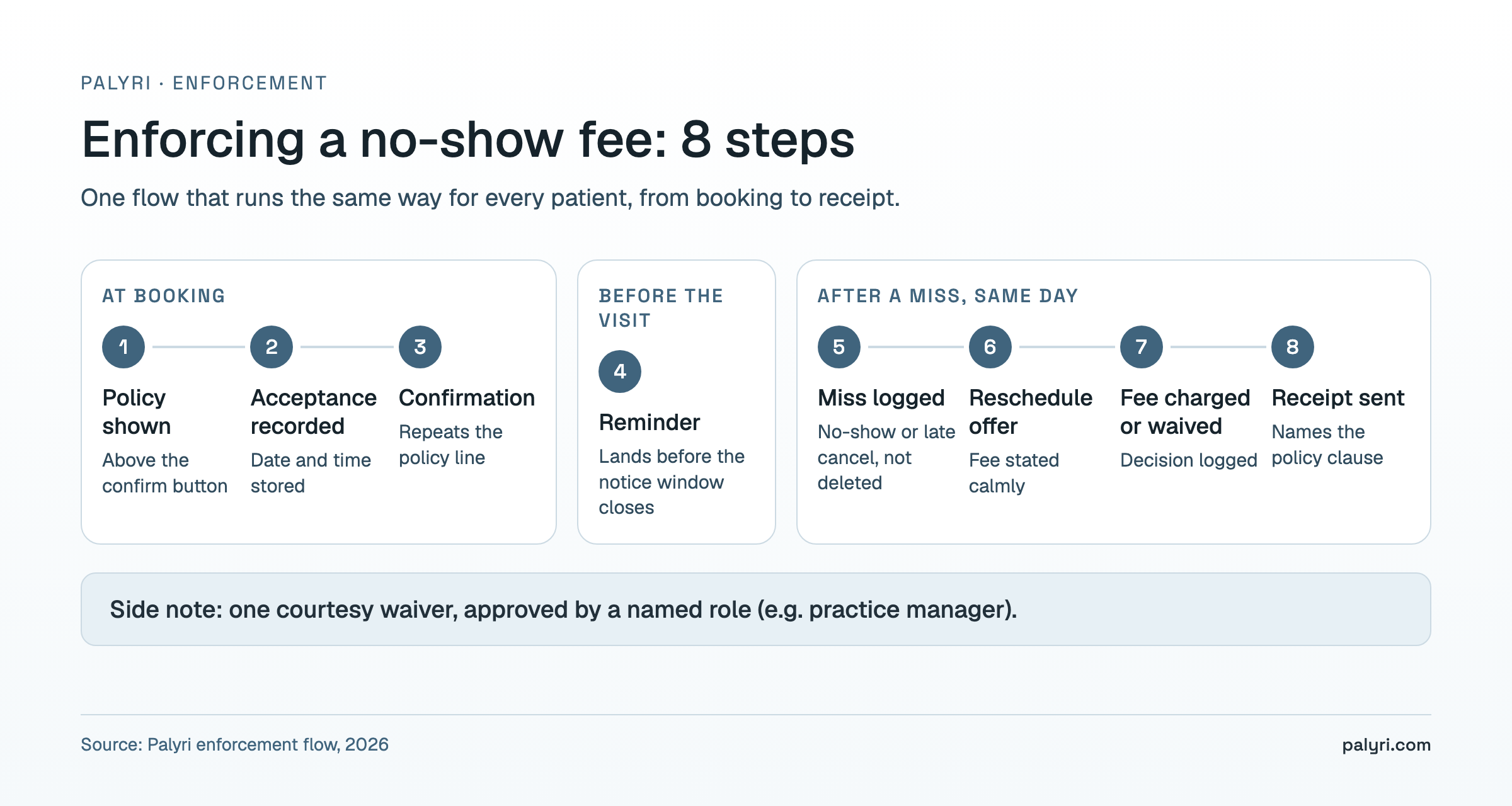
Enforcement fails when the front desk waives fees for favorites or the fee arrives as a surprise. Fix both with one flow that runs the same way for every patient.
| Step | When | What happens |
|---|---|---|
| 1. Policy shown | At booking | Full policy above the confirm button |
| 2. Acceptance recorded | At booking | Checkbox or signature, with date and time stored |
| 3. Confirmation | Right after booking | Short policy line repeated in the confirmation |
| 4. Reminder | Before the notice window closes | Reminder repeats the deadline and the fee |
| 5. Miss logged | Same day | Marked as no-show or late cancel, not deleted |
| 6. Same-day message | Same day | Offer to reschedule, state the fee calmly |
| 7. Fee charged | Per your policy timing | Charged or waived, decision logged |
| 8. Receipt sent | With the charge | Receipt names the policy clause |
Step 4 matters most: the reminder must land before the window closes. A patient who tried to cancel by phone and got no answer can credibly say "I did call", so a missed call text back setup protects the policy as much as the schedule.
Waivers. Keep a waiver log: patient, date, reason, approved by (a named role, such as practice manager). Consistency means the same facts get the same outcome. A first miss with a real reason gets the courtesy waiver; a second miss gets the fee.
Staff scripts.
- First miss, waived (text): "Hi [Name], we missed you today at [time]. We've waived the no-show fee this once. Want us to find you a new time this week?"
- Second miss, charged (text): "Hi [Name], we missed you at your [time] appointment today. Per the cancellation policy you accepted on [date], the [$__] no-show fee has been charged to your card on file. Your receipt is attached. Reply here to rebook."
- Patient pushes back (phone): "I understand. The policy you agreed to when booking says [read the clause]. We already used the one-time courtesy waiver on [date], so I'm not able to remove it, but I can get you on the schedule [day]."
- Medical or family emergency (phone): "I'm sorry to hear that. I'll note it for the practice manager, who reviews emergencies, and you'll hear back by [day]. Let's get you rebooked for when you're ready."
Every freed slot is also a slot to refill. A fast response to new inquiries is how you fill it on short notice; see how to refill a freed slot fast from new leads.
Before charging anyone, know who actually misses. Palyri records a showed or no-show outcome for each lead and visit, counts no-shows in its reports and computes show rate from completed appointments in the Clinic Pulse digest, so you can track booked, showed and no-show outcomes per patient and spot repeat no-shows. The fee itself is charged in your booking or payment system, not in Palyri.
What to keep if a patient disputes the no-show fee
If a patient disputes the charge with their bank, you respond with evidence through your processor. Stripe's dispute evidence best practices recommend presenting evidence chronologically, uploading only the relevant cancellation policy section with the violated details emphasized (not your entire terms and conditions), and including a clean screenshot of how the policy was presented at checkout. A signed document and any receipt or message notifying the patient of the charge belong in the pack too.
| Evidence item | What it proves | Where it comes from |
|---|---|---|
| Booking record with date and time | When the appointment was made and for what | Booking system |
| Accepted policy and card authorization | Patient agreed before the visit | Booking system or signed intake form |
| Screenshot of the booking screen | How the policy was shown at checkout | Your booking flow, captured once per policy version |
| Highlighted policy clause | Which rule the patient broke | Your policy document |
| Confirmation and reminder messages | Patient was told the deadline again | Messaging log |
| No-show entry | The appointment was missed, not cancelled | Schedule or CRM |
| Receipt or charge notice | Patient was informed of the charge | Payment processor |
Save a dated screenshot every time you change the policy or the booking screen.
Prevention still beats winning. Stripe notes that card networks count disputes received, not won, and that overturning a disputed payment is very difficult even in favorable cases. Clear disclosure and a timely reminder keep a charge from becoming a dispute.
Is a no-show fee legal? What to check with your attorney
This section is not legal advice. In general, a no-show fee rests on contract and disclosure: the patient agreed to a clear policy before booking. Whether a specific amount and wording hold up depends on your state, because state consumer protection and contract law vary. Ask your attorney whether your fee could be treated as a penalty rather than a reasonable estimate of your loss. Have an attorney review your amounts and wording for your state before you publish them.
Two primary-source points are worth knowing:
- The FTC's fee rule does not target med spas. The FTC announced on December 17, 2024 a rule banning junk ticket and hotel fees, covering the live-event ticketing and short-term lodging industries. Its core requirement, clearly and conspicuously disclosing the true total price, is still a good habit: state the fee before the patient books, not after.
- Your processor puts compliance on you. Stripe's save-and-reuse documentation states that when you save payment details, you are responsible for complying with all applicable laws, regulations and network rules.
- Are our fee amounts a reasonable estimate of our loss under our state's law, or could they be read as a penalty?
- Does our state require specific disclosure wording, font size or placement for cancellation fees?
- How should the fee be labeled on receipts, and must it be kept separate from any insurance billing?
- Is our card-on-file authorization enough to charge a fee without the patient present?
- How should deposits be handled on refunds, transfers and practice-initiated cancellations?
- Do package and membership terms need their own cancellation language?
FAQ
Is it legal for a med spa to charge a no-show fee?
Generally a no-show fee is treated as a contract term: the patient agreed to a disclosed policy before booking. Whether your specific amount and wording are enforceable depends on state consumer protection and contract law, which varies, so have an attorney review it. The FTC's December 17, 2024 junk fee rule covers live-event tickets and short-term lodging, not med spas, but its principle of disclosing the full price upfront is the safe habit. Show the policy at booking and record acceptance with a date and time.
How much should a no-show fee be?
There is no universal number. Set it per treatment tier so it reflects what the empty slot cost you: a flat fee for short consults and neurotoxin appointments, a deposit or percentage for long filler, laser and body appointments. Keep it proportionate, and ask your attorney whether the amount is defensible under your state's law. Estimating what empty chair time costs you gives you a defensible basis.
Is a deposit the same as a cancellation fee?
No. A deposit is collected at booking and applied to the treatment; under your policy it is forfeited only if the patient no-shows or cancels late. A cancellation fee is charged after the fact, usually to a card on file. The fee depends on the card working and the patient not disputing it, and Stripe notes a dispute fee applies even if you accept the dispute.
Can you charge a no-show fee without a card on file?
You can send an invoice for the fee, but collecting it then depends on the patient choosing to pay. Stripe's save-and-reuse docs list what the terms must state before you charge a customer who is offline, including the specified transactions, when the charge happens and how the amount is set, and say to keep a record of the written agreement.
Should you waive a patient's first no-show?
A single courtesy waiver per year is a sensible rule, provided it is written into the policy and logged. Record the patient, date, reason and who approved it. On the second miss, charge the fee and offer a new time in the same message. Pair the policy with reminders from how to reduce no-shows at your aesthetic clinic so fewer patients reach that point.
Can a patient dispute a no-show fee with their bank?
Yes. Any card charge can be disputed. Your response is the evidence pack described in Stripe's dispute evidence best practices: timeline, highlighted policy clause, booking screenshot, signed authorization and charge receipt. Card networks count disputes received rather than won, so preventing them with clear disclosure and a reminder before the deadline matters more than winning them.
Want to implement this in your clinic?
Book a free Palyri demo. We'll show how it works on your clinic's data.
Book a demoPalyri blog author
Writes for the Palyri blog about getting clients from ads, handling leads and front-desk work in aesthetic clinics and beauty salons.