Med spa advertising money mostly goes to two channels, Google Search and Meta (Facebook and Instagram), and US benchmarks put a search lead at a median $39.25 and a Meta lead-ad lead at $51.42 for beauty and personal care businesses. Before you spend, track every lead from ad to booked and showed consult, because cost per lead alone hides which channel actually fills your chairs.
Below: the paid channels side by side with sourced unit costs, the arithmetic from click to showed consult, and a checklist of what every lead record needs before the first dollar goes out. For a month-by-month plan and budget split, see the 90-day med spa marketing plan.
How much does med spa advertising cost?
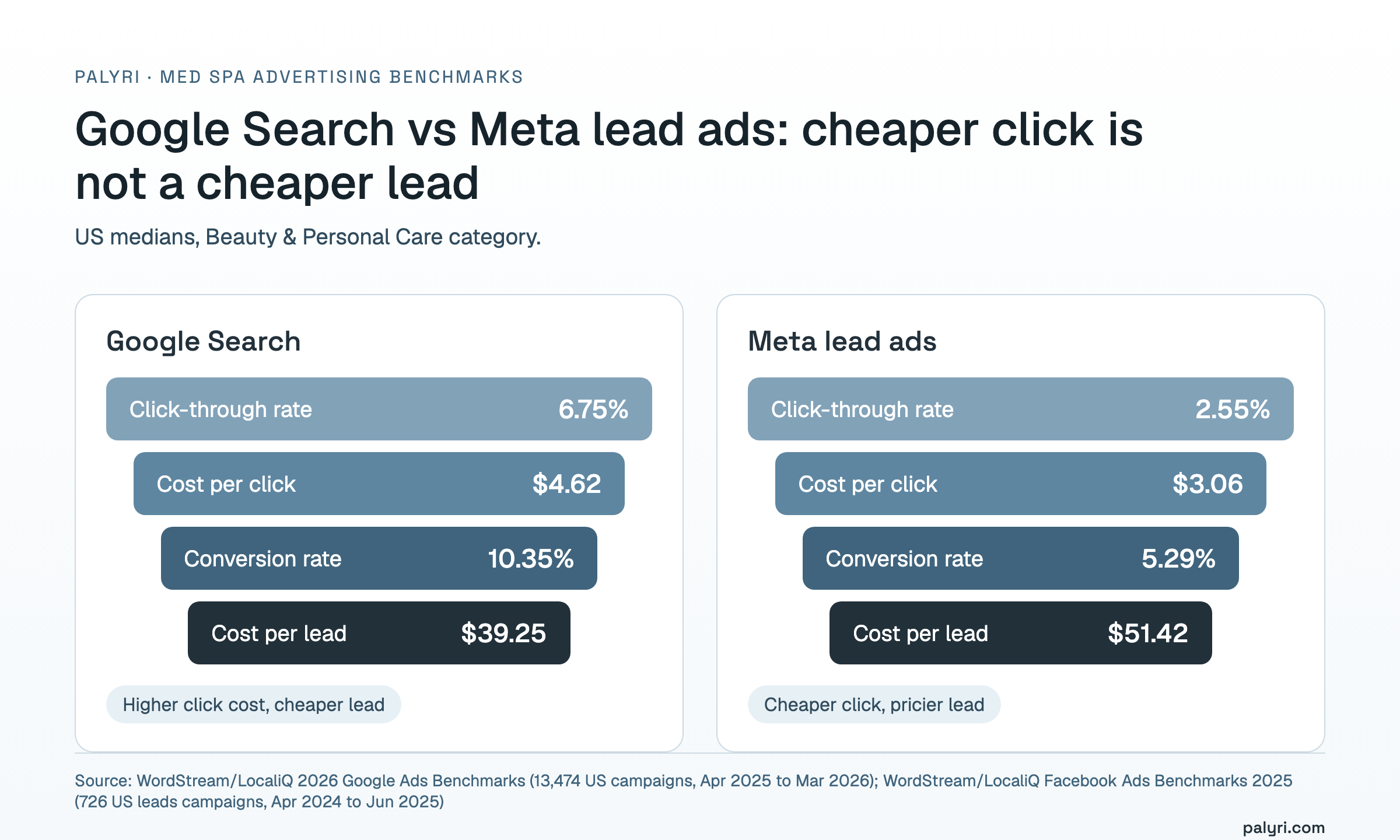
The most current public benchmarks come from WordStream by LocaliQ. Its 2026 Google Ads report is based on 13,474 US search campaigns that ran between April 2025 and March 2026, and every "average" in it is a median. For Beauty & Personal Care, the median cost per click was $4.62 and the median cost per lead was $39.25. Across all industries, the same report puts CPC at $5.42 and cost per lead at $66.69.
On Meta, the Facebook Ads Benchmarks 2025 report used 726 US campaigns with a leads objective, running April 2024 to June 2025, also reported as medians. Beauty & Personal Care leads campaigns had a median CPC of $3.06 and a median cost per lead of $51.42. The all-industry leads CPL was $27.66, so beauty sits well above the average on Meta.
Sources: WordStream 2026 Google Ads Benchmarks (Beauty & Personal Care, Apr 2025 to Mar 2026); WordStream Facebook Ads Benchmarks 2025 (Beauty & Personal Care, leads objective, Apr 2024 to Jun 2025).
Two caveats before you use these numbers. First, "Beauty & Personal Care" is broader than med spas: it includes salons and other personal care businesses whose offers are cheaper and simpler to sell than injectables or laser packages. Treat the figures as a floor check, not a target. Second, the direction matters. Google costs for the category fell: CPC dropped 18.95% and cost per lead dropped 34.95% year over year, while conversion rate rose 32.34% (WordStream, 2026). On Meta, the category's CPC rose 32% year over year (WordStream, 2025).
Nearby Meta categories: Physicians & Surgeons had a leads CPL of $47.47, Health & Fitness $52.98, and Dentists & Dental Services $76.71 (WordStream, 2025). For deeper CPL and CPA benchmark detail by treatment and channel, see our cost per lead benchmarks for aesthetic clinics.
Med spa advertising channels compared: Google, Meta, video and local
Each paid channel catches a patient at a different moment. The table and infographic below show the trade-off in unit costs; the notes after them cover the channels with no reliable public benchmark.
| Channel | Patient intent | Benchmark (Beauty & Personal Care) | Best use |
|---|---|---|---|
| Google Search | High: already searching for a treatment | CTR 6.75%, CPC $4.62, CVR 10.35%, CPL $39.25 | Capture existing demand ("lip filler near me") |
| Meta lead ads | Low to medium: interrupted while scrolling | CTR 2.55%, CPC $3.06, CVR 5.29%, CPL $51.42 | Create demand with offers and visuals |
| Meta traffic campaigns | Low | CTR 1.81%, CPC $0.74 | Retargeting and awareness, not lead generation |
| YouTube, TikTok | Low | No sourced med spa benchmark | Test after Search and Meta are tracked |
| Local Services Ads | High | No sourced benchmark; eligibility varies | Check availability in your own Google Ads account |
Sources: WordStream 2026 Google Ads Benchmarks, mirrored by LocaliQ Search Advertising Benchmarks; WordStream Facebook Ads Benchmarks 2025.
Google Search is where patients type the treatment and their city. Clicks cost more, but more of them convert: the category's median conversion rate of 10.35% is the main reason its cost per lead lands lower than Meta's.
Meta lead ads buy cheaper clicks and almost unlimited reach, but the median conversion rate is about half of Search. The leads are often colder: someone tapped a form on Instagram, not someone researching a provider. That means more follow-up work per booked consult. Whether to send Meta traffic to an instant form or your own page is its own decision, covered in Facebook lead ads vs landing pages.
Meta traffic campaigns show a median CPC of only $0.74 for the category, but they optimize for clicks, not leads. Use them to retarget site visitors or warm up an audience, and judge them on assisted bookings, not on cost per click.
YouTube, TikTok and Local Services Ads have no public, sourced cost benchmarks for med spas that we could verify. Treat them as tests that come after Search and Meta are measured end to end. If you cannot yet say what a booked consult from Google costs you, adding a third channel only adds noise.
Google Ads vs Facebook ads for med spas: which is cheaper per booked consult?
A cheaper click does not mean a cheaper patient. What you pay for is a showed consult, and that depends on cost per lead multiplied through your booking and show rates. Here is the arithmetic using the benchmark CPLs.
Example (assumed inputs, not a benchmark): spend $2,500 a month on each channel. Assume 30% of leads book a consult and 80% of booked patients show, and hold both rates equal across channels so the only variable is cost per lead.
- Google Search: $2,500 / $39.25 = about 64 leads. Cost per booked consult = $39.25 / 0.30 = $130.83. Cost per showed consult = $130.83 / 0.80 = $163.54.
- Meta lead ads: $2,500 / $51.42 = about 49 leads. Cost per booked consult = $51.42 / 0.30 = $171.40. Cost per showed consult = $171.40 / 0.80 = $214.25.
| Example metric | Google Search | Meta lead ads |
|---|---|---|
| Cost per lead (benchmark median) | $39.25 | $51.42 |
| Leads per $2,500 | about 64 | about 49 |
| Cost per booked consult (30% book, assumed) | $130.83 | $171.40 |
| Cost per showed consult (80% show, assumed) | $163.54 | $214.25 |
The catch is the assumption. Booking rates can differ by channel, because a searcher who called about a specific treatment is closer to booking than someone who tapped an Instagram form. If your Meta leads book at a lower rate than your Google leads, the gap above widens. If your team follows up Meta leads within minutes and books them at a similar rate, the gap narrows. Only your own data settles it.
That is why the right comparison is cost per showed consult per channel, measured in your own pipeline. To set a maximum bid from your own numbers, use the method in how to find your break-even Google Ads bid, and run your own numbers in the ROI calculator.
What is a good cost per lead for a med spa?
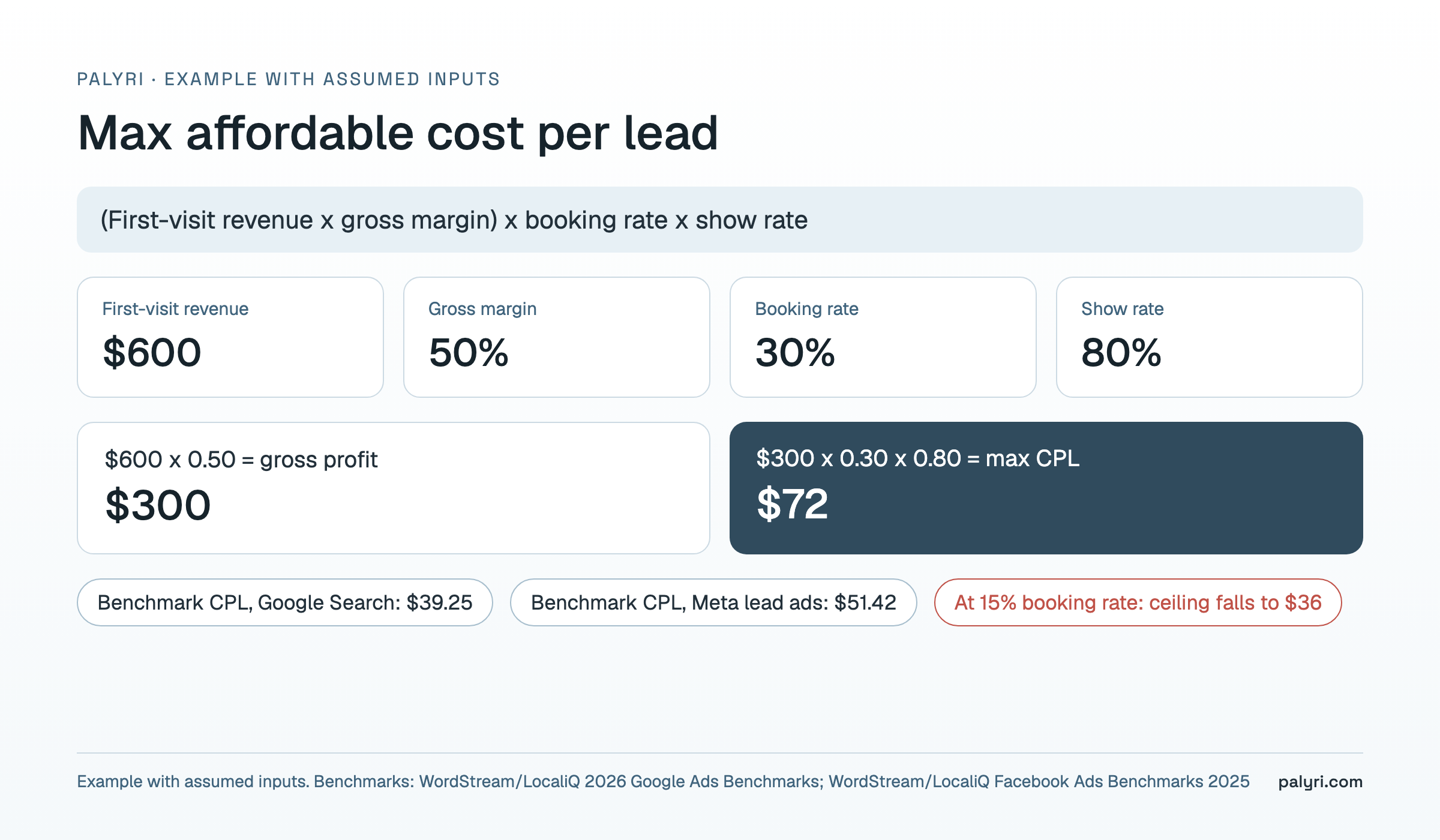
A good cost per lead is one your treatment economics can carry. The benchmark tells you whether your CPL is unusual; your margin and conversion rates tell you whether it is affordable. The break-even formula:
Max affordable CPL = (average first-visit revenue x gross margin) x booking rate x show rate
This assumes a showed patient buys on the first visit and ignores repeat visits, so it is a conservative ceiling. If your patients typically return, you can justify a higher CPL, but only once you have tracked that repeat revenue back to the original ad.
Example (assumed inputs): average first-visit revenue $600, gross margin 50%, booking rate 30%, show rate 80%.
- Gross profit per first visit: $600 x 0.50 = $300
- Max affordable CPL: $300 x 0.30 x 0.80 = $72
Under these assumptions, a $39.25 Google lead or a $51.42 Meta lead both fit, with room to spare. Change the booking rate to 15% and the ceiling drops to $36, below both benchmarks. That is the point of the formula: booking rate moves the answer more than ad costs do.
For CPL ranges by treatment and how they compare across channels, see our cost per lead benchmarks for aesthetic clinics.
What to track before you spend a dollar on med spa ads
Every calculation above depends on one thing: each lead record carrying its source and its outcome. If your leads arrive in three inboxes and outcomes live in the front desk's memory, you will end up judging channels on cost per lead alone. Set up these fields first.
| Field on every lead | Why it matters | Where it comes from |
|---|---|---|
| Source channel | Separates Google, Meta, organic and referral leads | UTM source or lead-ad integration |
| Campaign | Shows which offer or treatment campaign pays | UTM campaign or ad platform campaign name |
| Ad set / ad group | Shows which audience or keyword theme pays | Ad platform IDs passed with the lead |
| Ad ID | Lets you compare creatives on cost per booking, not clicks | Meta lead ads payload or URL parameter |
| UTM parameters on every landing URL | Without them, website leads show up as "direct" | Your ad URLs (source, medium, campaign, content) |
| Lead timestamp | Needed to measure response time and day-of-week patterns | Form or CRM, automatic |
| First response time | Slow follow-up lowers booking rate on any channel | CRM: time of first call or text |
| Booked (yes/no + date) | Turns cost per lead into cost per booked consult | Front desk or booking system |
| Showed (yes/no) | Turns cost per booked into cost per showed consult | Front desk after the appointment |
| Treatment purchased | Shows which channel brings high-value treatments | Visit outcome |
| Revenue | Feeds the max affordable CPL and return on ad spend | Point of sale or visit outcome |
Four setup items sit around the checklist:
- Call tracking for search. Many Google searchers call instead of filling a form. Without tracked numbers, those leads disappear from your channel report.
- One pipeline for every lead type. Web form leads, Meta lead-ad leads and phone leads should land in the same list with the same fields, or your cost per booked consult will be wrong for every channel.
- Send booked consults back to Meta. If Meta only sees form fills, it optimizes for people who fill forms. Passing booked consults back teaches it to find people who book; the setup is in send booked consults to Meta with the Conversions API.
- Measure response speed. The booking rate in every formula above depends on how fast someone answers. See why the first 5 minutes matter for med spa leads.
How to read med spa ad results in the first 30 days
In the first month, look at each channel weekly on the same six numbers: spend, leads, cost per lead, booked consults, cost per booked consult and showed consults. Early weeks have small counts, so read trends rather than single days.
Turn those into decisions:
- CPL far above benchmark, booking rate normal: the ad or targeting is the problem. Change creative, offer or keywords before adding budget.
- CPL near benchmark, booking rate low: the follow-up is the problem. Check first response time and who calls the leads before touching the ads.
- Cost per booked consult below treatment gross profit: the channel is paying for itself on first visits. This is the condition for scaling spend.
- Cost per booked consult above treatment gross profit: cut spend on that campaign or move it to a higher-margin treatment.
For campaign structure and creative on Meta, use the complete Meta ads guide for aesthetic clinics. For how ads fit with the rest of your marketing over a quarter, the 90-day med spa marketing plan has the weekly scorecard and phase plan.
How a CRM connects ad spend to booked consults
The tracking checklist only works if lead source and visit outcome sit in the same record. Attribution usually breaks in the gaps between ad platform, inbox and front desk.
You can see how the pipeline is set up for practices on the Palyri for aesthetic clinics page, and plan costs on the pricing page.
FAQ
How much does med spa advertising cost per month?
There is no single right monthly figure; it depends on how many consults you need and what each costs you. Start from unit costs: US benchmarks put the Beauty & Personal Care median at $39.25 per Google Search lead (WordStream, 2026) and $51.42 per Meta lead-ad lead (WordStream, 2025). Multiply the leads you need by your expected CPL, then check the result against your booking rate. For a full budget split by phase, see the 90-day med spa marketing plan.
Are Google Ads or Facebook ads better for med spas?
They do different jobs. Google Search catches patients already looking for a treatment, which is why its category median conversion rate (10.35%) is about double Meta lead ads (5.29%), and its median cost per lead is lower ($39.25 vs $51.42). Meta creates demand among people who were not searching and can scale further. Most med spas run both, but the right split comes from comparing cost per showed consult per channel in your own pipeline, not from cost per click. Benchmarks are for Beauty & Personal Care, a broader category than med spas.
What is a good cost per lead for a med spa?
A good cost per lead is one your treatment margin can carry. Use the break-even formula: max affordable CPL = first-visit revenue x gross margin x booking rate x show rate. With assumed inputs of $600 revenue, 50% margin, 30% booking and 80% show, the ceiling is $72. Compare your actual CPL with the category medians of $39.25 on Google Search and $51.42 on Meta lead ads to see whether it is unusual, then with your ceiling to see whether it is affordable. More detail is in our cost per lead benchmarks.
Why are my Facebook leads cheap but not booking?
Meta lead ads reach people who were scrolling, not searching, so intent is lower and a form is easy to submit without much thought. Two fixes usually matter most. First, reply fast, while the patient still remembers the ad; see why the first 5 minutes matter. Second, tell Meta which leads booked by sending booked consults back through the Conversions API, so the algorithm stops optimizing for form fills alone. Also check whether an instant form or a landing page suits your offer better, and judge the channel on cost per booked consult rather than cost per lead.
Should a med spa run TikTok or YouTube ads?
Only after Google Search and Meta are tracked end to end. There are no public, sourced cost benchmarks for med spa campaigns on TikTok or YouTube that we could verify, so you will be setting your own baseline. If you cannot yet state your cost per booked consult on Google and Meta, a new video channel adds spend you cannot judge. Once lead source, booking and show outcomes are recorded on every lead, run a time-boxed test with its own UTM tags and compare it on the same cost per showed consult as your other channels.
What should a med spa track before running ads?
Every lead needs its source channel, campaign, ad set, ad ID, UTM parameters, timestamp, first response time, booked status and date, showed status, treatment purchased and revenue. Add call tracking for search leads, because many searchers phone instead of filling a form. Keep web form, lead-ad and phone leads in one pipeline with the same fields. Without these, you can only compare channels on cost per lead, which hides the booking and show rates that decide what a patient really costs you. The full checklist with where each field comes from is in the table above.
Sources
- WordStream by LocaliQ, 2026 Google Ads Benchmarks: 13,474 US search campaigns, Apr 1, 2025 to Mar 31, 2026, medians, USD. Checked Nov 2, 2026.
- LocaliQ, Search Advertising Benchmarks: same 2026 dataset. Checked Nov 2, 2026.
- WordStream by LocaliQ, Facebook Ads Benchmarks 2025: 726 US leads campaigns and 554 traffic campaigns, Apr 1, 2024 to Jun 30, 2025, medians, USD. Checked Nov 2, 2026.
Want to implement this in your clinic?
Book a free Palyri demo. We'll show how it works on your clinic's data.
Book a demoPalyri blog author
Writes for the Palyri blog about getting clients from ads, handling leads and front-desk work in aesthetic clinics and beauty salons.