To rank for searches like "Botox in city]", a med spa needs one genuinely useful page per treatment for each city it has a physical location in, linked from the Google Business Profile and the main menu, plus LocalBusiness schema and a steady flow of Google reviews. Google says local results come down to [relevance, distance and prominence, so med spa SEO on the website is about relevance and prominence, because distance you cannot change.
The profile itself (categories, services, photos, posts) is covered in our Google Business Profile audit for aesthetic clinics. This guide is about the website: treatment + city pages, on-page elements, schema, internal links, and reviews as a ranking signal.
How does Google rank med spas for "treatment + city" searches?
Google's own help page puts it in one sentence: "Local results are mainly based on relevance, distance, and popularity." It then defines each one:
- Relevance is "how well a Business Profile matches what someone is searching for."
- Distance "refers to how far each business is from the customer who's searching."
- Prominence "means how well-known a business is," and is "also based on info like how many websites link to your business and how many reviews you have."
What most med spa SEO guides skip: a search like "lip filler Scottsdale" usually returns two different result sets. The map pack (three businesses with a map) ranks Business Profiles. The organic results under it rank web pages. They reward different things.
The best public evidence for that split is the Whitespark Local Search Ranking Factors 2026 survey, published November 6, 2025. It asked 47 local search experts to rank 187 factors. It is an expert opinion survey, not Google's algorithm: Whitespark states that "None of the experts have special access to the internal workings of Google's local search algorithm."
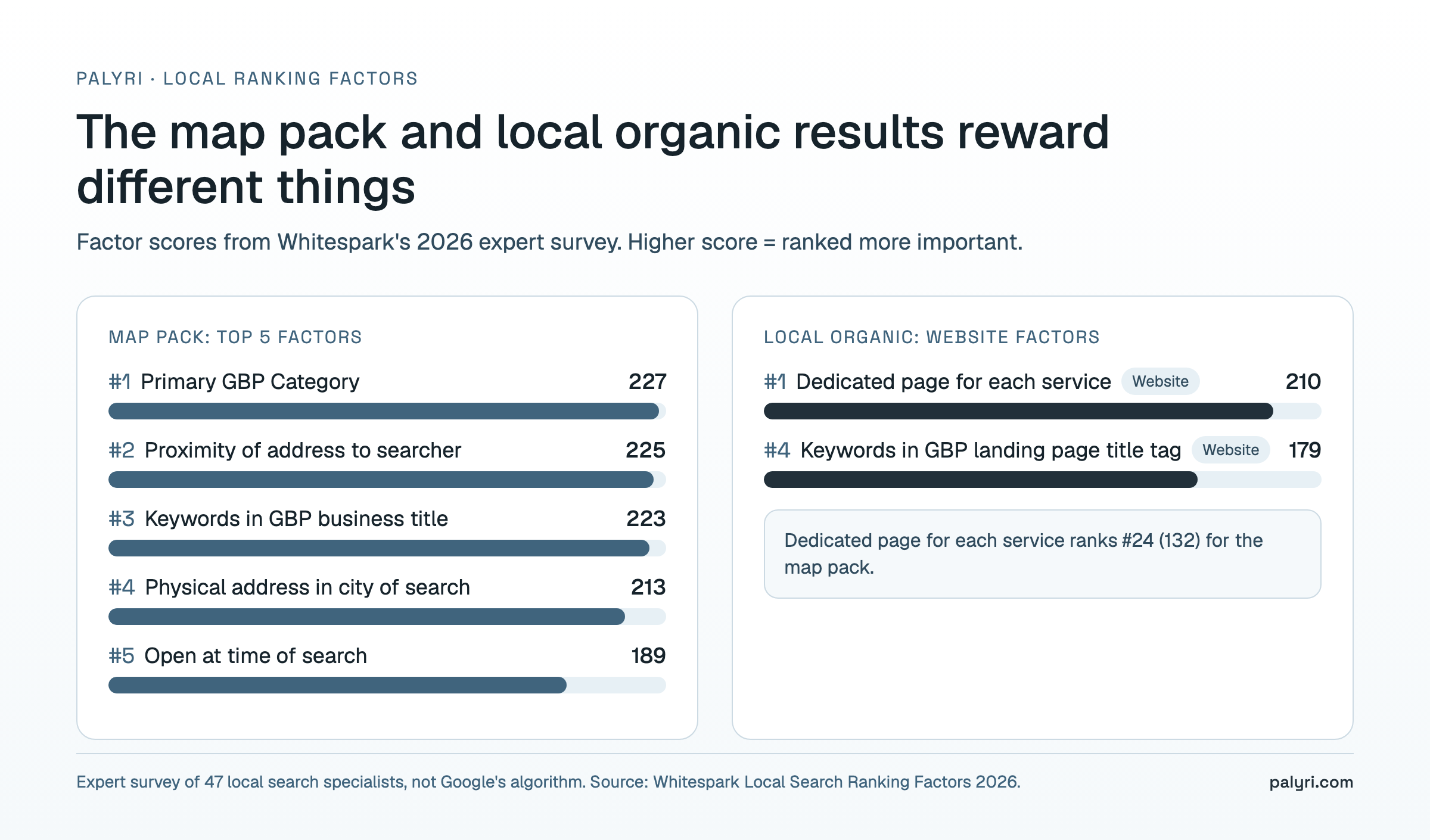
The top five map pack factors, with their survey scores:
- Primary GBP Category (227)
- Proximity of Address to the Point of Search (225)
- Keywords in GBP Business Title (223)
- Physical Address in City of Search (213)
- Business is Open at Time of Search (189)
None of those are website factors. For local organic results, the picture flips: "Dedicated Page for Each Service" ranks #1 (210), and "Keywords in GBP Landing Page Title Tag" ranks #4 (179). In the map pack, the same dedicated service page factor sits at #24 (132), per Whitespark.
So the website wins the organic listings for treatment + city queries and supports the pack through relevance and links.
Do you need a separate page for each treatment and each city?
Per treatment: yes. A single "Injectables" page cannot be the most relevant result for both "Botox" and "lip filler". Each treatment you want to rank for needs its own URL, which lines up with the #1 local organic factor above.
Per city: only where you have a real location. "Physical Address in City of Search" is the #4 map pack factor in the Whitespark survey, and proximity is #2. A page for a suburb where you have no clinic is fighting both.
It also brushes against Google's spam rules. Google's spam policies define doorway abuse as "when sites or pages are created to rank for specific, similar search queries," and list as an example "Having multiple domain names or pages targeted at specific regions or cities that funnel users to one page." The same document covers scaled content abuse: "many pages are generated for the primary purpose of manipulating search rankings and not helping users."
| Situation | Decision | What to do instead |
|---|---|---|
| City where you have a staffed location with an address | Build it | Location page plus one page per treatment offered there |
| Treatment offered at only one of your locations | Build it once | One treatment page under that location; other locations do not get a copy |
| Nearby suburb or neighborhood with no address | Do not build | Mention it on the location page ("patients from X, about 15 minutes north") |
| Same treatment text with the city name swapped | Do not build | Write location-specific content or keep one page |
| Separate domain per city | Do not build | One domain, one location section per city |
What goes on a med spa treatment + city page (template)?
A complete template for one treatment at one location. Copy it per treatment and fill each block with facts true for that location only.
URL: /locations/[city]/[treatment]/ (for example /locations/scottsdale/botox/)
Title tag: [Treatment] in [City], [ST] | [Med Spa Name]
Meta description: one sentence on who the treatment is for, the location, and the next step (consult or booking).
H1: [Treatment] at [Med Spa Name] [City]
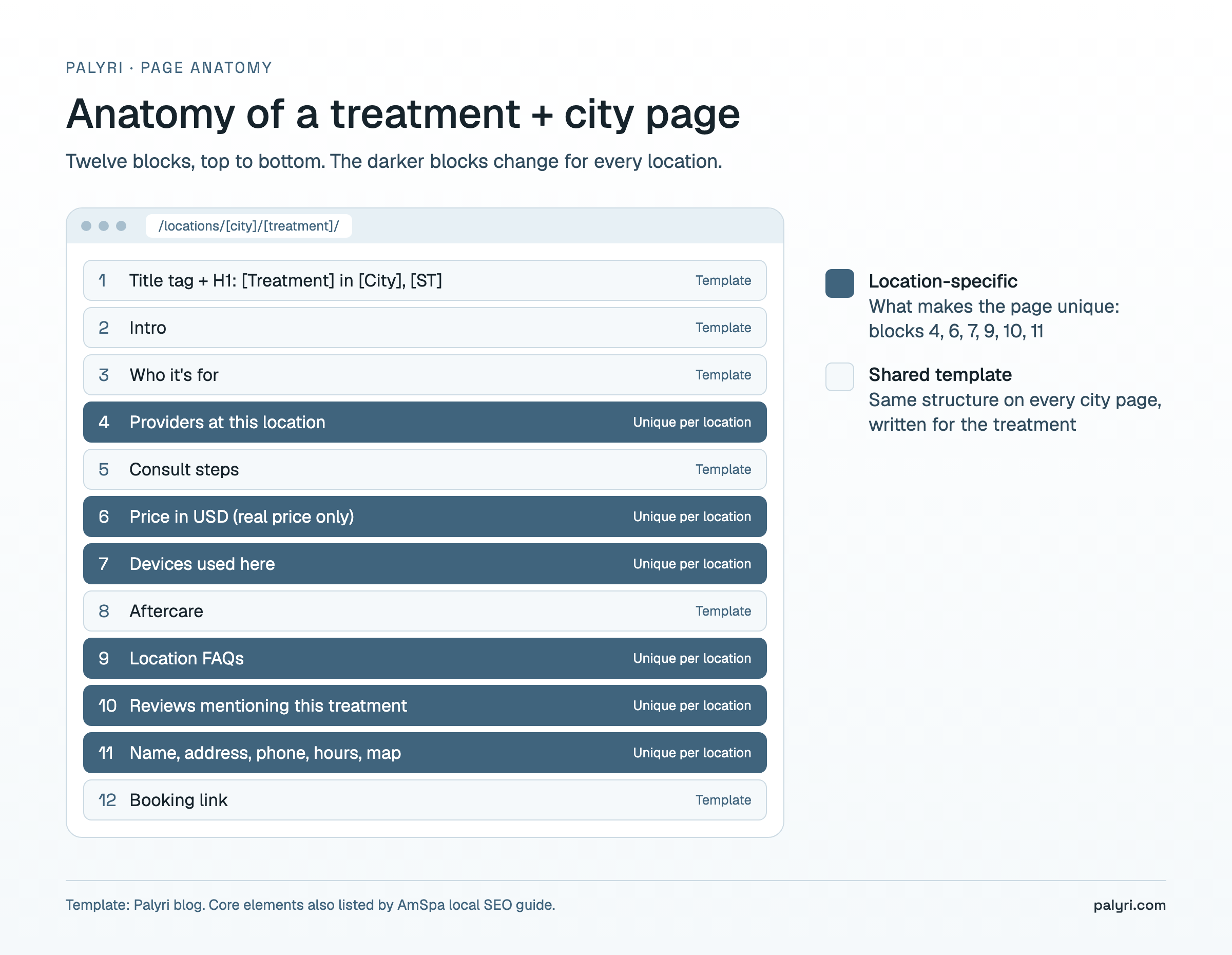
Page blocks, top to bottom:
- Intro (2-3 sentences): what the treatment does, who it suits, which location performs it.
- Who it's for and who it isn't for: concerns it treats, common reasons a provider may suggest a different option.
- Providers at this location: names and roles of the injectors or providers who perform it here, with a link to each bio.
- What the consult looks like: steps from arrival to treatment plan, how long the visit usually takes at this location.
- Price: your real price or "starting at" in USD, and what changes it (units, syringes, sessions). Leave it out if you do not publish prices; never put a placeholder number.
- Devices or products used here: only those this location actually has.
- Aftercare: what patients should do and avoid after the visit, and how to reach the location with questions.
- Location FAQs: 3-5 questions patients at this location really ask (parking, weekend slots, how far in advance to book).
- Reviews that mention this treatment: quoted as text with the reviewer's first name and date, from patients of this location.
- Name, address, phone, hours and an embedded map for this location, matching the Business Profile exactly.
- Booking or consult form link at the top and bottom.
The American Med Spa Association's guest post lists a similar core: "a clear H1, description of the service, what to expect, pricing, FAQs and direct booking link."
The form at the bottom matters more than it looks. An organic lead who fills it in at 9 pm still needs a fast reply, which we cover in speed to lead for med spas.
How unique does each city page need to be? (the doorway test)
Google gives no word count or percentage. It gives a description: one of its doorway examples is "Creating substantially similar pages that are closer to search results than a clearly defined, browseable hierarchy." The practical test is whether a patient would lose something if the page disappeared.
Run this checklist on every treatment + city page before it goes live. A page that scores under 5 "yes" answers is a merge candidate.
Checklist: does this page earn its URL?
- There is a staffed location with a street address in this city.
- The page names the providers who perform this treatment at this location.
- Hours, parking or access details are specific to this location.
- Price or package details are stated for this location (or the page says pricing is the same across locations and links to one price page).
- The devices or products listed are the ones this location has.
- At least 3 FAQs are answered with location-specific facts.
- Reviews shown are from patients of this location and mention this treatment.
- The page is reachable from the menu or the location page, not only from a sitemap or footer list.
- If you deleted it, a patient of this location would lose information they cannot find elsewhere on your site.
Which schema markup should a med spa use?
Start with LocalBusiness structured data, one block per location. Google's LocalBusiness documentation says: "Define each local business location as a LocalBusiness type. Use the most specific LocalBusiness sub-type possible; for example, Restaurant, DaySpa, HealthClub, and so on." If more than one type fits, "specify them as an array (additionalType isn't supported)."
Two properties are required: name and address. Google is explicit: "You must include the required properties for your content to be eligible for display as a rich result." The table below lists what to fill for a med spa location page, within Google's rules.
| Property | Status | What to enter (example values) |
|---|---|---|
| @type | Required | Most specific subtype, for example "DaySpa", or an array of types if more than one fits |
| name | Required | "[Med Spa Name] [City]", same as the Business Profile |
| address | Required | PostalAddress with streetAddress, addressLocality, addressRegion, postalCode, addressCountry "US" |
| geo | Recommended | Latitude and longitude with at least 5 decimal places |
| url | Recommended | The full URL of this location's page, not the homepage; must be a working link |
| telephone | Recommended | Location number with country and area code, for example "+1-480-555-0100" |
| openingHoursSpecification | Recommended | Days and open/close times for this location |
| priceRange | Recommended | A numeric range like "$10-15" or a currency-sign level like "$$$" |
| department | Recommended | Only if a location has a distinct department with its own details |
| aggregateRating / review | Skip | Google: "only recommended for sites that capture reviews about other local businesses" |
The last row is where many agency guides go wrong. Star markup on your own testimonials does not fit Google's guidance, because the review properties are "only recommended for sites that capture reviews about other local businesses." Show reviews as visible text on the page instead.
Put the LocalBusiness block on the location page; treatment + city pages under it can repeat that location data.
How should internal links connect treatment and location pages?
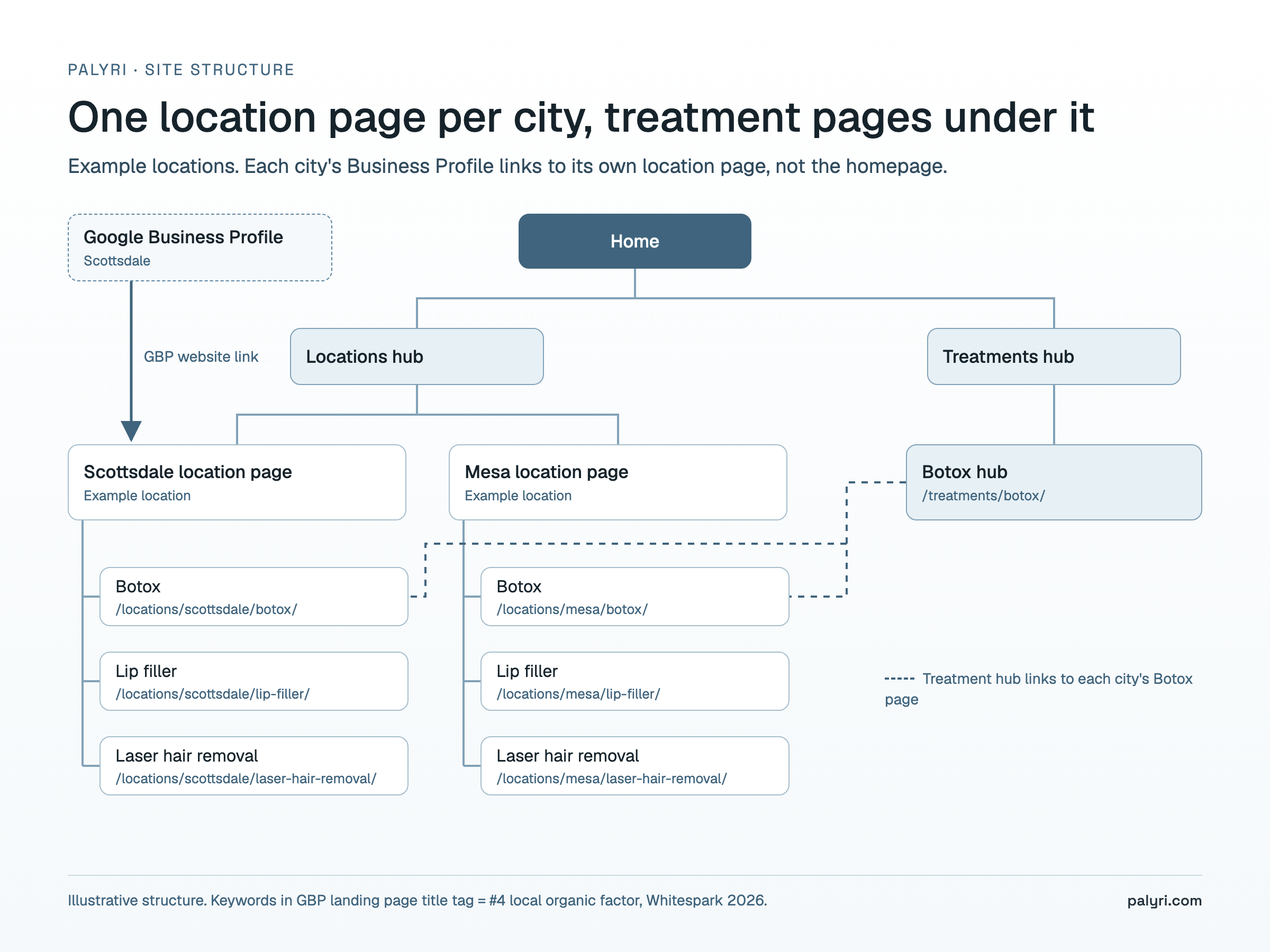
Use a simple hub-and-spoke structure, so both Google and patients can browse it:
- Home links to a Locations hub and a Treatments hub.
- Locations hub links to each city location page.
- City location page links to every treatment + city page offered there.
- Treatment hub (for example /treatments/botox/) explains the treatment in general and links to each city version.
- Each treatment + city page links back to its city page, to its treatment hub, and to 2-3 related treatments at the same location.
This is the "clearly defined, browseable hierarchy" that Google's doorway policy contrasts with doorway pages. Pages reachable only through a footer list of 40 city links look like the opposite.
One link matters more than the rest: the website link on each Business Profile. Point it at that city's location page, not the homepage. "Keywords in GBP Landing Page Title Tag" is the #4 local organic factor and #17 for the map pack (146) in the Whitespark survey, so that location page's title tag should carry the city and your main treatment category.
Use descriptive anchors ("Botox at our Scottsdale location"), not "click here".
Do reviews help the website rank, or only the map pack?
Google ties reviews to prominence, the third local factor: "More reviews and positive ratings can help your business's local ranking." It also notes that "Positive reviews and helpful replies can help your business stand out."
In the Whitespark 2026 survey, four review factors land in the top 15 for the map pack:
Scores: 181, 170, 164 and 154. The experts rank a sustained influx "rather than bursts", not a one-off campaign.
On the website, reviews work through the page itself. A treatment + city page that quotes patients of that location describing that treatment adds unique, relevant text, which also helps it pass the doorway checklist above. Keep them as visible text, not star markup (see the schema section).
How to ask for reviews consistently is a separate process, covered in how to collect Google reviews systematically.
Which pages to build first? (worked example)
You do not need every page on day one. Build the pages whose consults are worth the most to you, then expand.
Example: a med spa with 2 locations offers 6 treatments. If every treatment were offered at both, that is 2 x 6 = 12 possible treatment + city pages. Assume the second location only offers 4 of the 6, so 6 + 4 = 10 pages pass the "real location" rule. Every number below is an assumption for the example, not a benchmark. Replace them with your own figures.
| Treatment (example) | Locations offering it | Assumed value of one booked consult | Priority |
|---|---|---|---|
| Neurotoxin (Botox) | 2 | $400 | Wave 1 (2 pages) |
| Dermal filler | 2 | $700 | Wave 1 (2 pages) |
| Laser hair removal | 2 | $900 | Wave 1 (2 pages) |
| Microneedling | 1 | $500 | Wave 2 (1 page) |
| Chemical peel | 2 | $200 | Wave 2 (2 pages) |
| Body contouring | 1 | $1,500 | Wave 1 (1 page) |
With these assumptions, wave 1 is 7 pages and wave 2 is 3. The ranking logic: high consult value first, then treatments offered at both locations, because one well-built template serves two pages. A practice that does not know what one consult is worth can estimate it with the ROI calculator for aesthetic clinics.
Once the pages bring in form leads, the work shifts to answering and tracking them to a booked visit. That is what a CRM for med spas and aesthetic clinics does; it does not do SEO. If you also bid on the same treatment + city terms in Google Ads, the break-even bid guide shows how to compare paid cost with organic.
FAQ
How long does med spa SEO take to show results?
There is no reliable fixed timeline, and any guide that promises one is guessing. Google first has to crawl and index each new treatment + city page, then judge it against competing pages in that city, and both steps vary by site and market. Measure instead of waiting: in Google Search Console, check that each new page is indexed, then watch impressions and average position for queries like "[treatment] [city]". Rising impressions come before clicks, so they are your first sign that a page is working.
Does each med spa location need its own website?
No. One domain with a location section per city is the cleaner setup. Google's spam policies list "Having multiple domain names or pages targeted at specific regions or cities that funnel users to one page" as an example of doorway abuse. Give each location its own page with its own address, phone, hours, providers and treatments, and point each Business Profile's website link to that location page. Medspa SEO for multiple locations is a structure question, not a domain question.
Can I rank in a city where I don't have an address?
In the map pack, it is hard. The Whitespark 2026 survey ranks proximity of the address to the searcher #2 and a physical address in the city of search #4 among map pack factors. In organic results, a page is possible only if it is genuinely useful to patients from that city. A page that swaps the city name into your main treatment copy fits Google's doorway definition. A better route is to mention nearby areas on your real location page, with travel time and directions, and let that page rank for them.
What schema markup should a med spa add first?
LocalBusiness structured data on each location page. Google's documentation asks you to use the most specific subtype possible and to define each location separately. Only two properties are required, name and address, and Google says you must include them to be eligible for a rich result. Then add the recommended ones: geo with at least 5 decimal places, url of that specific location, telephone with country and area code, openingHoursSpecification and priceRange. Skip aggregateRating for your own testimonials, which Google recommends only for sites reviewing other businesses.
How many Google reviews do I need to rank in the map pack?
No source gives a magic number, and Google does not publish one. Google says "More reviews and positive ratings can help your business's local ranking," which is relative to what your competitors have. In the Whitespark 2026 survey, experts rank high ratings #6, number of reviews with text #9, recency #11 and a sustained influx over time #14 among map pack factors. That points to a steady habit of asking every satisfied patient, rather than a target count.
Is it OK to copy the same treatment page and change the city name?
No. Google's spam policies describe doorway abuse as pages "created to rank for specific, similar search queries" and name "substantially similar pages" as an example. Its scaled content policy covers "large amounts of unoriginal content that provides little to no value to users, no matter how it's created." A city-swapped page fails both. If you have no real location in that city, do not create the page. If you do, rewrite it with location facts: providers, devices, hours, parking, local FAQs and reviews from patients of that location.
Want to implement this in your clinic?
Book a free Palyri demo. We'll show how it works on your clinic's data.
Book a demoPalyri blog author
Writes for the Palyri blog about getting clients from ads, handling leads and front-desk work in aesthetic clinics and beauty salons.