The cheapest med spa lead generation channels per booked consult are the ones that start with people who already know you: past-client reactivation, referrals and reviews, then Google Business Profile and treatment-plus-city SEO pages. Paid Google and Meta ads book consults fastest but cost the most per consult, so they belong on top of an owned base, not instead of it.
The reason is in the numbers. An AmSpa industry report found that an average of 73% of med spa patients are repeat patients, up from 65% in the 2022 report. Meanwhile, CorralData research published by AmSpa shows median new-patient growth of just 1.2% in the first half of 2026, while the median practice grew revenue 19.2% year over year. Growth is coming from clients who return, not from a flood of new ones.
This guide ranks nine channels by what a booked consult costs. Every calculation is labelled as an example, so you can swap in your own numbers.
What is the cheapest med spa lead generation channel?
Past-client reactivation is usually the cheapest, because the audience already trusts you and the list costs nothing to rent. Referrals and reviews come next: you pay a reward or staff time, and the person arriving was recommended by someone they know or by strangers they trust.
Sources: 73% and $527 from the AmSpa 2024 State of the Industry recap; 1.2% from CorralData H1 2026 data via AmSpa.
The ranking below orders channels by three criteria: cost per booked consult, time to first result and how warm the audience is when it arrives. Where a sourced figure exists, it is shown. Where none exists, the cell says so.
| Rank | Channel | What you pay | Time to first result | Audience | Sourced figure |
|---|---|---|---|---|---|
| 1 | Past-client reactivation (email/SMS) | Tool + staff time | Days | Warm, known | Returning clients spent $1,681 vs $355 for single-visit clients (H1 2026) |
| 2 | Referrals | Reward, paid on booking | Weeks | Warm, recommended | None; cost is the reward you set |
| 3 | Reviews | Staff time | Weeks | Warm, pre-sold | 42% trust reviews as much as personal recommendations |
| 4 | Google Business Profile | Staff time, no ad spend | Weeks | Local, high intent | Primary category ranked the #1 local pack factor (expert survey) |
| 5 | Memberships | Discount or perks you fund | Weeks to months | Existing clients | Members spent 2.5x more than non-members |
| 6 | SEO treatment + city pages | Writing + site time | Months (slowest) | Cold, high intent | None for time or cost |
| 7 | Events and local partnerships | Event cost | Weeks | Lukewarm, local | None |
| 8 | Google Search ads | Ad spend | Days | Cold, high intent | Beauty and personal care CPL $39.25 |
| 9 | Meta lead ads | Ad spend | Days | Cold, interrupted | Beauty and personal care CPL $51.42 |
Rank order is a framework judgment on these criteria, not a measured result.
How do you calculate cost per booked consult?
Cost per booked consult is total channel cost divided by booked consults. Total cost means everything the channel consumes in a month: ad spend, software, rewards, discounts and the staff hours spent running it. Booked consults equal leads multiplied by your consult-booking rate.
Cost per lead hides the gap between a cheap lead nobody books and a pricier one who books on the first call. So the ranking uses three criteria:
- Cost per booked consult. The monthly cost divided by consults on the calendar.
- Time to first result. Reactivation can book this week; SEO pages take months.
- Consult-booking rate. A referred friend books at a different rate than a stranger who tapped an ad. No public source gives a med spa consult-booking rate, so measure your own.
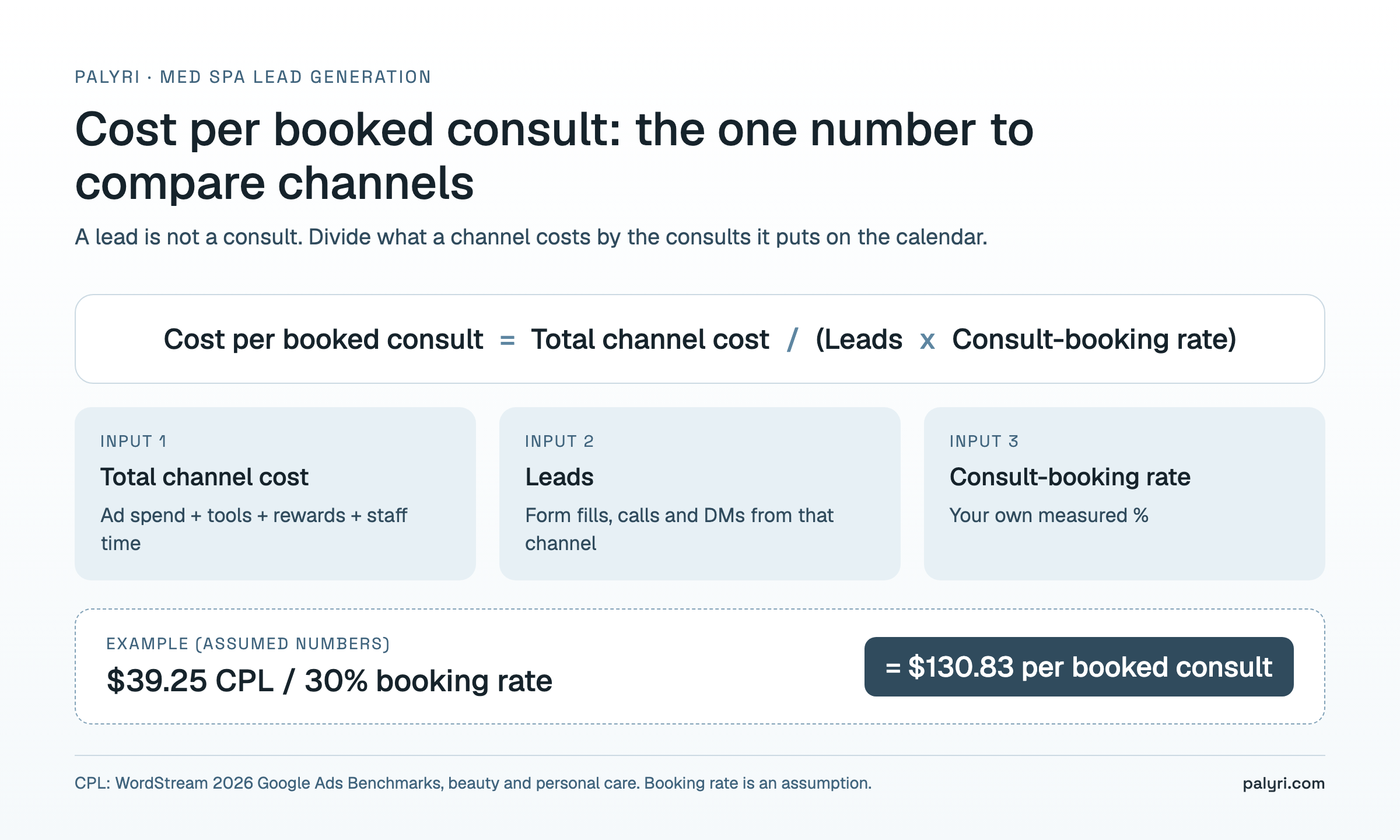
Use this fill-in calculator once a month. Fill the blank columns with your own numbers, then sort by the last column.
| Channel | Monthly cost ($) | Leads | Booking rate (%) | Booked consults (leads x rate) | Cost per booked consult ($) |
|---|---|---|---|---|---|
| Past-client reactivation | |||||
| Referrals | |||||
| Reviews | |||||
| Google Business Profile | |||||
| Memberships | |||||
| SEO treatment + city pages | |||||
| Events and partnerships | |||||
| Google Search ads | |||||
| Meta lead ads |
Count staff time at a real hourly cost. A channel that looks free because no invoice arrives can still be the most expensive one if the front desk spends ten hours a week on it.
The 9 med spa lead generation channels, ranked
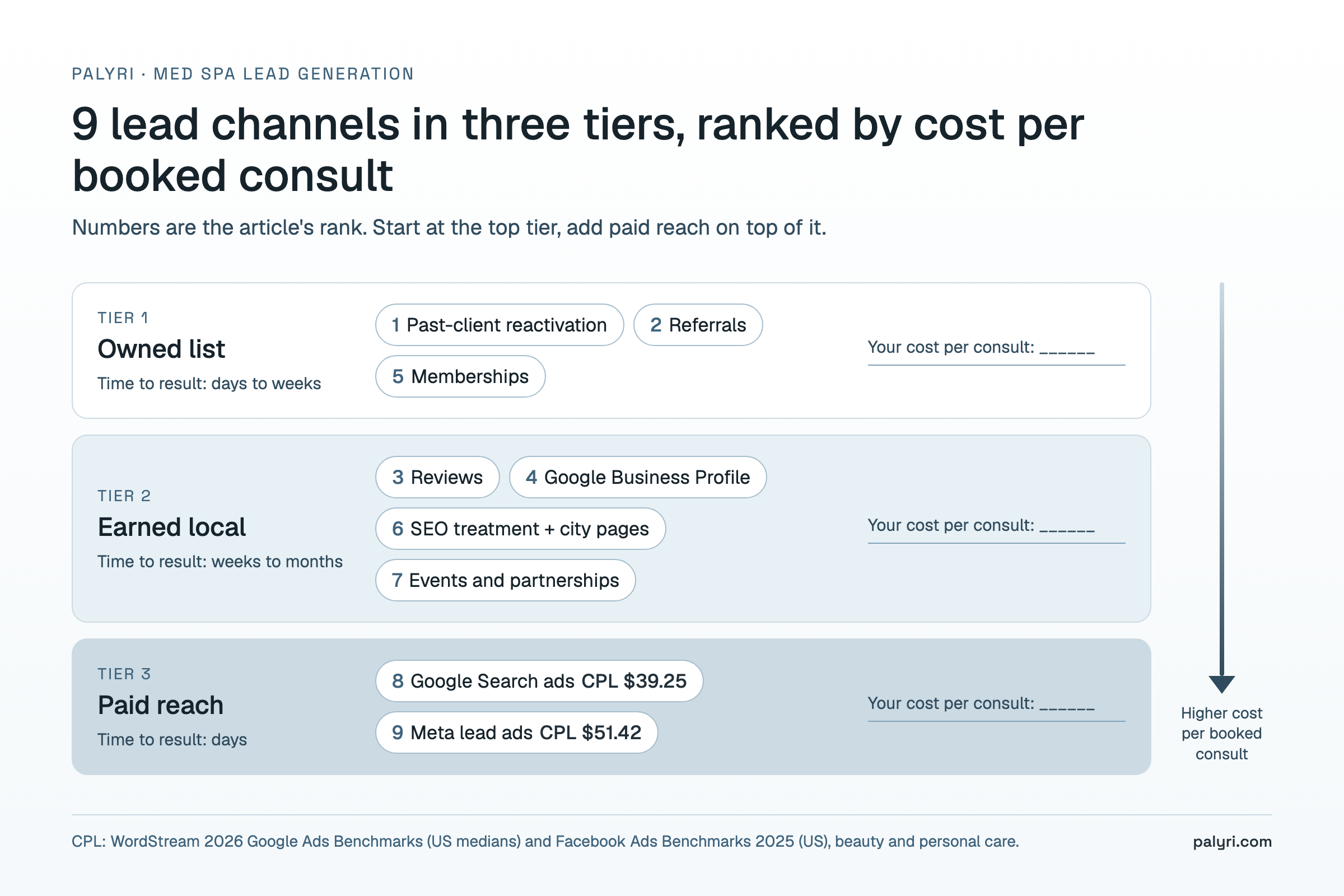
The nine channels fall into three tiers: your owned list, earned local visibility and paid reach. Each section covers what it costs, how fast it works and why it does or does not book, with a link to the full how-to.
1. Past-client reactivation (email and SMS to your list)
This is the channel with the most money on the table. In the CorralData H1 2026 benchmark reported by AmSpa, single-visit clients spent $355 on average versus $1,681 for clients who came back, a $1,326 gap per person. Bringing a lapsed client back for a consult is worth more than most new leads.
Cost is your email or SMS tool plus the time to segment lapsed clients and write the message. Results arrive within days of sending. For scale, Mailchimp's email benchmarks put the average click rate across all users at 2.62% (data last updated December 2023; no beauty-specific row). For sequences and segment ideas, see email marketing benchmarks and automations for aesthetic clinics.
2. Referrals
A referral program costs whatever reward you choose, and you can pay it only when the friend actually books. That makes the cost per booked consult fixed and known in advance, which no ad channel offers.
Referred friends arrive warm: someone they trust already vouched for your injector. No public source gives a reliable share of med spa clients who come from referrals, so track yours from day one. The structure, reward options and tracking are covered in how to build a referral program.
3. Reviews
Reviews cost staff time and a consistent ask after each visit. They work twice: they persuade people comparing options, and they feed local ranking. In BrightLocal's 2025 Local Consumer Review Survey of US consumers, 42% said they trust online reviews as much as personal recommendations (down from 79% in 2020), and 74% use two or more review sites before choosing a business.
Google states in its local ranking guidance that "more reviews and positive ratings can help your business's local ranking." Reviews rarely create a lead on their own; they raise the booking rate of every other channel. Collection scripts and timing are in how to collect Google reviews.
4. Google Business Profile
Your profile carries no ad spend, only setup and upkeep time. Google says local results are mainly based on relevance, distance and popularity, and prominence draws on links and reviews. In the Whitespark 2026 Local Search Ranking Factors expert survey, the primary GBP category ranked as the #1 local pack factor and keywords in the business title ranked #3. Whitespark notes that none of the experts have special access to Google's algorithm.
People who find you here are searching for a treatment near them right now, so intent is high. Work through the 100-point Google Business Profile audit before spending on ads.
5. Memberships
Memberships are mostly a retention tool, but they generate consults too: member-only consult offers and member pricing give existing clients a reason to book the next treatment. The CorralData data via AmSpa found members spent 2.5 times more than non-members and retained 35 percentage points better, with no exceptions among practices running a program. Some practices had under 3% of active patients enrolled.
Cost is the discount or perks you fund. Plan design is covered in membership programs for recurring revenue.
6. SEO treatment and city pages
Pages like "lip filler in [city]" are the slowest channel on this list: results take months and depend on competition, your domain's history and your local signals. There is no reliable public figure for how long it takes or what it costs, so treat any promised timeline with caution.
Once a page ranks, each extra visitor costs nothing, which gives SEO the lowest marginal cost per consult over time. Start with your top three treatments. The page template is in treatment + city pages.
7. Events and local partnerships
Open houses, treatment nights and partnerships with gyms, salons or bridal shops cost whatever the event costs: product, staff hours, food, a partner's commission. No public benchmark measures their cost per booked consult, so this channel ranks on mechanism alone.
Attendees meet your providers in person, but results arrive in batches. Collect a consented phone number or email at every event, or the leads vanish.
8. Google Search ads
Google Search ads reach people already searching for a treatment. The WordStream 2026 Google Ads Benchmarks (13,474 US campaigns, April 2025 to March 2026, medians) put beauty and personal care at a $39.25 cost per lead. Setup and budgets are covered in paid channel costs and what to track before you spend.
9. Meta lead ads
Meta lead ads reach people who were not searching, which brings volume but colder intent. In the WordStream Facebook Ads Benchmarks 2025 (US campaigns, April 2024 to June 2025), beauty and personal care lead campaigns averaged a $51.42 cost per lead. Compare treatment-level figures in the CPL and CPA benchmarks.
What does a booked consult cost on each channel? (worked examples)
The examples below are calculations, not benchmarks. Each uses a sourced input where one exists and a stated assumption where none does. Replace the assumptions with your own numbers.
Example A (paid ads): assume 30% of leads book a consult. Google: $39.25 CPL / 0.30 = $130.83 per booked consult. Meta: $51.42 CPL / 0.30 = $171.40 per booked consult. CPLs are from WordStream's Google and Facebook benchmarks; the 30% rate is an assumption.
Example B (reactivation email): assume you email 2,000 past clients. At the Mailchimp all-user click rate of 2.62%, that is 2,000 x 0.0262 = 52 clicks. Assume 20% of clickers book: 52 x 0.20 = 10 consults. Assume $150 for the tool and staff time: $150 / 10 = $15 per booked consult.
Example C (referral): assume a $50 credit to the referring client and $50 to the friend, paid only when the friend books. Cost per booked consult: $100, fixed regardless of volume.
How much should a med spa spend on lead generation?
According to AmSpa's 2024 State of the Industry Report, as cited by AmSpa, a med spa invests about 7% of revenue in marketing on average, ranging from 2% to 15%. That budget covers every channel on this list, not just ads.
A practical split follows the ranking. Fund the owned channels first, because they cost the least per consult: a reactivation sequence, a referral reward, a review ask and a maintained profile. Then use paid ads to fill provider capacity the owned channels cannot.
Example: assume a practice at the AmSpa average annual revenue of $1,398,833. At 7%, the marketing budget is about $97,918 a year, or roughly $8,160 a month. That is an assumption-based illustration, not a target. To test whether a channel pays back, estimate your return per booked consult with your own treatment prices.
Why leads from every channel die before the consult
The same lead can be cheap or expensive per booked consult depending on what happens after it arrives. Slow replies and one-call follow-up waste leads from every channel, owned or paid. Response timing is covered in speed to lead for med spas, and the sequence of calls and texts in the med spa lead follow-up cadence.
If you text leads or past clients, consent rules apply. Under the FCC rules in 47 CFR 64.1200, requests to revoke consent must be honored within a reasonable time not to exceed ten business days, and telephone solicitations are barred before 8 a.m. or after 9 p.m. local time. The CTIA Messaging Principles add that an opt-in applies only to the campaign and sender it was obtained for, so a reactivation campaign needs its own consent basis.
2. Reply to new leads in minutes, not hours.
3. Try to book the consult on the first call; offer two specific times.
4. If no answer, follow a written call and text cadence, not a single retry.
5. Record consent for texting per campaign, and honor opt-outs fast.
6. Tag no-shows and cancellations, and count only attended or booked consults in the calculator.
7. Review the cost per booked consult table monthly.
Track which channel books, not which channel clicks
Clicks and leads are easy to count; booked consults per channel are what decide your budget. The rule is simple: every lead carries a source tag, and the booked consult is the event you count. A CRM that tags each lead's source and marks the booked consult turns the calculator above into a report instead of a spreadsheet chore. If you want that set up, see a CRM built for aesthetic clinics and its pricing plans.
Use this monthly review template alongside the calculator.
| Question | Where the answer comes from | Decision it drives |
|---|---|---|
| Which channel booked the most consults? | Source tag on booked consults | Protect its budget and time |
| Which channel has the lowest cost per booked consult? | Calculator, last column | Scale it first |
| Which channel has many leads but few bookings? | Leads vs booked consults | Fix follow-up before adding spend |
| How many lapsed clients have not been contacted? | Client list, last visit date | Schedule the next reactivation send |
| How many new reviews this month? | Google Business Profile | Tighten the post-visit ask |
| Did paid ads fill open provider hours? | Booking calendar | Raise or cut ad budget |
FAQ
What is the best lead generation for a med spa?
The best lead generation for a med spa is the channel with the lowest cost per booked consult in your own data. For most practices that starts with past clients: CorralData data via AmSpa shows returning clients spent $1,681 in H1 2026 versus $355 for single-visit clients. Referrals, reviews and Google Business Profile follow, because they bring warm or high-intent people at low cost. Paid ads book fastest and fill capacity. Run the fill-in calculator monthly and let your own booking rates set the order, using the 100-point Google Business Profile audit as a low-cost first step.
How much does a med spa lead cost?
It depends on the channel. For paid search, the WordStream 2026 Google Ads Benchmarks put beauty and personal care at a $39.25 median cost per lead among US campaigns. For Meta lead campaigns, WordStream's 2025 Facebook benchmarks list $51.42 for the same category. Owned channels like reactivation and referrals have no media cost, only tools, rewards and staff time. A lead is not a consult, so divide CPL by your booking rate. Treatment-level comparisons are in the CPL and CPA benchmarks.
How do med spas get new clients without ads?
Med spas get new clients without ads through referrals, reviews, Google Business Profile, treatment and city pages, and local events or partnerships. Referrals bring friends recommended by existing clients, and you can pay the reward only when they book. Reviews matter because 42% of US consumers in BrightLocal's 2025 survey trust them as much as personal recommendations. A well-kept profile shows up for local treatment searches with no ad spend. SEO pages take the longest but have the lowest marginal cost. Start with the treatment + city pages template.
How much should a med spa spend on marketing?
On average, a med spa invests about 7% of revenue in marketing, with a range of 2% to 15%, according to AmSpa's 2024 State of the Industry Report as cited by AmSpa. That figure covers all marketing, not just ads. A sensible order is to fund low-cost owned channels first (reactivation, referrals, reviews, Google Business Profile) and then add paid ads to fill provider hours those channels leave open. Use the ROI calculator to test payback with your own prices.
Do referral programs work for med spas?
Referral programs work because the friend arrives already trusting your practice, and the cost is known in advance. You set the reward, for example a credit to both sides, and pay it only when the friend books, so cost per booked consult is fixed. There is no reliable public figure for what share of med spa clients come from referrals, so measure it yourself with a source tag on every lead. The full setup is in how to build a referral program.
How long does SEO take for a med spa?
SEO is the slowest channel on this list, and no reliable public source gives a fixed timeline. How long it takes depends on how many local competitors target the same treatment, how established your website is, how many sites link to you and how strong your reviews and Google Business Profile are, which Google lists among local ranking signals. Once a page ranks, extra visitors cost nothing. Start with your three highest-value treatments, and run owned and paid channels while the pages mature, as described in treatment + city pages.
Want to implement this in your clinic?
Book a free Palyri demo. We'll show how it works on your clinic's data.
Book a demoPalyri blog author
Writes for the Palyri blog about getting clients from ads, handling leads and front-desk work in aesthetic clinics and beauty salons.