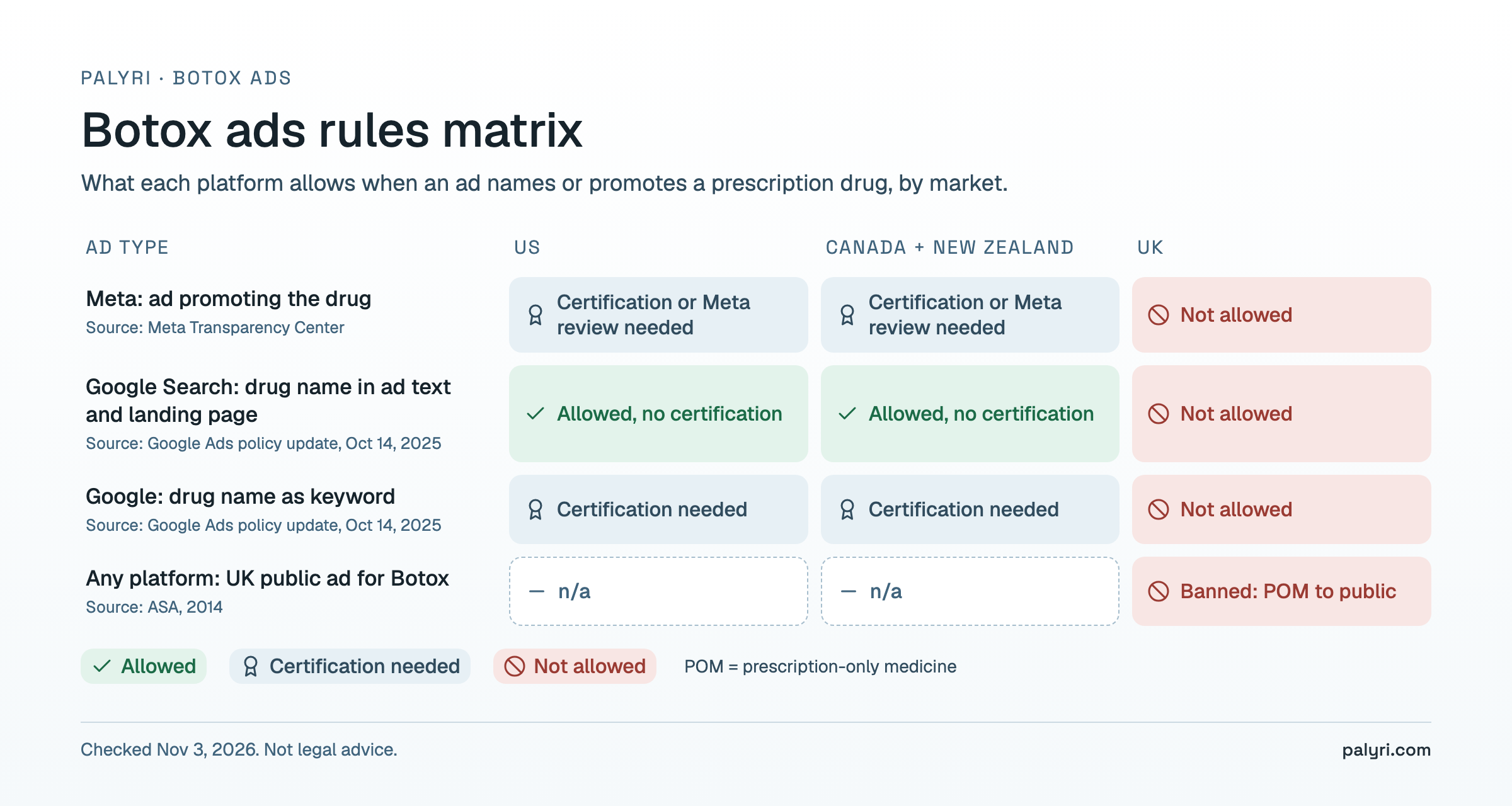
Yes, in the US a med spa can run Botox ads, but Meta's prescription drug policy only lets an ad promote a prescription drug when the advertiser is LegitScript-certified or approved through Meta's internal review, carries a consult-a-professional disclaimer and targets adults 18+ in the United States, Canada or New Zealand. Google has allowed prescription drug terms in US ad text and landing pages without certification since its October 2025 policy update, but keyword-targeting those terms still needs certification, so most med spas get approved faster by advertising the consultation, the provider and the outcome rather than the drug.
In the UK the answer is different: the ASA states that Botox, as a prescription-only medicine, cannot be advertised to the public at all, directly or indirectly. The UK detail lives in our guide to UK aesthetics marketing under ASA and CAP rules.
This guide gives you a dated rules matrix, 12 Botox ad ideas rated by policy risk with copy templates, and a 10-item checklist to run before launch. All policy pages below were checked on November 3, 2026.
Can you run Botox ads on Facebook and Instagram?
Meta does not have a Botox-specific rule. It has a prescription drug rule, and Botox is a prescription drug, so any ad that promotes the drug itself falls under it. Meta's stated aim is to allow ads that "share information around medical efficacy, accessibility and affordability of different types of treatments" while respecting that laws vary by region (Meta Advertising Standards, checked Nov 3, 2026).
Meta's page names online pharmacies, telehealth providers and pharmaceutical manufacturers as the groups with specific certification paths. It does not name med spas. The practical read for a med spa: an ad whose message is "buy Botox here" is a prescription drug ad, and you should expect it to need the same conditions. Meta's authorization steps explain how to apply.
2. A disclaimer to "consult a licensed health professional or obtain a valid prescription".
3. The Meta onboarding process for prescription drugs completed.
4. Targeting only the United States, Canada or New Zealand, and only countries where you are certified.
5. Targeting only people 18 or older.
Source: Meta Transparency Center, checked Nov 3, 2026.
One door stays open without certification. Meta allows ads that "educate, advocate or give public service announcements related to prescription drugs". That is why education reels, what-to-expect videos and consultation-first ads are the backbone of the ideas list below. They sell the appointment and the provider, not the vial.
Can you use the word Botox in Google Ads?
Google changed its rules on October 14, 2025. For campaigns targeting Canada, New Zealand or the United States, advertisers "may use prescription drug terms for promotional purposes, in accordance with local laws and regulations", including content promoting "the branding, use, sale, and distribution of prescription drugs" (Google Ads policy update, checked Nov 3, 2026).
The split that matters for Botox advertising on Google:
- Ad text and landing pages (US, Canada, NZ): no certification needed to use prescription drug terms.
- Keywords: Google says "you must be certified in order to keyword-target these terms".
- Everywhere else: no promotional use of prescription drug terms. Non-promotional use, such as public health campaigns and legal notices, is permitted.
- Enforcement: started October 29, 2025, ramping up over about 4 to 6 weeks. Google says it will warn "at least 7 days before suspending your account".
- Label: on most healthcare policies, a certified domain targeting allowed locations gets ads marked "Eligible (limited)" (Healthcare and medicines policy).
Google keeps a restricted drug terms page and a non-exhaustive list of prescription drugs. Check the current list yourself before building a keyword set. If you are not certified, build Search campaigns on service and problem keywords such as "wrinkle treatment near me", "forehead lines treatment" or "med spa near me", and use the drug name only in the ad text and on the landing page in the three allowed countries. The bidding side is covered in our post on the Google Ads break-even bid for aesthetic clinics.
What FDA rules apply to Botox advertising?
The FDA's Office of Prescription Drug Promotion (OPDP) exists to help "ensure that prescription drug promotion is truthful, balanced, and accurately communicated", and its reviewers check that promotional materials are "not false or misleading" (FDA OPDP, checked Nov 3, 2026). OPDP's main targets are drug makers, and its untitled letters are published on that page. Read them for the kinds of claims that draw attention: overstated benefits and minimized risks.
For a med spa writing its own ad copy, the same standard is a sensible floor. Every claim should be true, balanced by a mention that risks exist, and limited to what the treatment is used for. A line that would embarrass you in an FDA letter will also tend to trip Meta's and Google's reviewers.
A note on the name: Botox is a brand name and a registered trademark of Allergan, an AbbVie company. Use it as a proper noun for the product you actually inject, and use "neuromodulator" or "wrinkle relaxer" when you mean the category.
| Risky claim | Why it is risky | Safer rewrite |
|---|---|---|
| "Painless Botox in 10 minutes" | Promises an experience no provider can guarantee | "Most appointments take under an hour. Your injector explains what you may feel." |
| "Permanent results" | Overstates the benefit | "Results wear off over time. Your provider will explain what to expect." |
| "No side effects" | Removes the risk side of the balance | "Like any treatment, it has risks. A consultation decides if it suits you." |
| "FDA-approved for everything" | Implies approval for uses you have not checked | Name only the specific use you treat, as stated in the product's labeling |
| "Look 10 years younger" | An outcome guarantee with a made-up number | "Soften the look of frown lines. Book a consult to see if it fits you." |
12 compliant Botox ad ideas for med spas
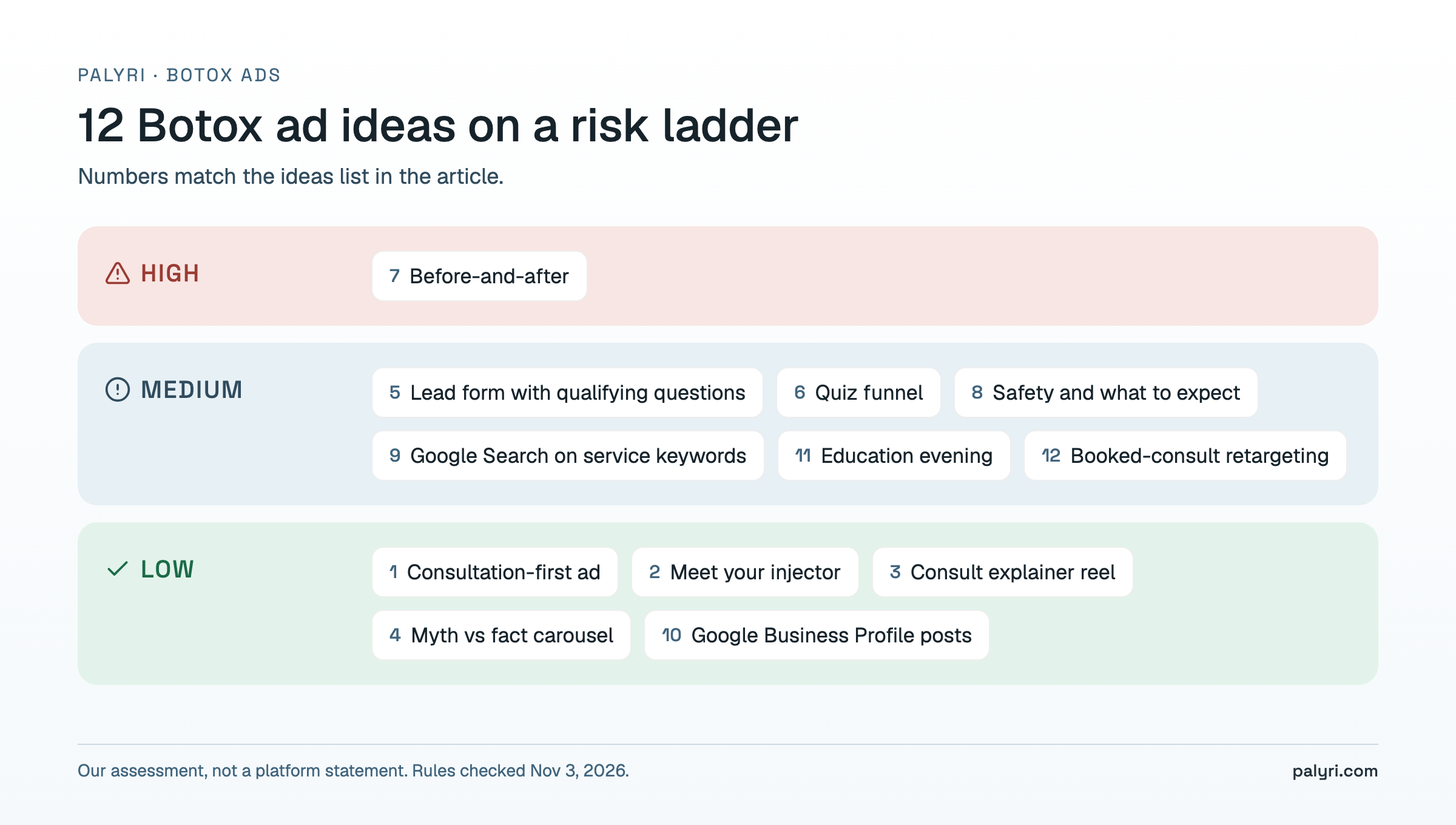
The risk rating below is our own assessment of how likely each idea is to hit a platform restriction or a misleading-claim problem. It is not a statement by Meta, Google or any regulator. Low = the ad promotes a consult, a provider or education. Medium = it needs careful copy, a disclaimer or the right targeting. High = rules on images, claims and offers stack up.
| # | Idea | Platform | Risk and why | Copy template |
|---|---|---|---|---|
| 1 | Consultation-first ad | Meta, Google | Low: sells the appointment, not the drug | "Book a 15-minute wrinkle consultation with a licensed injector. We will tell you honestly if treatment suits you." |
| 2 | Meet your injector video | Meta | Low: provider-led; state only credentials your provider really holds | "Meet [Name], [credential] at [Med Spa]. Ask her anything about frown lines at your first consult." |
| 3 | What happens at a neuromodulator consult | Meta Reels, Stories | Low: education, which Meta allows without certification | "What actually happens at a wrinkle-relaxer consult: questions, face mapping, risks, then a decision. No pressure to book." |
| 4 | Myth vs fact carousel | Meta | Low: factual and balanced, with a disclaimer slide | "Myth: it freezes your face. Fact: dosing is planned at a consultation. Consult a licensed health professional." |
| 5 | Meta lead form with qualifying questions | Meta | Medium: keep questions free of health details you do not need | "Thinking about frown-line treatment? Answer 3 quick questions and our front desk will call you to book a consult." |
| 6 | Quiz funnel: which treatment fits your concern | Meta, Google | Medium: the result page must route to a consult, not a drug offer | "Forehead lines, crow's feet or volume loss? Take the 60-second quiz and see which consult to book." |
| 7 | Before-and-after within the rules | Meta | High: image rules, claims and Rx rules all apply at once | "Real patient, treated by [Name]. Individual results vary. Consult a licensed health professional." |
| 8 | Safety and what to expect | Meta, Google | Medium: must name risks without sounding like a guarantee | "Every treatment has risks. Here is how we check suitability, what side effects can happen and when to call us." |
| 9 | Google Search ad on service keywords | Google Search | Medium: drug name only in ad text and landing page, US, CA or NZ, no drug-name keywords unless certified | Headline: "Frown Line Treatment Near You". Description: "Botox and other options discussed at a consult with a licensed injector." |
| 10 | Google Business Profile posts and reviews | Google local | Low: local visibility built on service posts and real reviews | "New consult slots this week for wrinkle treatments. Ask our injectors which option suits you." |
| 11 | Education evening or open house | Meta | Medium: no discounted drug units, no prize draws for treatment | "Free Q&A evening: our injectors explain wrinkle treatments, risks and costs. Seats limited, consults booked separately." |
| 12 | Retargeting optimized for booked consults | Meta | Medium: send the booking event only, never treatment or health details | "Still thinking about it? Pick a consult time that works for you." |
How to run the higher-effort ideas without repeating ground we already covered:
- Idea 5: the trade-off between instant forms and a page is in lead ads vs landing pages for med spas.
- Idea 7: image rules, framing and disclaimers are in before-and-after ad rules on Facebook and Instagram.
- Idea 10: a step-by-step listing check is in the Google Business Profile audit for aesthetic clinics.
- Idea 12: the event setup is in sending booked consults to Meta with CAPI.
Test 3 or 4 of these concepts at once and judge them by booked consults, not clicks. A CRM for med spas that tracks every ad lead to a booked consult, such as Palyri with its quiz funnels and ad creative performance view, shows which compliant concept actually fills the calendar.
How do UK aesthetics clinics advertise Botox when POM ads are banned?
The UK has no certification route. In its 2014 article on Botox rulings, the ASA said that because Botox is a prescription-only medicine (POM), it "is prohibited by law from being advertised to the public, either directly, as a product for sale or indirectly, as part of a service offering to treat consumers with a POM" (ASA, 2014). The article is older, but the principle it states is the legal baseline UK clinics still work from.
CAP code detail, MHRA, CQC and JCCP points are covered in our guide to UK aesthetics marketing under ASA and CAP rules. Google's October 2025 change does not help here either: outside the US, Canada and New Zealand, it allows no promotional use of prescription drug terms (Google).
Botox ad checklist before you hit publish
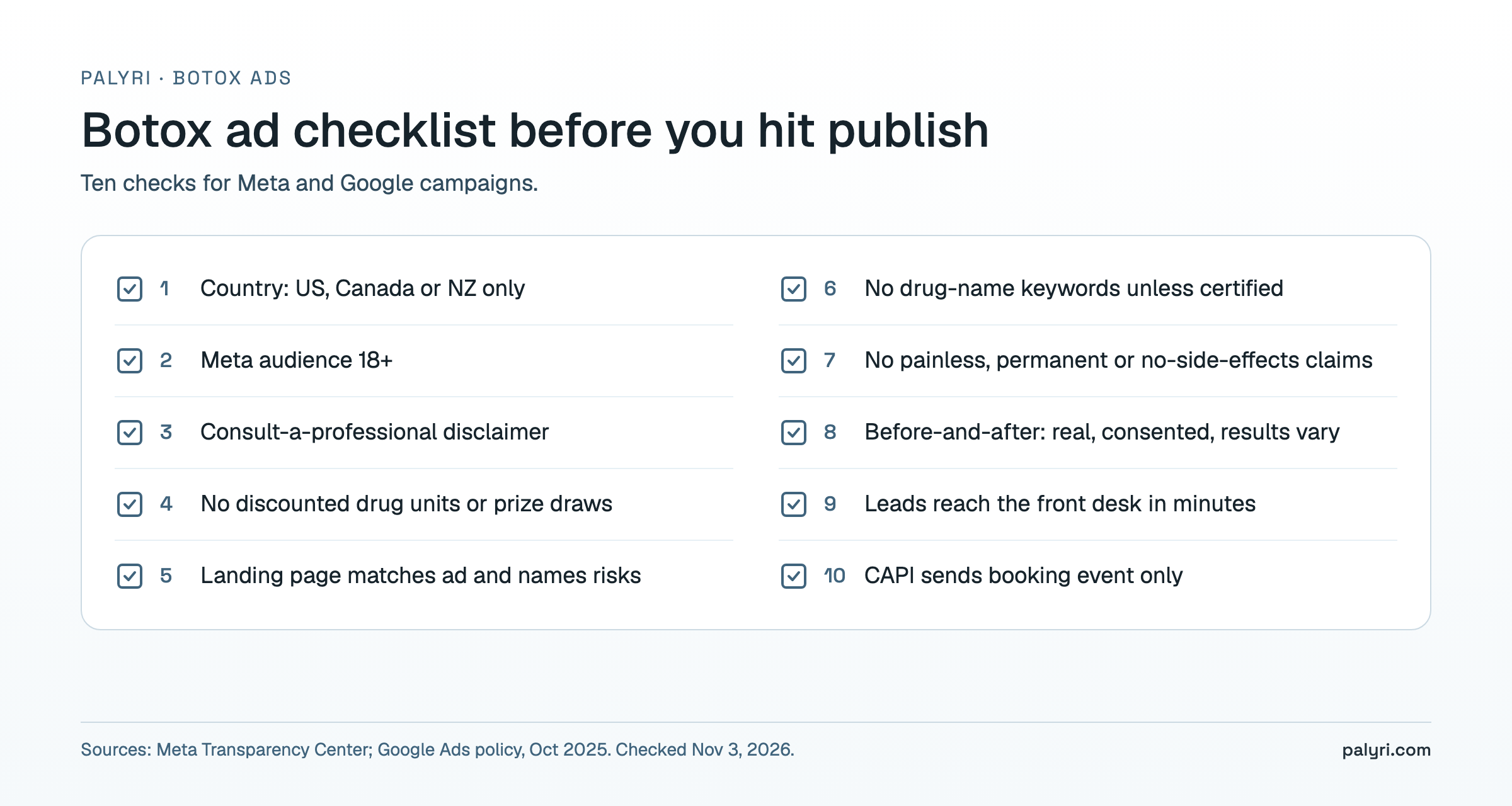
Run this list on every new Botox ad, in Meta Ads Manager or Google Ads, before you submit it for review.
| # | Check | Pass when |
|---|---|---|
| 1 | Country targeting | Drug-promoting ads target only the US, Canada or New Zealand, and only where you are certified |
| 2 | Age | Meta audience set to 18+ for any prescription drug ad |
| 3 | Disclaimer | "Consult a licensed health professional" or similar appears in ads that promote the drug |
| 4 | Offers | No discounted drug units, unit bundles or prize draws for treatment |
| 5 | Landing page | Says the same thing as the ad, names risks and leads to a consult |
| 6 | Google keywords | No drug-name keywords unless your account is certified |
| 7 | Claims | No "painless", "permanent", "no side effects" or outcome guarantees |
| 8 | Before-and-after | Real, unedited patient photos with consent and an "individual results vary" line |
| 9 | Lead routing | New leads reach the front desk within minutes, with a named owner |
| 10 | Conversion data | CAPI sends the booking event only, with no treatment or health details |
What to do with the leads Botox ads bring in
A compliant ad that books nobody is still wasted money. Because the safest Botox ads promote a consultation, the booked consult is the number to judge them by, and speed decides much of it. The mechanics are in our post on speed to lead for med spas.
Example (illustrative, all inputs assumed): a med spa spends $3,000 on consult-first Meta ads at an assumed $30 cost per lead, which gives 100 leads. If 25% book a consult, that is 25 consults, or $120 per booked consult ($3,000 / 25). If faster follow-up lifts the booking rate to 35%, the same spend gives 35 consults at about $86 each ($3,000 / 35). The ad did not change; the follow-up did.
Plug your own numbers into the calculator to estimate what a booked consult is worth. In Palyri, Meta lead ads flow straight into the CRM pipeline, and a Meta CAPI "Schedule" event is sent when a booking happens, so Meta can optimize for consults rather than form fills. Plan costs are on the pricing page.
FAQ
Can you advertise Botox on Facebook?
Yes, with conditions. Meta allows ads that promote prescription drugs only when the advertiser is actively certified by LegitScript or has passed Meta's internal review, has completed Meta's prescription drug onboarding, includes a disclaimer to consult a licensed health professional, and targets people 18 or older in the United States, Canada or New Zealand (Meta, checked Nov 3, 2026). Education and public service ads about prescription drugs are allowed without certification. Most med spas therefore advertise the consultation and the injector, which keeps the message about the appointment rather than the drug.
Can you use the word Botox in Google Ads?
In the United States, Canada and New Zealand, yes, in ad text and on landing pages. Since Google's update posted October 14, 2025, with enforcement from October 29, 2025, advertisers in those countries may use prescription drug terms for promotional purposes without certification (Google). Keyword-targeting those terms still requires certification. Outside these three countries, promotional use is not allowed. If you are not certified, bid on service keywords such as "frown line treatment near me" and mention the brand only in the ad copy and on the page.
Do med spas need LegitScript certification to run Botox ads?
It depends on the platform and the ad. On Meta, an ad that promotes a prescription drug needs LegitScript certification or approval through Meta's internal review process (Meta). An education ad or a consultation-first ad that does not promote the drug is a different case. On Google, certification is needed to keyword-target prescription drug terms, but not to use them in US, Canadian or New Zealand ad text and landing pages (Google). Without certification, build campaigns around consults, providers and education.
Is it legal to advertise Botox in the UK?
No, not to the public. The ASA has stated that Botox, as a prescription-only medicine, is prohibited by law from being advertised to the public directly or indirectly, including as part of a service offer (ASA, 2014). Removing the word from an ad does not fix a page that links straight to Botox content. Factual, balanced references online are allowed. UK clinics advertise the consultation and the practitioner instead; our guide to UK aesthetics marketing under ASA and CAP rules covers the detail.
Can you offer Botox discounts or specials in ads?
In the US, a price or unit discount on the drug turns the ad into promotion of a prescription drug, which on Meta brings in the full certification, disclaimer, country and 18+ conditions (Meta). The lower-risk route is to promote a consultation and discuss pricing there, and to avoid unit bundles and prize draws in ads. In the UK, any offer to treat consumers with a POM counts as advertising it, which the ASA describes as prohibited by law (ASA, 2014).
What disclaimer should a Botox ad include?
Meta's policy requires ads that promote prescription drugs to "include a disclaimer to consult a licensed health professional or obtain a valid prescription" (Meta, checked Nov 3, 2026). A simple version for a med spa ad: "Consult a licensed health professional. Individual results vary." Put it in the ad itself, not only on the landing page, and repeat a balanced risk line on the page. For before-and-after creatives, add the extra framing covered in our before-and-after ad rules post.
Want to implement this in your clinic?
Book a free Palyri demo. We'll show how it works on your clinic's data.
Book a demoPalyri blog author
Writes for the Palyri blog about getting clients from ads, handling leads and front-desk work in aesthetic clinics and beauty salons.