Most med spas need both jobs done, but not always two products: the EMR holds charts and consents, the CRM runs leads and pipeline. You need a clinical record from your first patient, and a separate CRM once paid leads outgrow what your EMR's built-in follow-up can track.
The timing is our judgment, not a legal rule. The med spa EMR vs CRM decision comes down to who owns which record, and Prospyr, which sells both jobs in one product, reaches the same split: "Most med spas end up needing both jobs done. The real decision is whether they run in one system or two."
Vendors wrote most of what you will read on this topic, and that includes this article. Palyri is a CRM, not an EMR. So below you get a field-by-field ownership map, a spec for what crosses between the two systems, and a rule for what stays out of ad platforms, with sources named.
Med spa EMR vs CRM: what is the difference?
An EMR is the clinical system. A CRM is the revenue and relationship system. Prospyr's one-line split is a good starting point: the EMR "holds the clinical record (medical history, treatment notes, consents, photos and prescriptions)," while the CRM "runs the patient relationship (leads, inquiries, reminders, campaigns and rebooking)."
Zenoti, which sells EMR and practice management in one platform, uses a three-record test: a clinical record, a commercial record and a relationship record. Its questions run from "what was done to this patient, by whom, with which product, at what dose" to "when they were last seen, what they were told, when they're due back."
The cleanest practical test is timing. A CRM record starts before anyone has become a patient. An EMR record starts once care begins.
| Question | EMR | CRM |
|---|---|---|
| Main job | Document care | Turn inquiries into booked, returning patients |
| Holds | History, notes, consents, photos, prescriptions | Lead source, stage, messages, campaigns, rebooking dates |
| Primary user | Providers and injectors | Front desk and marketing |
| Record starts when | Intake or first treatment | First ad click, form or call |
| Record ends when | Retention rules decide, and they vary by state | Marketing stops at opt-out or lost lead; keep the opt-out on file |
| Key reports | Treatments by provider, products used | Cost per booked consult, show rate, lost reasons |
| Cost of failure | Clinical and legal exposure | Paid leads that nobody works |
| Typical owner | Medical director | Practice manager or owner |
What should a med spa EMR do?
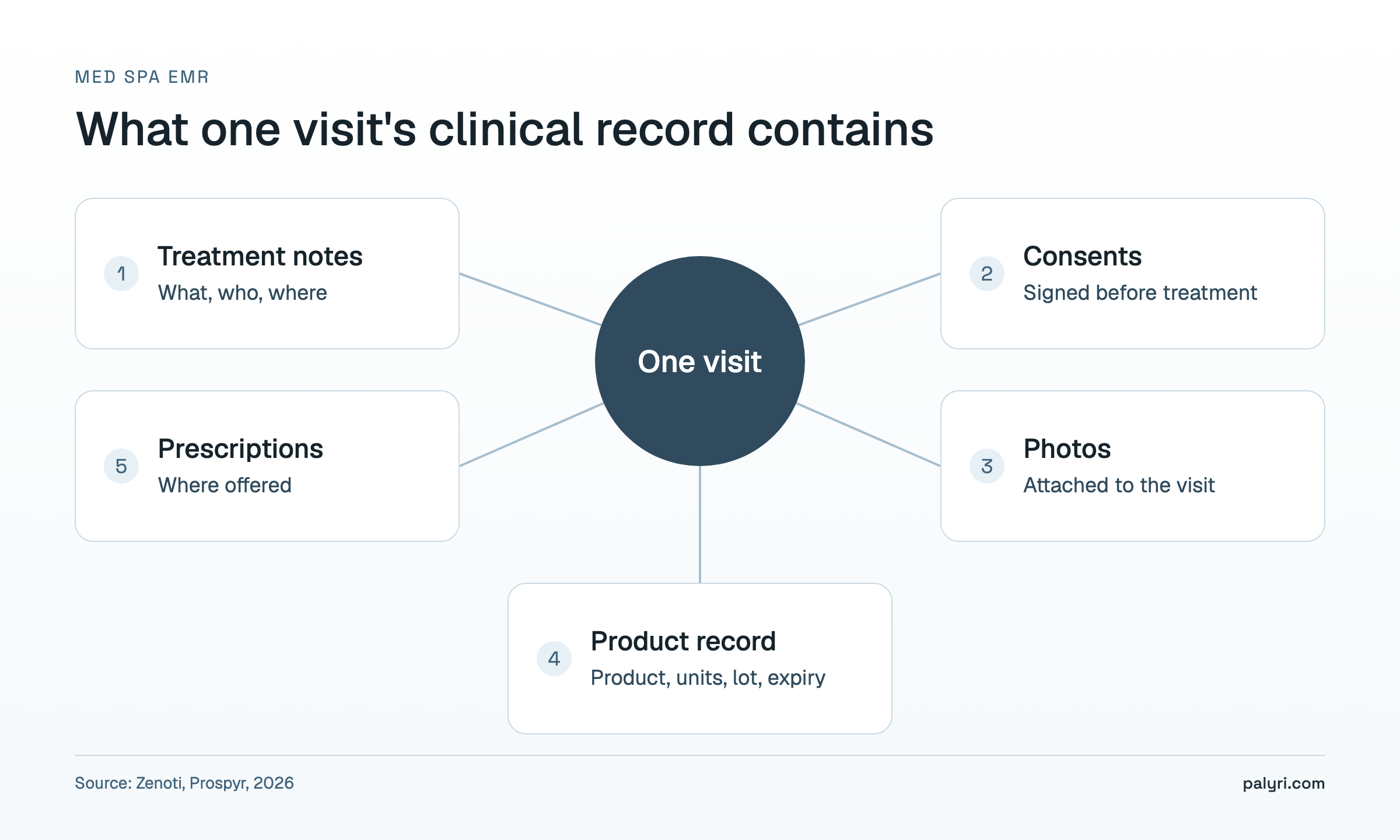
A med spa EMR should let a provider finish the clinical record for a visit without leaving the system. Zenoti describes the need as "treatment notes, consent, photos, and injectable records." Five parts make up that record:
- Treatment notes: what was done, by whom, in which area.
- Consents: signed before treatment and stored with the chart.
- Photos: attached to the visit, so before and after sets stay in order.
- Product records: Zenoti lists "structured injectable records (product, units, lot, expiry)" in its own product (checked November 4, 2026).
- E-prescribing, where offered: Zenoti says it provides this "through a Surescripts-certified partner in the US." Prospyr's definition also places prescriptions in the EMR.
The definitions go back to HealthIT.gov, 2011: an EMR is "a digital version of the paper charts in the clinician's office," and EHRs "focus on the total health of the patient." Vendors use the two terms loosely, so judge the features and not the label. Run one mock visit in a demo: chart it, attach a consent and photos, and log product, units and lot without leaving the screen.
What should a med spa CRM do?
A med spa CRM should answer one question every morning: which paid leads need a human today? Aesthetix CRM, a CRM vendor, lists email marketing, sales pipeline management and segmentation as the core tools. Prospyr adds inquiries, reminders, campaigns and rebooking. In practice, that adds up to seven jobs:
- Lead source: record the ad, campaign or form behind every inquiry.
- First response: timestamp it. Our guide to speed to lead for med spas covers why that clock matters.
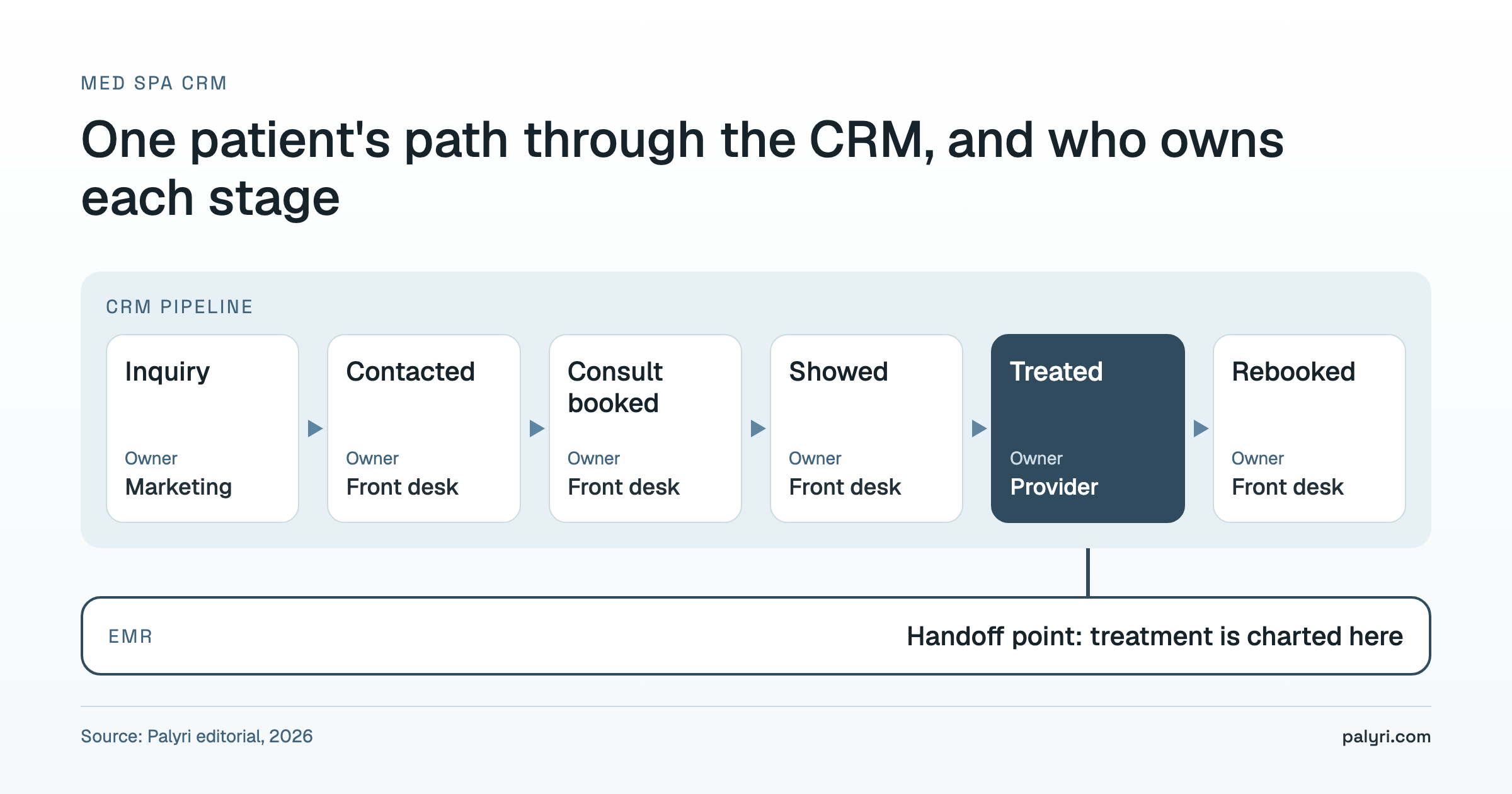
- Stages: show where each person sits, from inquiry to rebooked.
- Follow-up: run the sequence for people who go quiet. Use a 7-day lead follow-up cadence as the starting template.
- No-show recovery: move a missed consult into a rebooking task, not a dead end.
- Rebooking: trigger on a due-back date.
- Campaign results: tie spend to booked consults, not only to form fills.
None of these jobs needs a treatment note. That matters when you design the handoff later.
Do you need both an EMR and a CRM?
You need both jobs covered once you buy leads, and whether that means two products depends on how your practice gets patients. Prospyr's position on new practices is direct: a solo injector or new practice "needs an EMR from day one," and "a separate CRM can wait" if the EMR includes online booking, reminders and basic follow-up messages. The three cases below adapt that framing, and the last two rows are our judgment.
| Your practice | Start with | Add a CRM when |
|---|---|---|
| Solo or new, mostly referrals | EMR with booking and reminders | Inquiries start slipping through built-in follow-up |
| Growing on paid ads | EMR plus a real lead pipeline | Now, if you cannot see which ad produced which booked consult |
| Medical or surgical focus | EMR depth first | Clinical needs are covered and lead volume justifies a second tool |
Then choose one platform or two. Boulevard's guide, a vendor view written about practice management and EMR software, lists trade-offs that carry over here:
- Two specialized systems: deeper features tuned to one job, but "separate bills and likely greater costs," and harder setup with more chance of compatibility errors.
- One platform: "a single, less costly bill," but possibly less customizable for your workflow.
All-in-one is a real option. PatientNow's Standard plan lists both "Complete EMR & practice management" and "Lead management and patient communications" (wording checked October 20, 2026; pricing is quote-only). For vendor detail, see med spa software compared. If you have settled on a separate tool, read how to choose a CRM.
Which system should own which field?
Every field needs exactly one system of record. When two systems both think they own a field, staff stop trusting either one. Use this map whether you run one platform or two, and fill the "calendar system" rows with whichever tool actually holds your schedule.
| Field | System of record | May it copy to the other system? |
|---|---|---|
| Lead source | CRM | Yes, to the EMR as a referral note |
| Ad and campaign | CRM | No need |
| First response time | CRM | No need |
| Pipeline stage | CRM | No need |
| Lost reason | CRM | No need |
| Consult date | Calendar system | Yes, date and time only |
| Appointment | Calendar system | Yes, from the calendar system to the other system only |
| Show or no-show | Calendar system | Yes, to the CRM as a status |
| Allergies and history | EMR | No |
| Treatment notes | EMR | No |
| Photos | EMR | No |
| Signed treatment consent | EMR | No |
| Texting consent | System that sends the texts | Yes, to any other system that texts |
| Last treatment date for rebooking | EMR | Yes, to the CRM as a date, never the note |
| Due-back date | EMR | Yes, to the CRM as a date |
| Broad treatment type | EMR | Only if rebooking needs it, as a category, never the note |
Read the second column first. Lead and campaign fields belong to the CRM, scheduling fields belong to whichever tool holds the calendar, and clinical fields belong to the EMR and stay there. Apart from lead source, texting consent and an optional treatment category, only dates and statuses cross.
Texting needs its own record, separate from the treatment consent in the EMR. The FCC states that its rules ban autodialed texts to a mobile phone "unless the phone owner previously gave consent to receive the message or the message is sent for emergency purposes." Under 47 CFR 64.1200(a)(10), replies such as "stop," "quit" or "unsubscribe" are a reasonable way to revoke consent. So whichever system sends texts must log both the opt-in and the opt-out.
How should an EMR and CRM connect?
An EMR and CRM should exchange the least data that keeps follow-up accurate: dates, statuses and at most a broad treatment type, not notes. Zenoti's warning is the reason to take this seriously: "a disconnected system is where the clinical and commercial records drift apart." It also argues that "integrations matter more than features."
Apply a least-data rule. Send "last visit date" and "due back" to the CRM, and leave the note where it is. Prospyr's check, "Does treatment history reach the CRM, so a follow-up can be based on what was actually done?", is fair, but a date and a broad treatment type usually cover it.
Some CRMs advertise ready-made connections. Aesthetix CRM says it syncs with Boulevard, Zenoti, PatientNow and Mangomint (vendor claim, checked November 4, 2026). Ask any vendor to show you which fields move, in which direction.
Items 1 to 4 adapt Prospyr's connection checks; the rest are ours.
- How is the same patient matched in both systems: phone, email, or both?
- What happens with duplicates, and who merges them?
- Which system owns the appointment?
- How fast do changes sync? Reschedule one test appointment and time it.
- Which fields move, and in which direction? Compare with your ownership map.
- Can you block notes, photos and consents from crossing?
- Does role-based access stop marketing staff from seeing clinical fields?
- Can you export all your records in a usable format, including when you leave?
- Can you delete a lead or contact on request, and what stays behind?
- Who gets alerted when a sync fails, and is there a log of changes?
No integration available? Use a manual weekly step, and treat it as a workaround. Example: every Monday, the front desk exports last week's completed visits from the EMR and updates only two CRM fields, last visit date and due-back date. It is slower, but it keeps notes out of the CRM.
What data should never reach ad platforms?
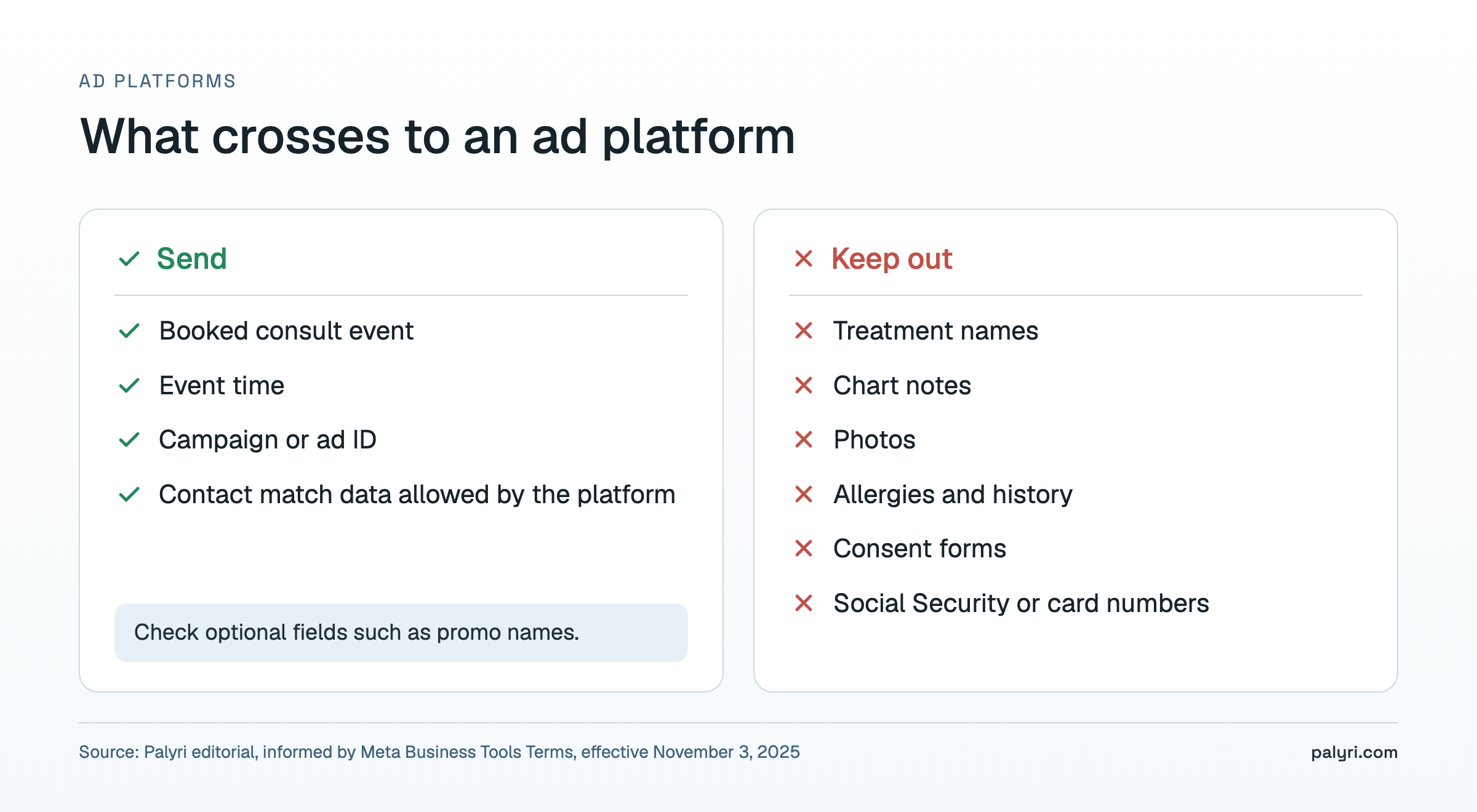
Clinical data should never reach an ad platform. Meta's Business Tools Terms (effective November 3, 2025) bar sharing data that includes or is based on health, financial or other sensitive information, along with identifiers such as Social Security or credit card numbers. This section uses Meta's terms as the example, so read the terms of each platform you use and take legal questions to your counsel. Google's restricted targeting policy, for one, lists health among its sensitive categories (checked November 4, 2026).
The working rule: tell the ad platform that a consult was booked, not what it was for. Our guide to sending booked consults to Meta covers the setup. Check the optional fields too. A promo or campaign name placed in an event can name a treatment without anyone intending it.
Contact match data means details such as an email address or phone number that a platform uses to match an event to a person. Meta's terms require it to be hashed, meaning turned into a scrambled code, before it is shared.
What does a lost lead cost compared with a second system?
It depends on your numbers: a lead is worth your lead-to-consult rate times your consult-to-purchase rate times your first ticket.
Example, with every figure assumed: a med spa gets 100 leads a month, and 35 become booked consults. Of those consults, 60% buy, at a $500 first ticket. That is $105 per lead on these assumptions (0.35 x 0.6 x $500). Better tracking and follow-up then lift booked consults from 35 to 40.
5 extra consults x 0.6 x $500 = $1,500 a month in first-visit revenue.
Swap in your own numbers with the med spa ROI calculator. Then compare gross margin on the added revenue, not the revenue itself, with the second system's monthly bill from Palyri pricing or any other vendor, plus staff time for keeping two systems aligned. At an assumed 50% gross margin, the $1,500 above is $750 a month, so the second system pays for itself only if its bill and staff time come in under that.
Where Palyri fits: it is a CRM for medical aesthetics practices, not an EMR, so keep charts and consents in your EMR. It is not a booking engine and does not take payments, so your schedule and checkout stay in another tool. It covers Meta lead ads intake, an embeddable lead form, a pipeline, automated follow-up sequences, patient segments and tags, role-based permissions, audit logs, and a Meta "Schedule" event for booked consults.
It has no EMR integration today, so the manual step above would apply. It is the wrong buy if you do not run ad-driven leads, or if your all-in-one already covers follow-up.
Frequently asked questions
Is an EMR the same as an EHR for a med spa?
Not exactly. HealthIT.gov's 2011 definition calls an EMR the medical and treatment history of patients "in one practice," while EHRs are designed to reach beyond the organization that collected the data. Zenoti says "Most medspas do not need an EHR," because cross-provider sharing is rarely relevant to a cash-pay practice. Vendors use both labels loosely, so check for four things instead: treatment notes, consents, photos and injectable records.
Can a CRM replace an EMR in a med spa?
No. A CRM tracks leads, stages, messages and rebooking, while the EMR holds the clinical record: history, treatment notes, consents, photos and prescriptions. Even when a CRM has patient profile fields, it may not be built as your chart, so ask how it handles signed consents and product records before relying on it.
Palyri, for one, is a CRM and not an EMR, and charts belong in your EMR. If you want a CRM alongside it, start with how to choose a CRM.
Does a med spa need an EMR from day one?
Prospyr's view is yes: a solo injector or new practice "needs an EMR from day one," since charting, consents and photos are not optional. That is vendor advice, not a legal rule.
Treat a clinical record from your first patient as the baseline, and a dedicated system as the practical way to keep it. Record retention rules vary by state, so confirm yours with counsel. A CRM can wait if your EMR already handles online booking, reminders and basic follow-up.
Can an EMR replace a CRM?
Sometimes. If you run on referrals and your EMR includes online booking, reminders and basic follow-up, a separate CRM can wait, as Prospyr notes.
The test is whether your EMR shows four things for each lead: source, first response time, pipeline stage and lost reason. If it cannot, paid leads will go unworked without anyone noticing. Speed to lead for med spas explains why the response clock is the first field to check.
Which system should send appointment reminders?
The system that owns the appointment should send reminders, and only that one. Prospyr's definition lists reminders under the CRM, which works if your CRM also holds the calendar. If both systems send them, patients get duplicates and nobody knows which message was seen.
Keep the CRM on the work around the appointment: follow-up before a consult is booked, recovery after a no-show and rebooking later. Whichever system texts must hold the patient's texting consent and honor opt-outs, because the FCC's consent rule applies to autodialed texts whatever the software.
What integrations should a med spa EMR have?
Start with the connections your workflow touches daily: online booking, your CRM or lead tool, payments if they sit elsewhere, and e-prescribing if your providers prescribe. Zenoti, for example, lists e-prescribing through a Surescripts-certified partner in the US.
For each connection, get three answers: which fields move, in which direction and how fast. Then test one real change before you sign. For a vendor-by-vendor view, see med spa software compared.
Want to implement this in your clinic?
Book a free Palyri demo. We'll show how it works on your clinic's data.
Book a demoPalyri blog author
Writes for the Palyri blog about getting clients from ads, handling leads and front-desk work in aesthetic clinics and beauty salons.