A two-injector practice books two demos in one week. By Friday the notes say "both do photos" and nothing else. Here is how to get a real answer instead.
Neither wins for every med spa. PatientNow is an all-in-one platform built around the clinical record and its RxPhoto system, with quote-only pricing. Aesthetic Record lists a per-user price ($15 or $19 per user per month as listed on 2026-11-24, plus a $399 onboarding fee) and bundles EMR, inventory, photos and CRM tools.
This guide compares them on charting, photos, inventory, memberships, messaging, multi-location and cost logic. It ends with a demo script of 8 tests you can run on both vendors with the same patient file. Every vendor fact below links to the vendor page or a named review platform and carries the date it was checked.
PatientNow vs Aesthetic Record: which is better for a med spa?
It depends on how your practice works. The table below the next section gives the detail; this is the short version.
PatientNow describes itself as software that connects scheduling, EMR, payments, memberships, and marketing in one med spa software. Aesthetic Record describes itself as EMR, scheduling, inventory, CRM and more. Both are all-in-one pitches. The practical difference is how you buy: PatientNow builds a custom quote, Aesthetic Record publishes tiers.
PatientNow vs Aesthetic Record side by side
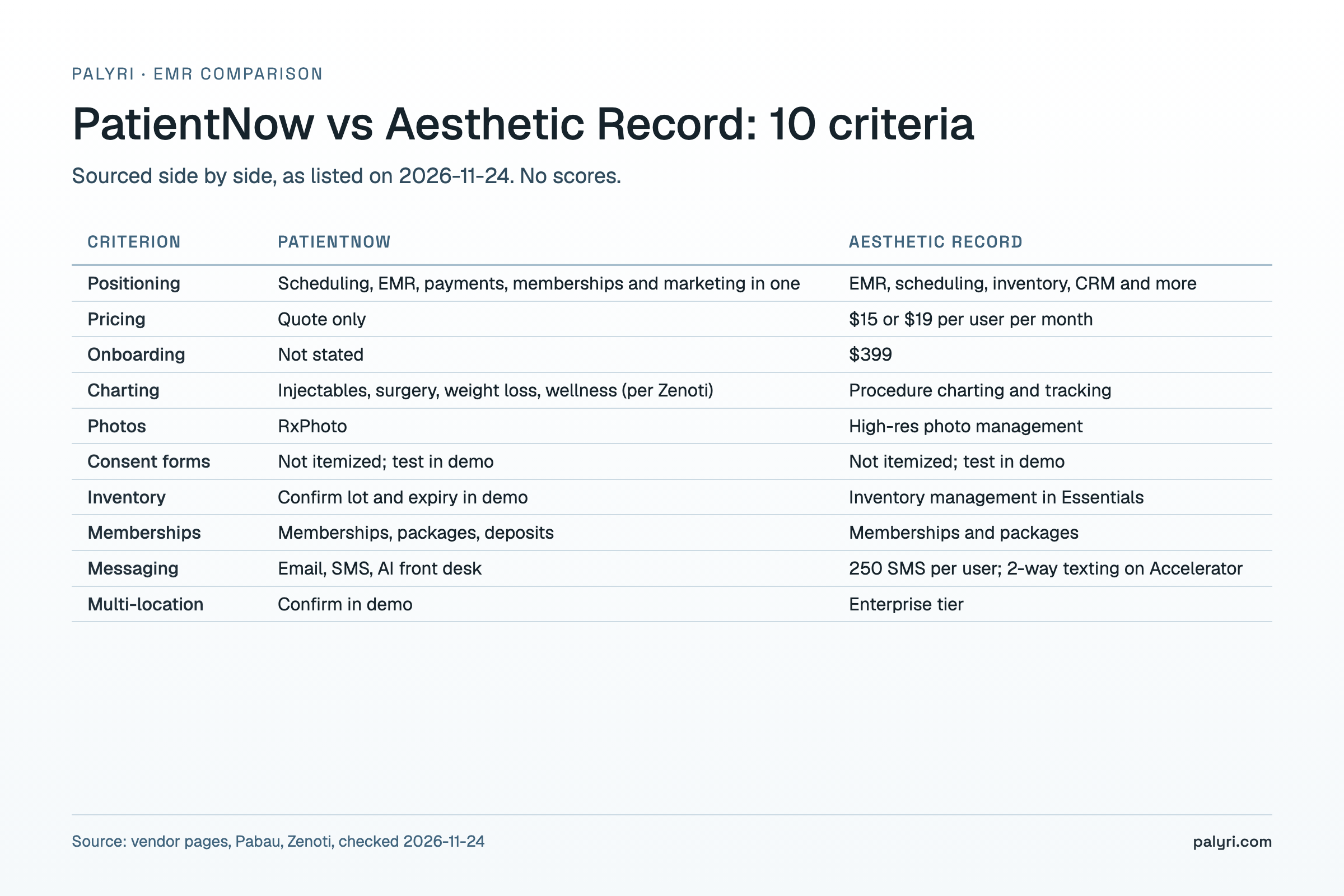
Ten criteria, each taken from the vendor's own wording or a named competitor, with the page and the date checked (2026-11-24). Where only a competitor states something, the cell says so. Where nothing public was found, the cell says "not stated" rather than guessing.
| Criterion | PatientNow | Aesthetic Record |
|---|---|---|
| Positioning | Scheduling, EMR, payments, memberships and marketing in one med spa software (vendor page) | "EMR, scheduling, inventory, CRM & more" (vendor homepage) |
| Pricing model | Custom quote; no public figures (per Pabau, a competitor) | Essentials $15 and Accelerator $19 per user per month, Enterprise by inquiry only (pricing page) |
| Onboarding | Not stated publicly | $399 startup and onboarding investment on both listed tiers (pricing page) |
| Charting | Charts injectables, surgery, weight loss and wellness visits (per Zenoti, a competitor) | "Procedure Charting & Tracking" in Essentials (pricing page) |
| Photos | RxPhoto, which the vendor calls "the leader in medical photography" (vendor claim); shares one patient timeline with the EMR (per Pabau) | "High-Res Photo Management" in Essentials; "Dynamic Before & After Videos" in Accelerator (pricing page) |
| Consent forms | Listed among the records an EMR should store, in the vendor's own EMR guide; feature detail not on that page | Not itemized on the pricing page; test it in the demo |
| Inventory | Lot and expiration tracking "isn't stated as a PatientNow feature" (per Pabau; competitor claim, confirm with the vendor) | "Inventory Management" in Essentials (pricing page) |
| Memberships and packages | Memberships, packages and prepaid treatments with deposits (vendor page) | Memberships, package creation and treatment subscriptions listed (pricing page) |
| Messaging and marketing | Email, SMS and an AI front desk called Recura; Recura was acquired in October 2025 (per Zenoti) | 250 SMS and 300 emails per user per month on Essentials; 2-way texting on Accelerator only (pricing page) |
| Multi-location | "One account for every location" was listed as "Coming soon" (per Zenoti; the page's date is not stated, so ask PatientNow for the current status) | Enterprise tier is contact-us; confirm location features in the demo (pricing page) |
Charting, photos and consents: how do they differ for injectors?
Both vendors cover the core record. PatientNow's EMR charts injectables, surgery, weight loss and wellness visits, and its RxPhoto tools let a practice mark injection sites, units and notes on the image, according to Zenoti. Pabau adds that the EMR and RxPhoto share one patient timeline. That is a strength for practices where photos drive every visit note.
Aesthetic Record lists procedure charting, high-res photo management and inventory management in its Essentials tier. Before-and-after videos sit one tier up, in Accelerator. Storage is capped at 2 GB per user on Essentials and 4 GB per user on Accelerator, which matters if you shoot a lot of high-resolution photos (pricing page).
On consents, neither vendor page we checked itemizes the feature. PatientNow's own guide says a med spa EMR stores treatment notes, consent forms, clinical history, photos, and outcomes in one record. That is a category definition, not a feature list. Test 3 below covers consent signing.
How much do PatientNow and Aesthetic Record cost?
PatientNow does not publish prices. Pabau notes that PatientNow builds each quote around practice size, locations and the features needed, and Zenoti says it uses custom pricing. Any figure you see for it elsewhere is not from the vendor. We do not guess one.
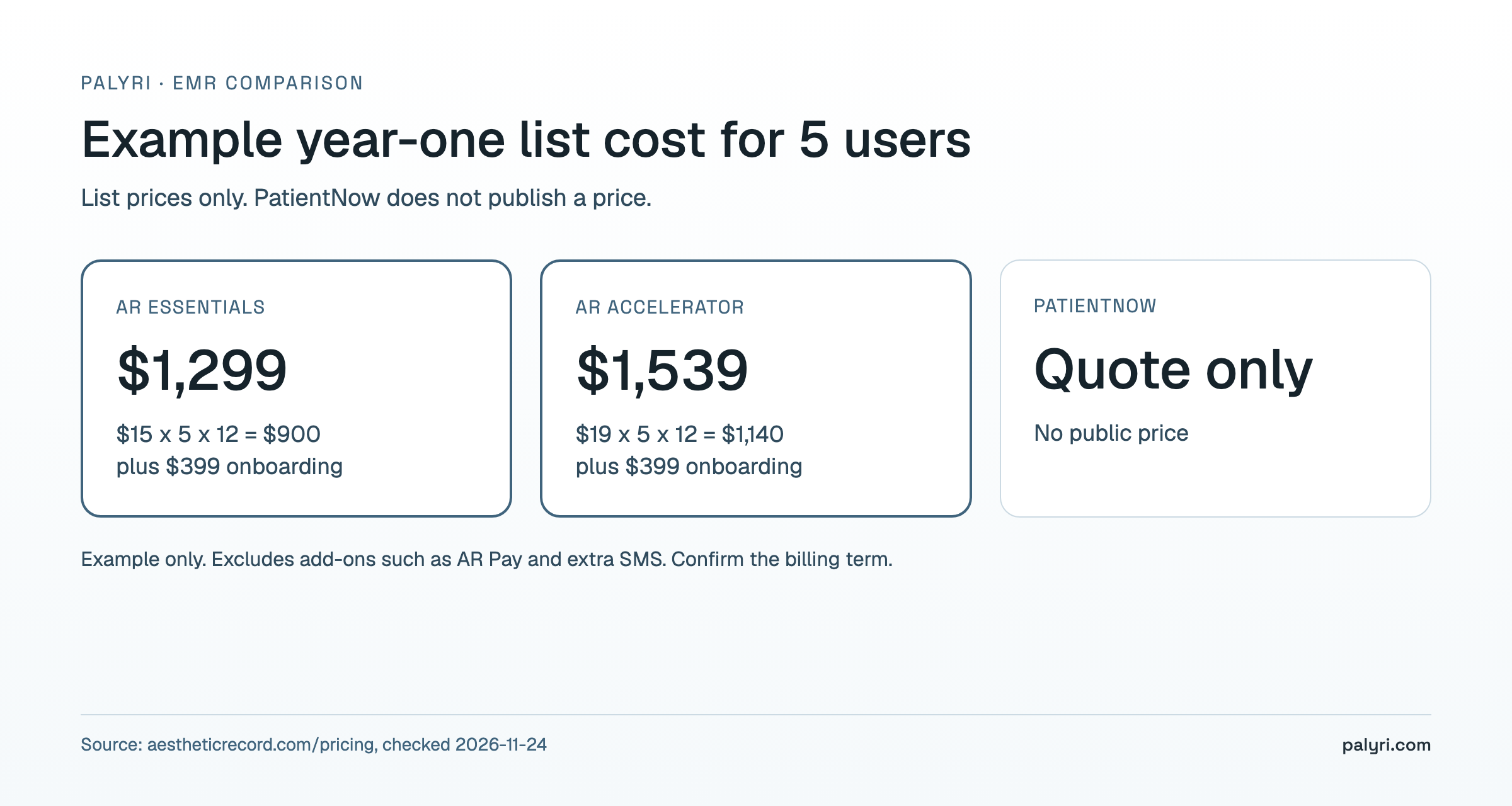
Aesthetic Record lists Essentials at $15 per user per month and Accelerator at $19, each with a $399 startup and onboarding investment. The page has an Annual toggle and does not say which billing term the displayed rate reflects, so confirm that before you budget. SMS and email above the included quotas, and features marked as additional cost such as AR Pay, are extra.
Example, not a quote: a med spa with 5 users on Aesthetic Record Essentials pays 5 x $15 = $75 per month, so year one is $75 x 12 + $399 = $1,299. On Accelerator it is 5 x $19 = $95 per month, so year one is $95 x 12 + $399 = $1,539. This uses list prices and excludes add-ons and extra messages.
For the full breakdown of each vendor's pricing, see our guides to Aesthetic Record pricing and PatientNow pricing, public versus quote-only. To estimate what a software change must return, use the Palyri ROI calculator.
What do reviews say about each?
Review platforms list both products, but ratings move, so we link them instead of quoting scores we could not verify on the day. Capterra publishes a PatientNow vs Aesthetic Record comparison page and G2 lists PatientNow reviews. Check the number of reviews, the date of the newest ones and the reviewer's practice size; a few detailed med spa reviews say more than a large mixed pool.
Which one fits your med spa? Decision rules by practice type
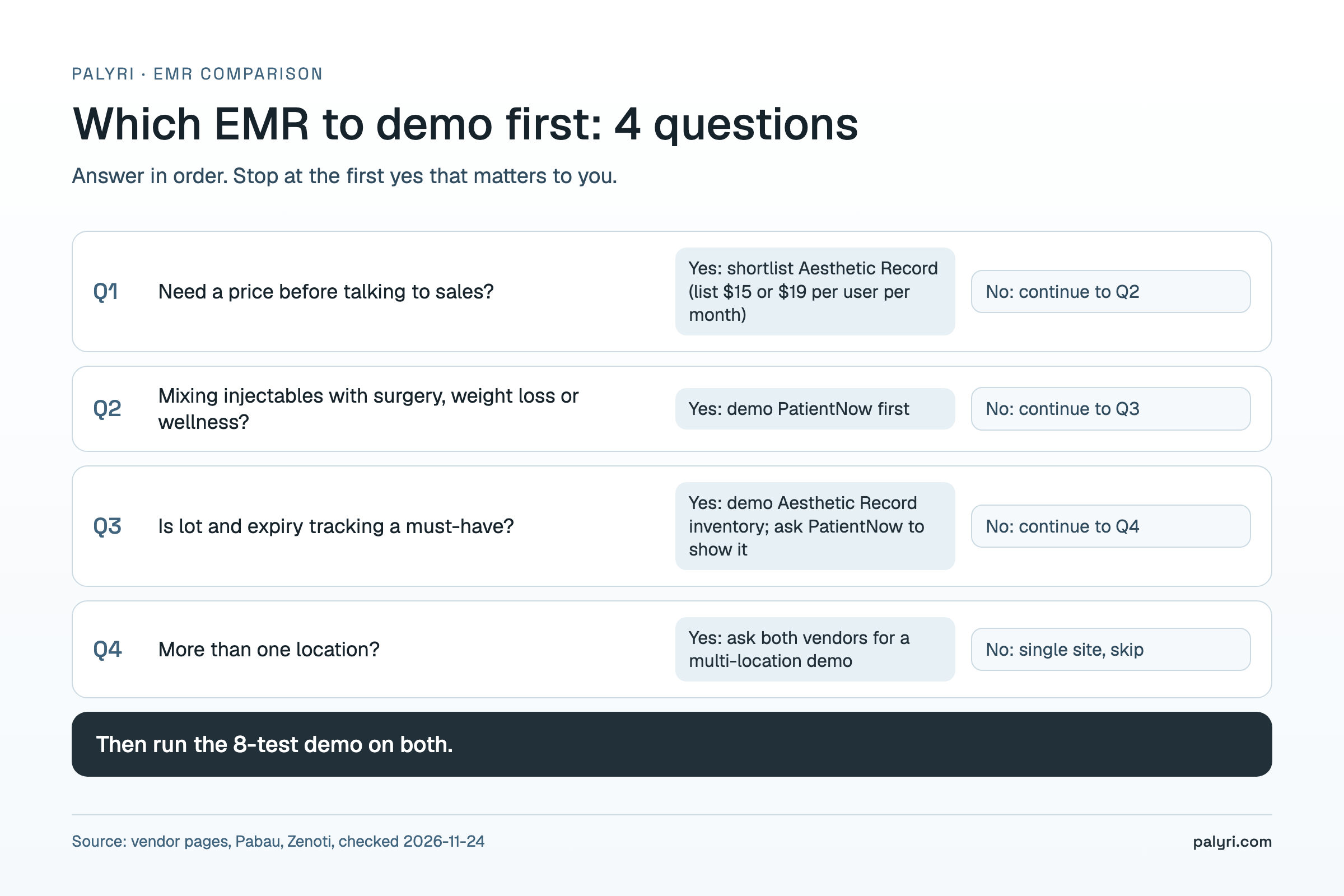
Use the practice profile first, then confirm in the demo. These rules are our reading of the sourced facts above, not vendor claims.
| Your practice | Lean toward | Why, from the sources |
|---|---|---|
| Solo injector or 1-3 users, wants a known cost | Aesthetic Record | Listed per-user price and onboarding fee make year-one cost calculable (pricing page) |
| Injectables plus surgery, weight loss or wellness | PatientNow | Charts all four visit types, per Zenoti; vendor says it serves med spas of all sizes |
| Photo-heavy practice, marks units on images | PatientNow, then test Aesthetic Record | RxPhoto injection-site marking, per Zenoti and Pabau (competitors); compare against AR photo storage caps |
| Strict inventory and lot tracking | Aesthetic Record, then ask PatientNow | Inventory is listed in AR Essentials; PatientNow lot tracking is unconfirmed |
| 2-3 locations | Ask both | PatientNow multi-location was "Coming soon" per Zenoti (date not stated, so ask for current status); AR multi-location sits in the Enterprise tier |
| Switching from a salon app | Either, test the import | PatientNow argues salon-first systems lack structured charting; vendor marketing, so test it |
For a wider view of the category, see best med spa software compared.
How to demo both: 8 tests to run with the same patient file
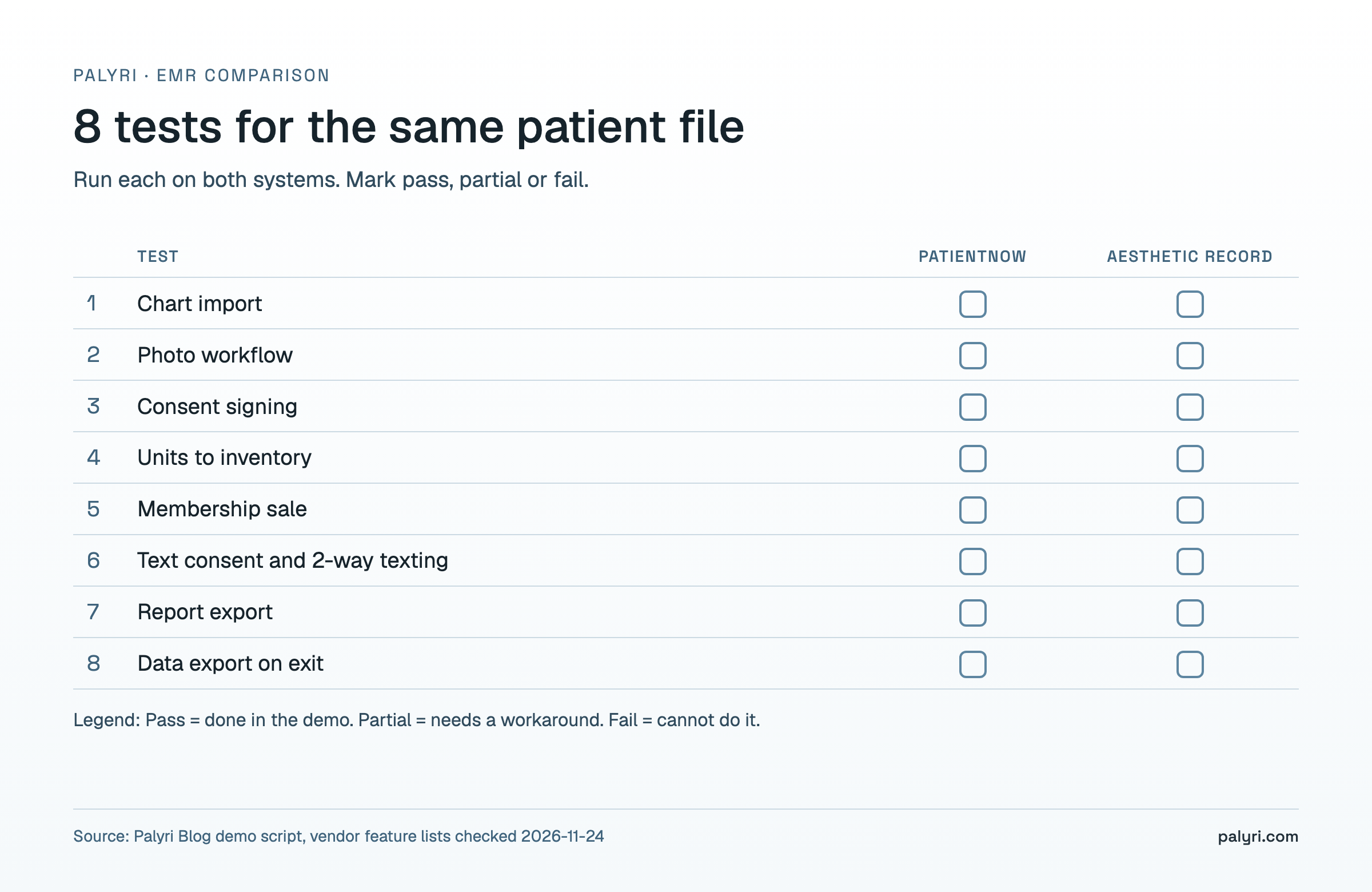
Vendors demo with clean sample data. Bring one real, anonymized patient file and run the same 8 tests with both, so differences come from the software and not the sales rep. Score each test pass, partial or fail, and write down who showed it live versus described it.
| # | Test | What to do | Pass means |
|---|---|---|---|
| 1 | Chart import | Ask how a legacy chart and history come in. Import or view a sample. | Notes, history and allergies land in structured fields, with a stated timeline and cost |
| 2 | Photo workflow | Take 3 photos on a tablet, tag them, compare against a prior visit. | Side-by-side view works; injection sites and units can be marked; storage limit is stated |
| 3 | Consent signing | Send a consent form, sign it on a tablet, find it in the chart. | Signed form is time-stamped and attached to the visit |
| 4 | Units to inventory | Chart 40 units of a neurotoxin and check stock. | Stock reduces; lot number and expiry are recorded and searchable |
| 5 | Membership sale | Sell a package and a monthly membership, then redeem a session. | Balance, billing date and redemption are correct without manual edits |
| 6 | Text consent and 2-way texting | Send a reminder and reply from a test phone. Ask where texting consent is stored. | Reply threads into the chart; consent status is visible; the plan tier includes it |
| 7 | Report export | Export revenue by provider and treatment for last month. | The report exports to a file without a support ticket |
| 8 | Data export on exit | Ask for a written description of exporting charts, photos and consents if you leave. | Full export, format and fees stated in writing |
Test 6 matters for compliance. Texting patients requires prior consent under the FCC's TCPA rules, so ask where each system records it. Aesthetic Record lists 2-way texting under Accelerator, so the cheaper tier does not include it.
Do you still need a CRM next to your EMR?
Often yes. An EMR records what happens after the patient is in the room. It does not necessarily manage the path from ad click to first consult. Aesthetic Record's Accelerator tier even lists integrations with third-party CRMs such as Constant Contact, ActiveCampaign, Mailchimp, Zoho and HubSpot, which shows how common the pairing is.
If you pick either EMR and still lose leads between the ad click and the first consult, a CRM layer handles that. Palyri is a CRM and lead pipeline for aesthetic practices: Meta lead ads into a pipeline, follow-up, and a booked visit. It is not an EMR and does not do charting or payments. The split is explained in med spa EMR vs CRM, and the CRM side is described on our page on CRM for aesthetic medicine and in Palyri pricing.
FAQ
Which is better for med spas, PatientNow or Aesthetic Record?
Neither is better for every practice. PatientNow positions itself as one platform for scheduling, EMR, payments, memberships and marketing, and its price is a custom quote. Aesthetic Record lists $15 or $19 per user per month plus a $399 onboarding fee, and includes inventory management in its base tier. Pick by workflow: photo-heavy and mixed-service practices should demo PatientNow, while cost-led practices with inventory needs should demo Aesthetic Record. Run the 8-test script in this guide on both before deciding.
How much does PatientNow cost?
PatientNow does not publish pricing. Competitors such as Pabau and Zenoti report that quotes are custom and depend on practice size, locations and features. Ask for a written quote that lists setup, per-user or per-location fees, payment processing, messaging and photo storage, and the contract term. Our guide to PatientNow pricing covers what to request. Figures from third-party sites are not from the vendor, so treat them as unverified.
How much does Aesthetic Record cost?
As listed on the vendor's pricing page on 2026-11-24, Essentials is $15 per user per month and Accelerator is $19, each with a $399 startup and onboarding fee. Enterprise is contact-us. Confirm whether the displayed rate is annual or monthly billing. The Aesthetic Record pricing breakdown shows the arithmetic.
Does either include photo management?
Yes. Aesthetic Record lists high-res photo management in Essentials and before-and-after videos in Accelerator, with 2 GB or 4 GB of storage per user depending on the tier. PatientNow offers RxPhoto, which its vendor page calls the leader in medical photography, a self-description rather than an independent ranking. Competitors report it shares one timeline with the EMR and lets you mark injection sites and units on the image.
Can I switch between them and keep my charts and photos?
Possibly, but confirm it in writing. Neither vendor page we checked describes data export or import in detail, so this is a question for the sales call, not an assumption. Ask each vendor what formats charts, photos and signed consents export in, whether there is a fee, and how long it takes. Tests 1 and 8 in the demo script cover both directions.
Do I need a CRM as well as an EMR?
If most of your patients come from ads, a CRM is worth considering alongside either EMR. The EMR holds the clinical record; a CRM tracks leads from first click through follow-up to a booked consult. Some EMRs include basic marketing tools, so check whether yours covers lead follow-up before adding software. Our guide to med spa EMR vs CRM explains how the two split the work, and the lead follow-up cadence guide shows what to send.
Want to implement this in your clinic?
Book a free Palyri demo. We'll show how it works on your clinic's data.
Book a demoPalyri blog author
Writes for the Palyri blog about getting clients from ads, handling leads and front-desk work in aesthetic clinics and beauty salons.