PatientNow does not publish prices: all three plans, Standard, Amplify and Catalyst, are listed as "Pricing tailored to your practice," and the price depends on the plan, your practice size, how many locations you run and the add-ons you pick (PatientNow pricing page, as listed on 2026-11-16). What is public is the plan names, what each plan includes, the add-on list and those four price drivers; every dollar figure in PatientNow pricing is quote-only.
That makes the useful question less "how much?" and more "what exactly will my quote cover?" This guide maps the public and quote-only parts, lists what each plan adds, and gives you a ready-to-send question checklist and a year-one cost worksheet so you can compare a PatientNow quote line by line.
How much does PatientNow cost in 2026?
There is no public answer in dollars. The vendor page says: "No two practices price the same, so we build a quote around your size, locations, and the features you need," and every plan card leads to a quote request rather than a price (PatientNow, as listed on 2026-11-16). Pricing is shown "in a personalized demo, no obligation," requested through the PatientNow demo form or by phone at 800-436-3150.
Review platforms do not fill the gap. G2's PatientNow pricing page lists no published pricing and points buyers to the vendor (as listed on 2026-11-16). Some third-party sites and competitor blogs print monthly estimates, but those figures conflict with each other, and even the Pabau article that relays them notes that PatientNow does not confirm them. This guide repeats none of them: only a written quote counts.
| Item | Public on patientnow.com? | Where you get it |
|---|---|---|
| Plan names (Standard, Amplify, Catalyst) | Yes | Pricing page |
| Features included in each plan | Yes, with some items marked * | Pricing page |
| Add-on and integration list (18 items) | Yes | Pricing page |
| What drives the price (plan, size, locations, add-ons) | Yes | Pricing page |
| Monthly subscription fee | No | Written quote |
| Per-user, per-provider or per-location basis | No | Written quote |
| Setup, onboarding and data migration fees | No | Written quote |
| Add-on prices | No | Written quote |
| Marketing and user limits per plan | No numbers published | Written quote |
| Contract length, renewal and overage terms | No | Contract |
PatientNow plans compared: Standard vs Amplify vs Catalyst
The three plans stack: Amplify is "Everything in Standard, plus," and Catalyst is "Everything in Amplify, plus" (PatientNow, as listed on 2026-11-16). AI Scribe appears on all three cards, so it is not an upgrade item.
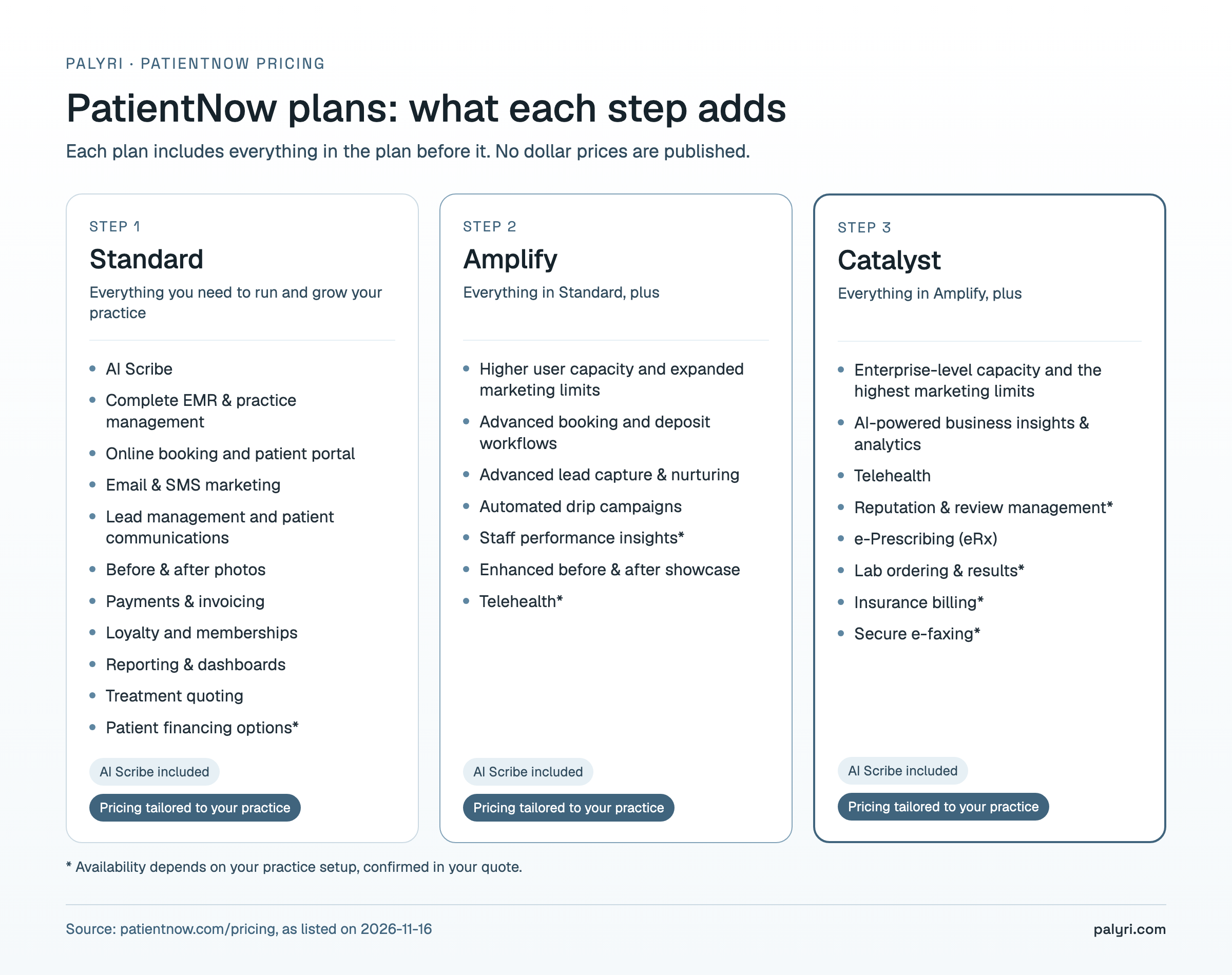
| Plan | Positioning (vendor wording) | What it adds |
|---|---|---|
| Standard | "Everything you need to run and grow your practice." | AI Scribe, complete EMR and practice management, online booking and patient portal, email and SMS marketing, lead management and patient communications, before and after photos, payments and invoicing, loyalty and memberships, reporting and dashboards, treatment quoting, patient financing options* |
| Amplify | "Scale faster with advanced marketing and automation." | Higher user capacity and expanded marketing limits, advanced booking and deposit workflows, advanced lead capture and nurturing, automated drip campaigns, staff performance insights*, enhanced before and after showcase, telehealth* |
| Catalyst | "The complete platform for high-growth practices." | Enterprise-level capacity and the highest marketing limits, AI-powered business insights and analytics, telehealth, reputation and review management*, e-prescribing (eRx), lab ordering and results*, insurance billing*, secure e-faxing* |
Two details matter for your quote. First, "capacity" and "marketing limits" rise by plan, but the page gives no numbers, so ask for the user count and the monthly email and SMS allowance in writing. Second, the jump from Amplify to Catalyst is mostly clinical depth (eRx, labs, insurance billing), so a med spa that does not prescribe or bill insurance should check whether Amplify plus one or two add-ons covers it.
What affects your PatientNow quote?
PatientNow names four price drivers: "The plan you choose," "Your practice size," "How many locations you run" and "The add-ons you pick" (PatientNow, as listed on 2026-11-16). The add-ons are "Optional add-ons to power your practice, available on any plan," sorted into three tabs: Clinical, Growth and marketing, and Operations and integrations.
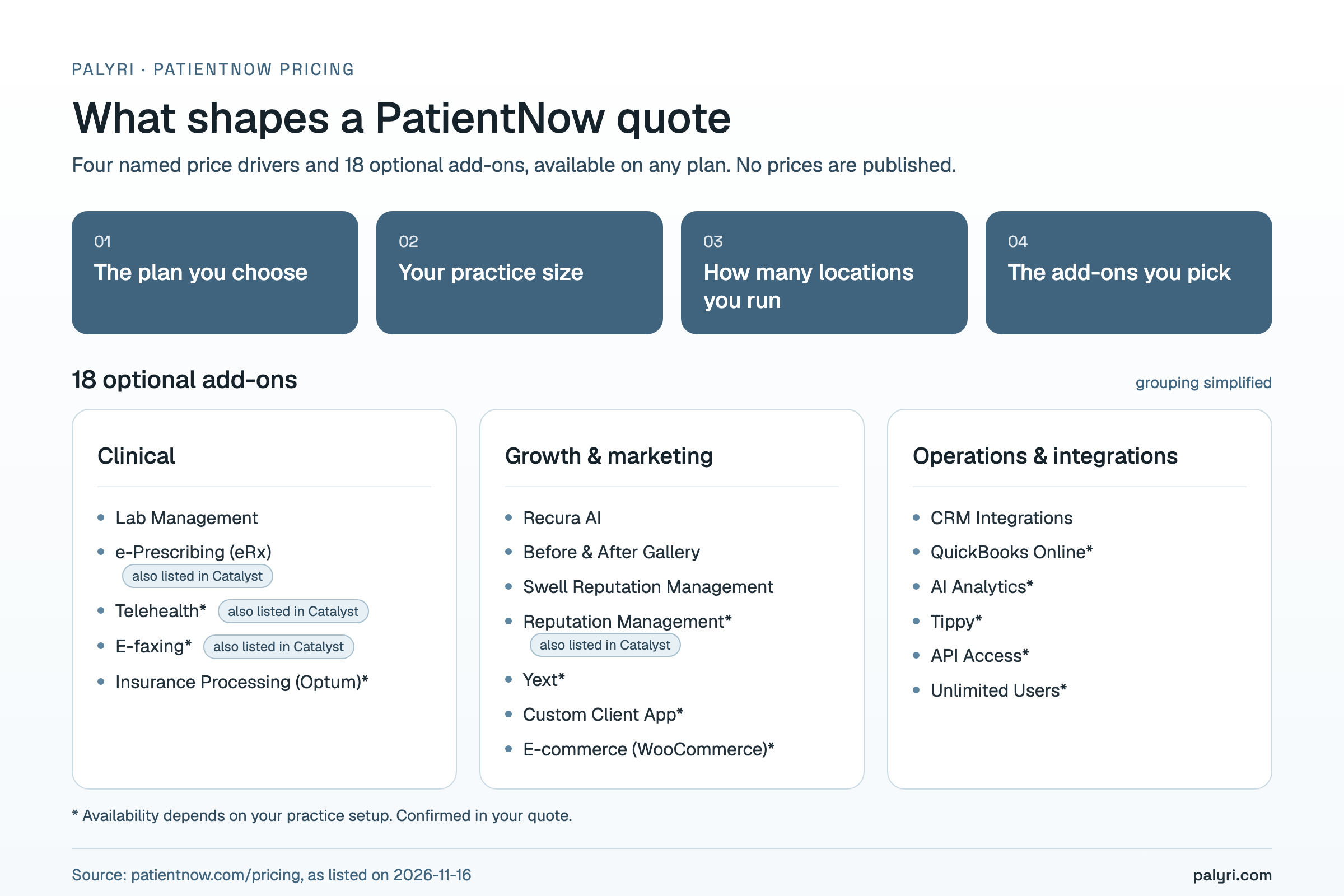
The full add-on list on the page: Lab Management, e-Prescribing (eRx), Telehealth*, E-faxing*, Insurance Processing (Optum), Recura AI, Before and After Gallery, Swell Reputation Management, Reputation Management, Yext*, Custom Client App*, E-commerce (WooCommerce), CRM Integrations, QuickBooks Online, AI Analytics*, Tippy*, API Access* and Unlimited Users*.
Costs to ask about that are not on the PatientNow pricing page
A subscription fee is only part of what software costs in year one. The pricing page covers plans and add-ons, but it does not mention onboarding, migration, payment processing rates or contract terms, so treat each of these as an open line until the quote fills it in.
- Onboarding and implementation: is there a one-time setup fee, and what does it include?
- Data migration: is moving patients, charts, photos and appointment history from your current system priced separately?
- Training: how many sessions are included, and what does extra training cost?
- Billing basis: is the fee per user, per provider, per location or flat? This decides how cost grows when you hire.
- User capacity: how many users does your plan allow, and what does the Unlimited Users add-on cost?
- Marketing limits: what is the monthly email and SMS allowance on your plan, and what is the overage rate?
- Payments processing: "Payments & invoicing" is in Standard; what are the card processing rates and any per-transaction fees?
- Contract terms: contract length, auto-renewal and the cancellation notice window.
- Renewal pricing: is there a cap on price increases at renewal?
- Exit and data export: in what format can you export your data if you leave, and is there a fee?
PatientNow quote checklist: questions to send before the demo
Sending questions in writing before the demo turns a sales call into a comparison you can file. Copy the list below into an email and ask for answers in the written quote.
- Which plan (Standard, Amplify or Catalyst) do you recommend for our practice, and why not the plan below it?
- What is the monthly subscription for that plan, and is it per user, per provider, per location or flat?
- How many users and locations does the quoted price cover?
- What are the monthly email and SMS marketing limits on this plan, and what does each overage unit cost?
- Which items marked * on your pricing page are available for our setup, and which are included in this quote?
- Are telehealth, eRx, e-faxing and reputation management included in our plan, or billed as add-ons?
- What is the monthly price of each add-on we are considering (for example Recura AI, Unlimited Users, QuickBooks Online)?
- What one-time fees apply: setup, onboarding, data migration, training?
- What are the card processing rates and fees for payments and invoicing?
- What is the contract length, auto-renewal rule and cancellation notice period?
- Is there a cap on price increases at renewal?
- How do we export all patient, chart, photo and financial data if we leave, in what format, and at what cost?
Once answers come back, put them into the worksheet below. It turns any quote, from PatientNow or another vendor, into a single year-one number and a per-provider number.
| Line | What to enter | Formula |
|---|---|---|
| A. Subscription | Quoted monthly fee for your plan | From quote |
| B. Add-ons | Sum of quoted monthly add-on prices | Add-on 1 + Add-on 2 + ... |
| C. One-time fees | Setup + onboarding + migration + training | From quote |
| D. Processing rate | Quoted card processing rate (%) | From quote |
| E. Card volume | Your projected card volume for the year (USD) | Your forecast |
| F. Overage | Expected marketing or user overage for the year | Overage units x unit price |
| Year-one cost | Total first-year spend | (A + B) x 12 + C + (D x E) + F |
| G. Providers | Number of providers using the system | Your count |
| Per-provider cost | Year-one cost spread across providers | Year-one cost / G |
| Year-two cost | Recurring cost after the one-time fees | (A + B) x 12 x (1 + renewal increase) + (D x E) + F |
Example: a med spa compares two quotes. It fills lines A to G for each vendor, using its own card volume forecast for E. Quote 1 has the lower subscription (A) but a separate migration fee in C; quote 2 bundles migration but charges for Unlimited Users in B. The worksheet shows which one costs less over year one and year two, which a monthly fee alone cannot. No prices are assumed here; the numbers come only from the written quotes.
To weigh that cost against what new patients bring in, run your own figures through the med spa ROI calculator.
Who PatientNow fits (and when to look elsewhere)
PatientNow has real strengths. It "combines an EMR, scheduling, payments, marketing, and analytics in one platform" and serves "med spas, plastic surgery practices, dermatology clinics, weight loss clinics, wellness clinics, and IV therapy clinics" (PatientNow llms.txt, checked 2026-11-16). AI Scribe is listed in every plan, RxPhoto (clinical photography) and Recura (AI voice and text that "answers leads, books appointments, and reactivates patients") sit in the same product family, and Catalyst adds eRx, lab ordering and insurance billing that lighter booking-first tools do not list (PatientNow, as listed on 2026-11-16).
| PatientNow fits well when you | Consider alternatives when you |
|---|---|
| Need an EMR with aesthetic charting, AI Scribe, digital intake and photos in one patient record | Want published prices before any sales call |
| Prescribe or order labs (eRx, lab ordering in Catalyst or as add-ons) | Run a booking-first med spa with little charting need |
| Mix med spa with plastics, dermatology or weight loss services | Have charting covered and your main gap is following up ad leads fast |
| Prefer one vendor for EMR, booking, payments and marketing | Want to add one tool alongside your current system, not replace it |
| Plan to grow from one location to several | Need a fixed per-user price to budget hiring |
If published prices matter to your shortlist, compare Boulevard pricing for med spas, Zenoti pricing for med spas and Mangomint pricing. For a broader view of six platforms side by side, see best med spa software compared.
PatientNow and a lead CRM: where Palyri fits
Palyri is not a PatientNow replacement. It is not an EMR, it has no charting, eRx or labs, it does not process payments and it uses an external booking widget rather than its own booking engine. If you need clinical records, a PatientNow-type platform is the right category, and our guide on med spa EMR vs CRM explains the split.
What Palyri covers is the step before the chart: Meta lead ads flow into a CRM built for aesthetic clinics, each lead moves through a pipeline with follow-up tasks, the front desk records the visit outcome and objections, and a Meta Conversions API "Schedule" event reports booked consults back to your ads. Reactivation SMS brings back inactive patients. Palyri can run alongside an EMR; it has no PatientNow integration, so ask about the hand-off you need before choosing.
FAQ
How much does PatientNow cost per month?
PatientNow does not publish a monthly price. As listed on 2026-11-16, its pricing page shows three plans, Standard, Amplify and Catalyst, each marked "Pricing tailored to your practice," and says the quote depends on the plan, practice size, number of locations and add-ons. Pricing is shared in a personalized demo. Third-party sites print estimates, but they conflict and PatientNow does not confirm them. The only reliable figure is a written quote, ideally with the subscription basis (per user, per provider or per location), one-time fees and add-on prices listed separately so you can compare it with other vendors.
Does PatientNow offer a free trial?
PatientNow's pricing page offers a free, no-obligation demo where pricing is shown, not a self-serve trial (as listed on 2026-11-16). The third-party tracker Toolradar lists "Free plan: No" for PatientNow, with prices last confirmed in September 2026. If you want hands-on time before signing, ask during the demo whether a sandbox or pilot period is possible and whether any onboarding fee is refundable if you cancel early. Get the answer in writing, since trial terms are not published on the vendor's pricing page.
Is AI Scribe included in every PatientNow plan?
Yes, according to the vendor page. As listed on 2026-11-16, "AI Scribe" appears in the feature list of all three plans: Standard, Amplify and Catalyst. That means you do not need to move up a tier to get it. The page does not say whether usage is capped or whether every provider on your account gets access at the same price, so add that to your quote questions: how many providers can use AI Scribe, and is there any usage limit or extra charge beyond the plan fee?
Which PatientNow plan is right for a single-location med spa?
PatientNow's page describes Standard as "Everything you need to run and grow your practice," Amplify as the plan for "advanced marketing and automation," and Catalyst as "The complete platform for high-growth practices" (as listed on 2026-11-16). A single-location med spa that does not prescribe or bill insurance will usually compare Standard and Amplify. The deciding questions are the user count, the email and SMS limits, and whether you need deposit workflows and drip campaigns. Ask the vendor why their recommended plan beats the plan below it.
Why do PatientNow prices differ across review sites?
Because PatientNow does not publish prices, review sites and blogs rely on estimates, user reports or older plan data. Toolradar, for example, still lists the earlier Essentials and Pro plans (prices last confirmed in September 2026), while PatientNow's own page on 2026-11-16 shows Standard, Amplify and Catalyst. G2 lists no published pricing. Competitor blogs sometimes relay dollar estimates that PatientNow does not confirm. Treat any figure you find online as unverified and use the vendor's current plan names when you request a quote.
What are the main PatientNow alternatives with public pricing?
Several med spa platforms publish at least part of their pricing, which helps if you want a number before a sales call. Our guides cover Boulevard pricing, Zenoti pricing and Mangomint pricing, each with what is listed and what is quote-only. For a broader comparison of six platforms, including PatientNow, see best med spa software compared. Compare on total year-one cost with the worksheet above, not on the monthly fee alone.
Want to implement this in your clinic?
Book a free Palyri demo. We'll show how it works on your clinic's data.
Book a demoPalyri blog author
Writes for the Palyri blog about getting clients from ads, handling leads and front-desk work in aesthetic clinics and beauty salons.