A med spa front desk fills the book through four jobs: answering and converting inquiries, confirming and protecting the schedule, checking patients in and out, and rebooking before they leave. Run it on a short list of KPIs, such as missed call rate, lead response time, inquiry-to-booked rate, confirmation rate, no-show rate and rebooking rate, and a daily checklist where every block moves one of those numbers.
This guide is about the human team: who owns what, what to measure and what to do each hour. If you are deciding which tasks software should take over, read which front desk tasks to automate first.
What does a med spa front desk actually do?
Most published duty lists are written for job seekers. Weave's list of spa receptionist responsibilities, for example, covers nine headings from "Greet and welcome clients" to "Support daily operations and inventory needs".
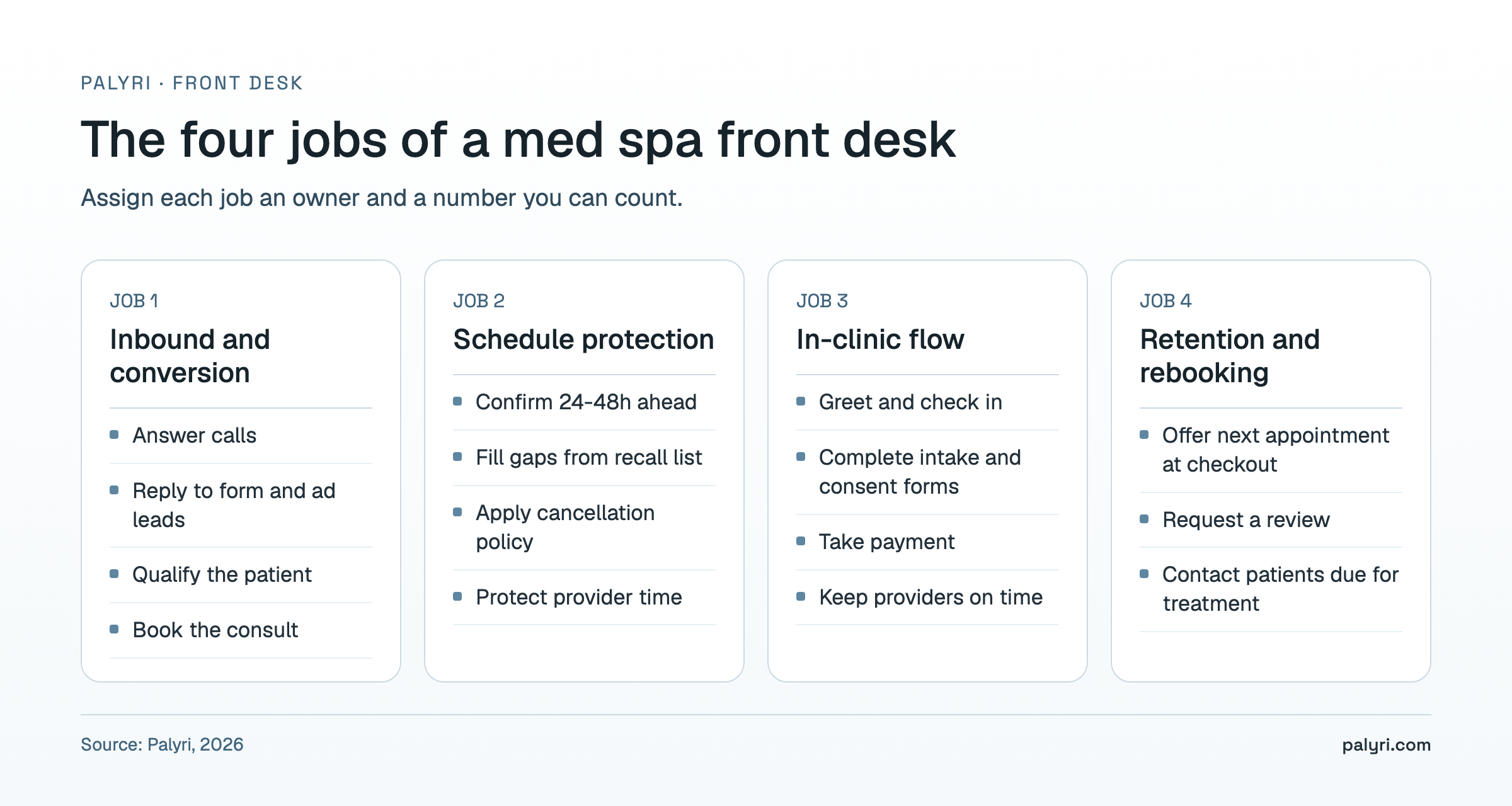
For a med spa that spends on ads, it helps to group the work into four jobs, each with an outcome you can count:
- Inbound and conversion. Answer calls, reply to web forms, ad leads and DMs, qualify the patient, and book the consult or treatment.
- Schedule protection. Confirm appointments 24 to 48 hours ahead, fill gaps from a recall or waitlist, apply your cancellation policy, and keep provider time from going empty.
- In-clinic flow. Greet, check in, make sure intake and consent forms are complete before the patient reaches the room, take payment, and keep providers on time.
- Retention and rebooking. Offer the next appointment at checkout, ask for a review, and contact patients who are due for their next treatment.
Which med spa front desk roles do you need, and who owns what?
Four roles cover the work. In a single-location med spa one person often holds two of them, which is fine. What is not fine is a task with no named owner, because "the front desk will handle it" means nobody checks whether it happened.
- Front desk coordinator or receptionist: in-clinic flow, check-in and checkout, payments, confirmations.
- Lead or phone coordinator: inbound calls, form and ad leads, follow-up until the lead books or says no.
- Patient care coordinator: consults, treatment plans, packages and the conversation about price. This is where selling happens, see consultation to treatment conversion.
- Practice manager: owns the KPIs, runs the weekly review, sets staffing by hour.
We deliberately do not give a "staff per treatment room" ratio. The ratios that circulate online are not backed by published data. Size the team from your own call volume by hour and check-ins per hour instead (method in the FAQ).
Use this table as a starting point and replace the role names with real people:
| Task | Owner | Backup | KPI it moves |
|---|---|---|---|
| Answer inbound calls during open hours | Lead/phone coordinator | Front desk coordinator | Missed call rate |
| First reply to form and ad leads | Lead/phone coordinator | Practice manager | Lead response time |
| Follow-up until booked or closed | Lead/phone coordinator | Patient care coordinator | Inquiry-to-booked rate |
| Confirm appointments 24-48h ahead | Front desk coordinator | Lead/phone coordinator | Confirmation rate |
| Fill same-week gaps from recall list | Front desk coordinator | Lead/phone coordinator | Schedule utilization |
| Intake and consent forms complete before the room | Front desk coordinator | Provider | Provider on-time start |
| Consults and treatment plans | Patient care coordinator | Provider | Consult-to-treatment rate |
| Offer next appointment at checkout | Front desk coordinator | Patient care coordinator | Rebooking-at-checkout rate |
| Return every missed call and voicemail same day | Lead/phone coordinator | Front desk coordinator | Missed call rate |
| Weekly KPI review | Practice manager | Owner | All of the above |
Which KPIs should a med spa front desk track?
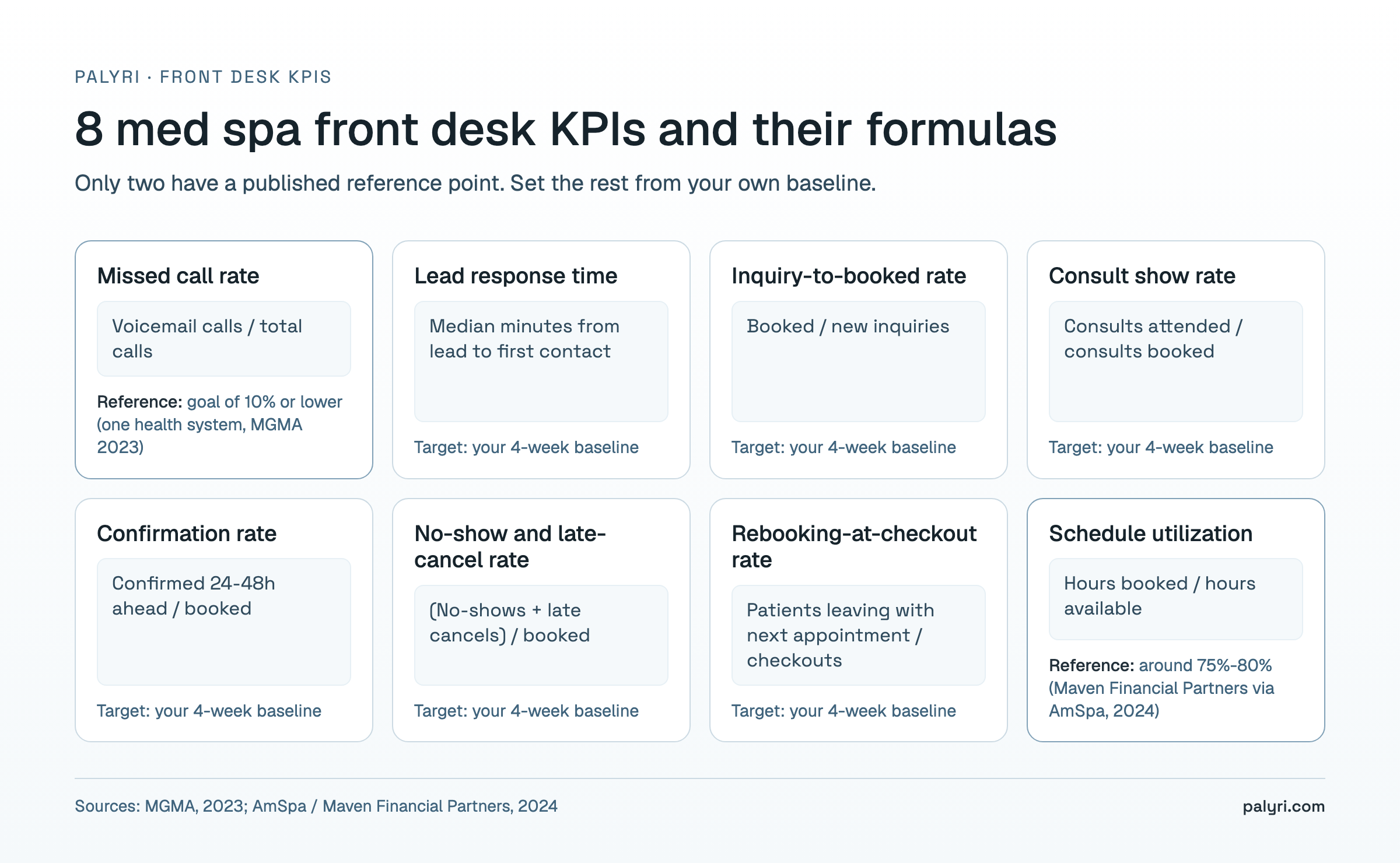
Track only numbers the front desk controls. Revenue per provider and treatment mix belong to the owner and the clinical team; for those, see the 10 aesthetic clinic KPIs. These eight are front desk numbers:
| KPI | Formula | Data source | Owner |
|---|---|---|---|
| Missed call rate | Calls that went to voicemail / total calls | Phone system call log | Lead/phone coordinator |
| Lead response time | Median minutes from lead arrival to first contact | CRM or lead inbox timestamps | Lead/phone coordinator |
| Inquiry-to-booked rate | Inquiries that booked / all new inquiries | CRM or lead log | Lead/phone coordinator |
| Consult show rate | Consults attended / consults booked | Scheduling system | Front desk coordinator |
| Confirmation rate | Appointments confirmed 24-48h ahead / appointments booked | Scheduling system | Front desk coordinator |
| No-show and late-cancel rate | (No-shows + late cancels) / appointments booked | Scheduling system | Front desk coordinator |
| Rebooking-at-checkout rate | Patients leaving with a next appointment / checkouts | Scheduling system | Front desk coordinator |
| Schedule utilization | Hours booked / hours available | Scheduling system | Practice manager |
Two of these have a published reference point. The rest do not, and we will not invent one.
- Missed call rate. In an MGMA article, one health system set an organizational goal of a missed call rate "of 10% or lower", after finding that some of its clinics had more than 50% of incoming calls going to voicemail. It is one health system's internal analysis, not a med spa study, but its definition (voicemail calls divided by total calls) is the one to copy.
- Schedule utilization. In a guest article for the American Med Spa Association, Maven Financial Partners says its capacity benchmark is "ideally somewhere around 75% – 80%". Maven calculates available hours by subtracting blocked time from the hours a provider is at the office. Consistently above that range can mean overloaded providers; below it points to too few patients or scheduling problems.
For every other KPI, set the target from your own four-week baseline. Lead response time matters most of all for ad leads; why lead response time matters for med spas explains the mechanism. For no-shows, pair the number with a written rule from your no-show fee and cancellation policy.
How do you measure missed calls and lead response time?
Missed calls are the easiest KPI to measure and the one most often ignored. Export the call log from your phone system for the last four weeks, count calls that went to voicemail, and divide by total calls. That gives you the baseline.
Then look at when the misses happen. In the MGMA health system data, "the greatest number of missed calls occurred at 10 a.m. each day", regardless of the day. Your peak will differ, which is the point of checking. The same article recommends not placing a caller on hold for more than 60 seconds, and checking back with them if you must.
Lead response time needs timestamps on both ends: when the lead arrived (form submit or ad lead) and when someone first called or texted back. Report the median, not the average, because one lead left overnight can distort an average. For calls that still slip through during peaks, a missed call text back setup gives the patient an instant reply while the team catches up.
Med spa front desk daily checklist (open to close)
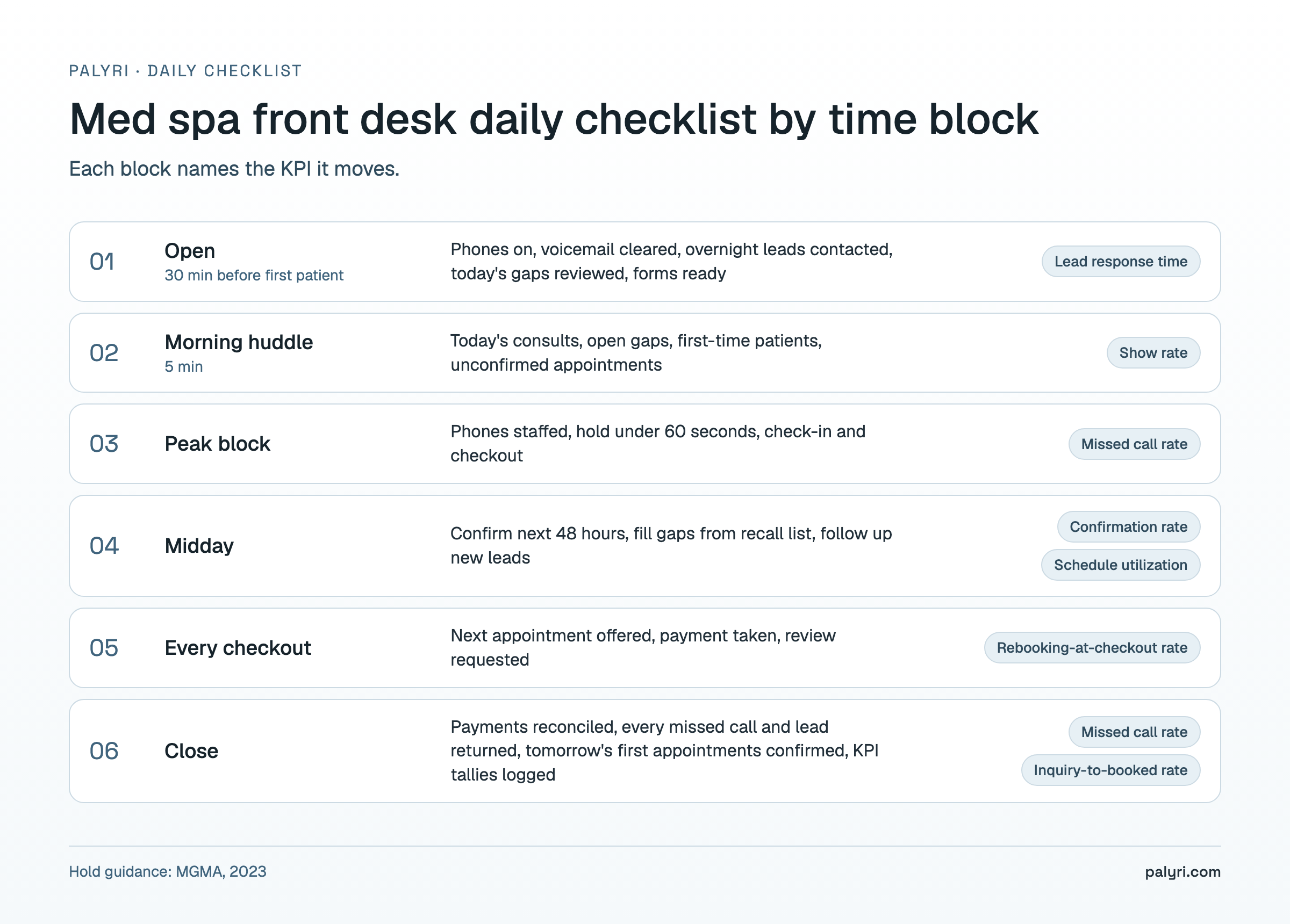
This checklist is organized by time block, and each block names the KPI it moves. Adjust the times to your hours. Pabau's reception schedule template uses a similar opening and closing structure; we dropped insurance steps, which do not apply to most cash-pay med spas, and added lead follow-up and rebooking.
Copy this list into your opening and closing binder or task app:
1. Open (30 minutes before the first patient) · moves lead response time
- Log in to the phone system, scheduling system and CRM; check that phones are forwarded back from after-hours mode.
- Clear voicemail and write down every callback.
- Contact every lead that arrived overnight, oldest first.
- Review today's schedule: open gaps, first-time patients, consults.
- Check that intake and consent forms are ready for every patient on today's list.
- Confirm room and device availability with providers.
2. Morning huddle (5 minutes, with providers) · moves show rate and on-time starts
- Walk through today's consults and who will run each one.
- Name the open gaps and who will try to fill them.
- Flag first-time patients and anyone who needs extra time.
- List appointments for today that are still unconfirmed and call them now.
3. Peak block (your busiest phone hours) · moves missed call rate
- One person is on phones and does not leave the desk without a handoff.
- No caller on hold for more than 60 seconds without a check-back.
- Check-in: forms complete, payment method on file, patient seated before their time.
- Checkout handled by the second person, never by the phone owner.
4. Midday · moves confirmation rate and schedule utilization
- Confirm every appointment in the next 48 hours that is not yet confirmed.
- Call or text patients on the recall or waitlist for same-week gaps.
- Work new leads through your lead follow-up cadence; update each lead's status and next contact date.
- Check that reminder messages went out; your appointment reminder text templates should already be loaded.
5. Every checkout · moves rebooking-at-checkout rate
- Offer the next appointment based on the provider's recommended interval.
- Take payment and confirm the receipt method.
- Ask for a review while the patient is still at the desk.
6. Close (last 30 minutes) · moves missed call rate and inquiry-to-booked rate
- Reconcile cash and card payments against the day's appointments.
- Return every missed call, voicemail and new lead from today, or log why not.
- Confirm tomorrow's first appointments.
- Log the day's tallies: total calls, voicemail calls, new inquiries, bookings, no-shows, rebooks at checkout.
- Switch phones to after-hours mode and log out of all systems.
How do you run a weekly front desk KPI review?
Keep it to 15 minutes, once a week, at the same time. The practice manager runs it with whoever owns each task. The format is simple: last week against the four-week baseline, one fix for the coming week, one named owner.
| KPI | This week | 4-week baseline | Owner | One fix for next week |
|---|---|---|---|---|
| Missed call rate | ||||
| Lead response time (median) | ||||
| Inquiry-to-booked rate | ||||
| Consult show rate | ||||
| Confirmation rate | ||||
| No-show and late-cancel rate | ||||
| Rebooking-at-checkout rate | ||||
| Schedule utilization |
Three rules keep the meeting useful:
- One fix per week. If the missed call rate is up, the fix might be moving a lunch break off the peak hour. Do not change five things at once, or you will not know what worked.
- Count, do not just quote rates. Write "21 of 70 inquiries booked (30%)", not just "30%". Small numbers swing hard, and the count shows when a change is noise.
- Judge people on what they control. The phone owner owns missed calls; nobody at the desk owns a provider running 20 minutes late.
To put a dollar value on one extra booked consult, estimate what one extra booked consult is worth with your own prices and show rate.
What does a small KPI change mean in dollars? (worked example)
Example: these numbers are assumptions for illustration, not benchmarks. A med spa gets 200 new inquiries a month. Its inquiry-to-booked rate is 30%, its show rate is 80%, and the average first-visit revenue is $400.
- Before: 200 x 30% = 60 booked; 60 x 80% = 48 visits; 48 x $400 = $19,200.
- After raising inquiry-to-booked to 35%: 200 x 35% = 70 booked; 70 x 80% = 56 visits; 56 x $400 = $22,400.
- Difference: 8 more visits and $3,200 more first-visit revenue per month, with the same ad spend.
Five points of conversion usually comes from front desk habits, not new ads: faster first replies, a set number of follow-up attempts, and returning every missed call before close.
How does a CRM support the med spa front desk team?
A CRM does not replace the people in the role table. It gives them one list of leads with an owner and a next step, so follow-up does not depend on someone's memory or a sticky note.
Palyri is a CRM and lead pipeline, not a booking engine, phone system or payment tool, so call logs and the schedule still come from your existing systems. See how it fits as a CRM for aesthetic clinics, or check Palyri pricing.
FAQ
What does a med spa front desk coordinator do?
A med spa front desk coordinator runs the in-clinic side of the patient visit: greeting and checking in patients, making sure intake and consent forms are complete before the treatment room, taking payment, and offering the next appointment at checkout. In many practices the same person also confirms upcoming appointments and fills same-week gaps from a recall list. The coordinator's KPIs are usually confirmation rate, no-show rate and rebooking-at-checkout rate.
How many front desk staff does a med spa need?
There is no published staff-per-room ratio that holds up, so size the team from your own data. Export four weeks of call logs and count calls by hour of the day, then count check-ins and checkouts per hour from your schedule. The hours where calls and check-ins peak together are where one person cannot do both without missing calls. MGMA's call review approach, which looks at the time of day and day of week calls are missed, is a good template. If your missed call rate stays high in the same hours, add coverage there first, even if only part-time.
What is a good missed call rate for a med spa?
No published benchmark exists specifically for med spas. The most usable reference comes from an MGMA article in which one health system set a goal of a missed call rate of 10% or lower, calculated as calls that went to voicemail divided by total calls. That system had found some clinics with more than half their calls going to voicemail. Measure your own baseline over four weeks using the same formula, check which hours the misses cluster in, and set a target that improves on your baseline. Returning every missed call before close matters as much as the rate itself.
How do you measure front desk performance fairly?
Measure each person only on KPIs they control. The phone owner is responsible for missed call rate and lead response time; the front desk coordinator for confirmations and rebooking at checkout; nobody at the desk is responsible for a provider running late or an ad campaign producing poor leads. Compare each KPI with a four-week baseline rather than an outside benchmark, report counts next to percentages, and review weekly in a short meeting with one fix and one owner. Daily tallies logged at close make the numbers reliable instead of estimated.
What should be on a front desk closing checklist?
A med spa front desk closing checklist should cover money, follow-up and tomorrow. Reconcile cash and card payments against the day's appointments. Return every missed call, voicemail and new lead from the day, or note why one could not be reached. Confirm tomorrow's first appointments so the day starts on time. Log the daily tallies: total calls, voicemail calls, new inquiries, bookings, no-shows and rebooks at checkout. The tallies are the part most practices skip, and they are what the weekly KPI review depends on.
Should the med spa front desk sell treatments?
The front desk should book, not sell. Its job is to turn an inquiry into a consult or appointment and to offer the next visit at checkout. Treatment plans, packages and price conversations belong to the patient care coordinator or the provider, who can explain options in a consult. If one person holds both roles in a small practice, separate the tasks by time block. For the consult side, see the guide on consultation to treatment conversion.
Want to implement this in your clinic?
Book a free Palyri demo. We'll show how it works on your clinic's data.
Book a demoPalyri blog author
Writes for the Palyri blog about getting clients from ads, handling leads and front-desk work in aesthetic clinics and beauty salons.