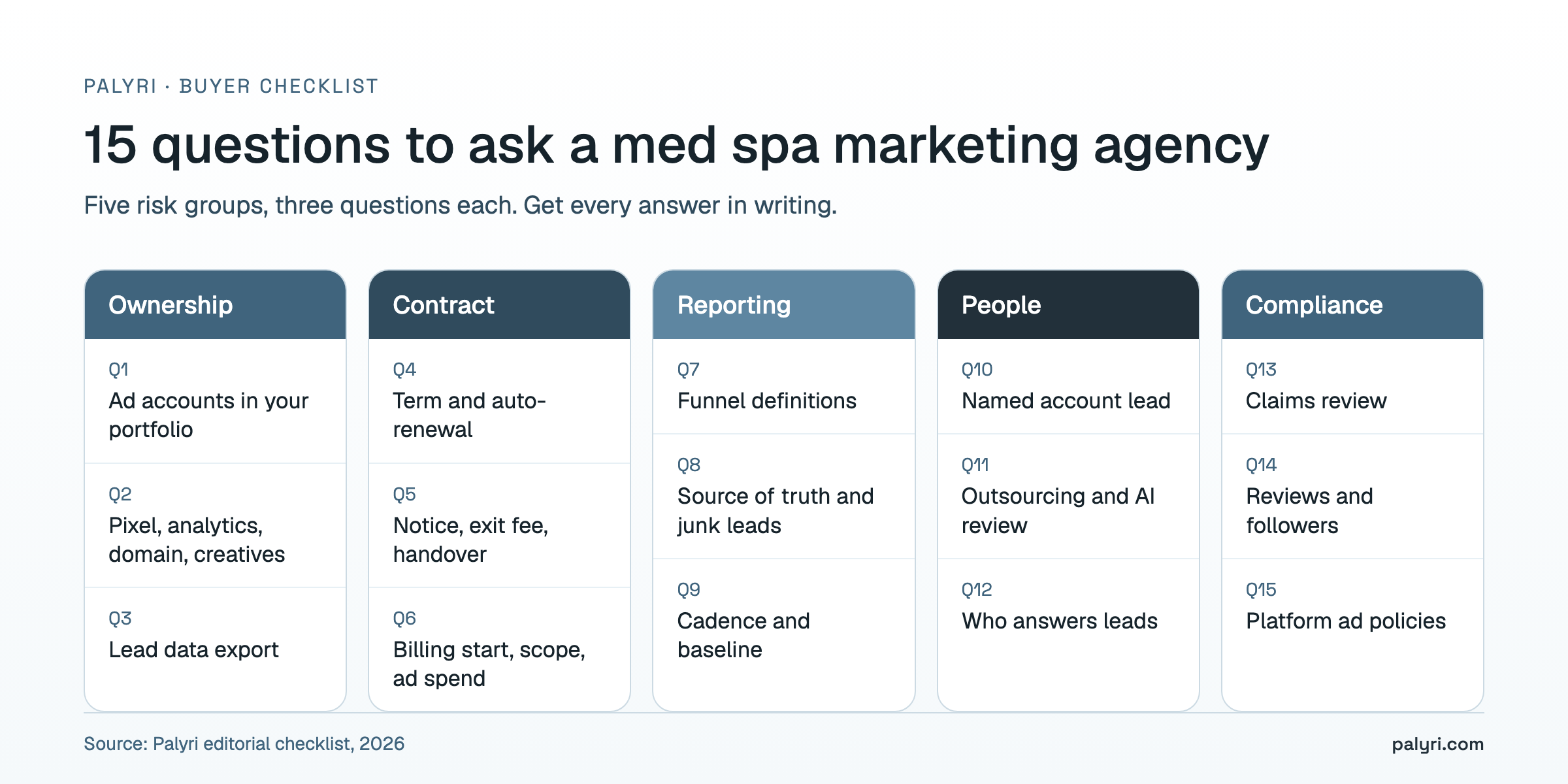
Before you sign with a med spa marketing agency, get written answers on three things: who owns the ad accounts, pixel, website and data if you leave; how you exit the contract (term, auto-renewal, notice, fees); and whether reporting counts booked and attended consults instead of clicks and leads. The 15 questions below cover those three areas plus who does the work and how claims stay compliant, and each comes with the answer you want to hear and a red-flag answer.
Send it to every agency on your shortlist and compare the written replies side by side.
2. Who owns the pixel, analytics, tag manager, domain, website files and creatives?
3. How do we export all lead data when the contract ends?
4. How long is the term, and does it renew automatically?
5. What is the notice period, the exit fee and the handover list?
6. When does billing start, what is in scope, and who pays the ad platforms?
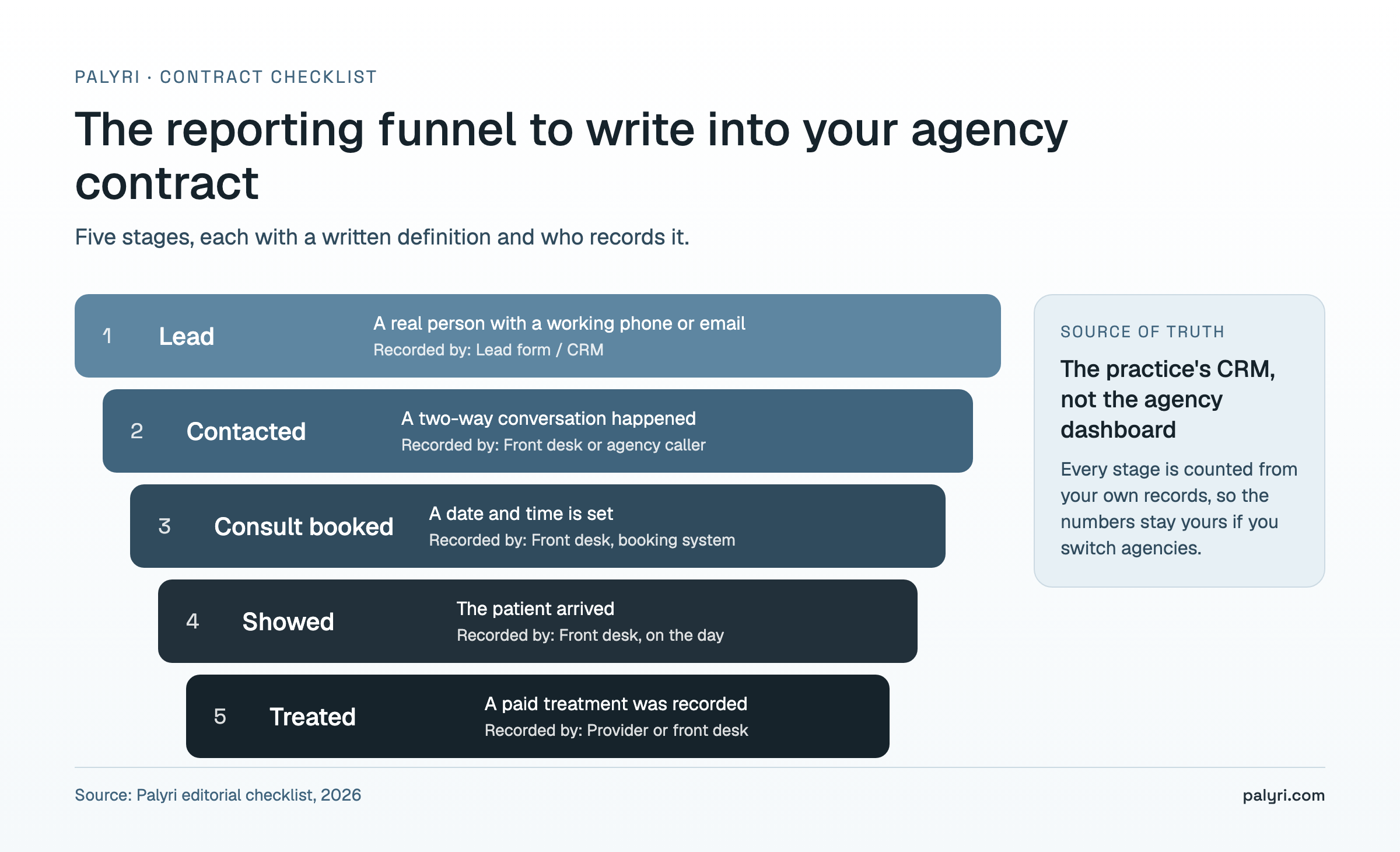
7. How do you define a lead, a contacted lead, a booked consult, a show and a treated patient?
8. Whose data is the source of truth, and how do you filter junk leads?
9. How often do you report, and will we get a baseline report in month one?
10. Who is our named account lead, and how many accounts do they manage?
11. Is any work outsourced or white-labeled, and how is AI-generated content reviewed?
12. Who answers new leads, and how fast?
13. How do you review medical and results claims before ads go live?
14. How do you get reviews, and do you ever buy reviews, followers or views?
15. How do you handle platform ad policies for injectables and weight-loss treatments?
What should you ask a med spa marketing agency before signing?
Ask questions that expose risk, not ones that invite a pitch. "Show me where the ad account lives" produces a fact you can check in two minutes.
The 15 questions fall into five risk groups, three questions each:
- Ownership (Q1-3): can you leave with your accounts, tracking and data intact?
- Contract (Q4-6): how long are you locked in, and what does leaving cost?
- Reporting (Q7-9): does the agency measure booked and attended consults, or only activity?
- People (Q10-12): who actually does the work, and who answers the leads?
- Compliance (Q13-15): will the ads, reviews and claims hold up with regulators and ad platforms?
The American Med Spa Association put the core problem plainly in a July 2026 article on agency contracts: "Activity is not the same as strategy." Every question below is built to separate the two.
This checklist covers the hiring decision only. If you are still deciding what the marketing itself should do, start with a 90-day med spa marketing plan tied to booked consults and med spa advertising channels and what each costs.
Who owns the ad accounts, pixel and website if you leave? (Q1-3)
Settle ownership first; it is the hardest to fix later. Foster Web Marketing states the standard: "You should own your website, your ad accounts, and all content created on your behalf."
Q1. Will the ad accounts sit in our Meta business portfolio and our own Google Ads account?
- Good answer: "Yes. You create or keep the ad account in your business portfolio, and you add our business as a partner." Meta documents this in its help page on giving a partner access to assets in your business portfolio. Your portfolio owns the ad account, Page, Instagram account and pixel; the agency gets assigned permissions.
- Google works the same way in reverse. Agencies use a manager account, and Google's help page on linking accounts to a manager account explains: "Once your invited account accepts an invitation, the system automatically links the account to the manager account." You keep your own account and accept their link.
- Red flag: "We run everything from our own ad account, it is simpler." If the agency created the ad account inside its own portfolio, the agency's portfolio owns it, along with its history.
Q2. Who owns the pixel, analytics, tag manager, domain, website files and creatives?
AmSpa's article suggests the exact wording: "Ask who controls the domain, website files, copy, photos, videos, analytics accounts, advertising accounts." Good answer: every item is registered to the practice, with the agency as a user. Red flag: the domain or the analytics property sits under an agency email address.
Q3. How do we export all lead data when the contract ends?
Good answer: leads flow into a CRM or system the practice owns, and you can export them any time, not only at exit. Red flag: leads live only in the agency's dashboard. Foster calls for "clear contract terms with no data hostage clauses" and warns that "if an agency controls your data and makes it difficult to see your own numbers, that is a serious warning sign."
| Asset | Who should own it | How to check in 2 minutes | Red flag |
|---|---|---|---|
| Meta ad account | Your business portfolio | Open your portfolio settings, look under ad accounts and partners | Account only visible in the agency's portfolio |
| Meta pixel / dataset | Your business portfolio | Check data sources in your portfolio settings | Pixel created and owned by the agency |
| Google Ads account | You, linked to their manager account | Sign in with your own login and look for the manager link | You have no login of your own |
| Google Analytics and Tag Manager | You, agency as a user | Check the admin and user list | Agency is the only admin |
| Domain and website files | You | Look up the registrar account and the hosting login | Domain registered to the agency |
| Copy, photos, videos | You, written into the contract | Read the intellectual property clause | Creatives licensed only while you pay |
| Lead and patient inquiry data | You, in your own CRM | Run a test export this week | Export only "on request" or at exit |
What terms should a med spa marketing contract have? (Q4-6)
AmSpa advises owners to "review how long the agreement lasts, whether it renews automatically, how cancellation works." No sourced norm exists for contract length, so judge the exit terms rather than the number of months.
Q4. How long is the term, and does it renew automatically?
Good answer: a defined term with a review point, and renewal that needs your written confirmation. Red flag: a long term that rolls over silently unless you cancel inside a short window.
Q5. What is the notice period, the exit fee and the handover list?
Good answer: a short notice period, no fee beyond work already delivered, and a written list of what you receive on exit (logins, files, creatives, data). Red flag: "We will sort out the handover when it happens."
Q6. When does billing start, what is in scope, and who pays the ad platforms?
AmSpa recommends you "ask what the timeline includes, what could delay the project, and who is responsible for each milestone." Get the scope in writing, then ask whether ad spend is billed to your card directly by Meta and Google or passed through the agency's invoice.
2. Renewal: "This agreement does not renew automatically. Any renewal requires written confirmation from the practice."
3. Exit and handover: "On termination, the agency removes its own access and delivers all logins, files, creatives and lead data within 10 business days, at no extra fee."
4. Reporting definitions: "Monthly reports count leads, contacted leads, booked consults, attended consults and treated patients, as defined in Appendix A, using the practice's CRM as the source of truth."
These are plain-language starting points, not legal advice. Ask your attorney to review the final wording.
How should an agency report on booked consults, not clicks? (Q7-9)
Clicks and "leads" can rise while the appointment book stays flat. Write the funnel definitions into the contract before the first campaign launches.
Q7. How do you define a lead, a contacted lead, a booked consult, a show and a treated patient?
Good answer: written definitions for each stage. A lead is a real person with a working phone number or email. Contacted means a two-way conversation happened. Booked means a consult with a date and time. Showed means the patient arrived. Treated means a paid treatment was recorded. Red flag: "We report leads and cost per lead; what happens after is up to your front desk."
Q8. Whose data is the source of truth, and how do you filter junk leads?
Good answer: the practice's own CRM or booking records, not the agency's dashboard. Lifestyle by PS suggests you "ask how they filter junk leads, like spam calls and wrong numbers," and "ask what they track, like calls, form leads, direction requests, and booked consults." A practice-owned system such as a CRM that tracks every lead to a booked consult keeps those stages in your hands, so any agency reports from the same numbers you see.
Q9. How often do you report, and will we get a baseline report in month one?
The same source recommends you "ask for a baseline report at the start, then monthly progress against it," and asks for "simple monthly reports that tie keywords to leads, visits, and revenue." Good answer: a baseline in month one, then a monthly report on the five funnel stages. Bonus: ask whether they will send booked consults back to Meta with the Conversions API, so the ad system learns from bookings instead of form fills.
Who will actually work on your account? (Q10-12)
The people in the sales meeting are often not the people running your ads. AmSpa notes that "med spa owners deserve to know who is setting the strategy, who is creating the content."
Q10. Who is our named account lead, and how many accounts do they manage?
Q11. Is any work outsourced or white-labeled, and how is AI-generated content reviewed?
Outsourcing is fine if you know where your ads are made. AmSpa adds: "Be sure you ask how AI generated content is reviewed."
Q12. Who answers new leads, and how fast?
A great campaign fails if nobody calls back. Agree who owns first contact (agency, front desk or both) and the response target. See why the first five minutes after a lead matter and a 7-day lead follow-up cadence before you set the target.
| Question | Good answer | Red flag |
|---|---|---|
| Q10. Named account lead | A named person, their role and how many accounts they handle | "Our team handles it" with no name |
| Q11. Outsourcing and AI | Says what is outsourced and who reviews AI drafts before publishing | Denies any outsourcing, cannot explain the review step |
| Q12. Lead response | A written owner and time target for first contact, tracked in the CRM | "Leads go to your inbox, the rest is up to you" |
How will the agency keep ads, reviews and claims compliant? (Q13-15)
Agency ads run in your practice's name, so its compliance mistakes become yours.
Q13. How do you review medical and results claims before ads go live?
AmSpa reminds owners that the FTC expects health-related claims to be "truthful, not misleading, and supported by appropriate evidence," and that ethical advertising should "avoid guarantees that no responsible provider can make." Good answer: a written review step, with your medical director signing off on claims and before-and-after images. Red flag: guaranteed results in ad copy.
Q14. How do you get reviews, and do you ever buy reviews, followers or views?
The FTC announced a final rule banning fake reviews and testimonials on August 14, 2024. It prohibits businesses from buying fake reviews or "procuring them from company insiders," bans "providing compensation or other incentives conditioned on the writing of consumer reviews" that express a particular sentiment, and "prohibits anyone from selling or buying fake indicators of social media influence," such as "followers or views generated by a bot or hijacked account." The rule was published in the Federal Register in August 2024 and lets the agency "seek civil penalties against knowing violators."
Q15. How do you handle platform ad policies for injectables and weight-loss treatments?
Ask for examples of ads they ran that passed review, and compare them with compliant Botox ad ideas for Meta and Google.
How do you compare two med spa marketing agency proposals?
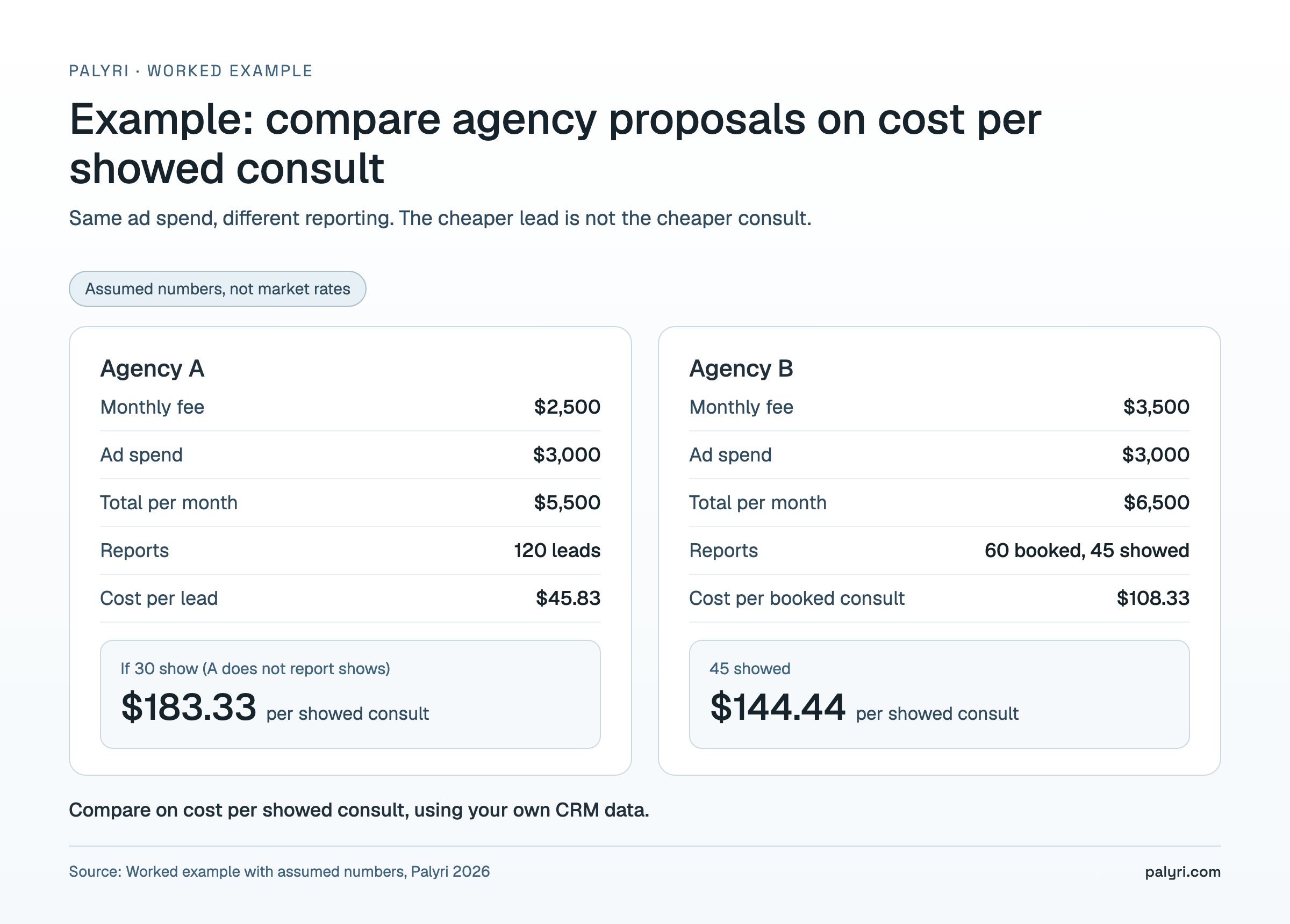
Compare proposals on cost per showed consult, not cost per lead.
Example: the numbers below are assumptions to show the arithmetic, not market rates.
- Agency A: $2,500 monthly fee + $3,000 ad spend = $5,500 a month. It reports 120 leads. Cost per lead: $5,500 / 120 = $45.83.
- Agency B: $3,500 monthly fee + $3,000 ad spend = $6,500 a month. It reports 60 booked consults and 45 showed. Cost per booked consult: $6,500 / 60 = $108.33. Cost per showed consult: $6,500 / 45 = $144.44.
Agency A looks cheaper, but you cannot compare it yet, because it does not report bookings or shows. If A's 120 leads turned into 30 showed consults, A's cost per showed consult would be $5,500 / 30 = $183.33, which is $38.89 more than B. If they turned into 50, it would be $110, and A would win. The only way to know is to make both agencies report the same five funnel stages from your data.
To see what a given cost per showed consult means for your margin, estimate the return on a consult funnel with your own treatment prices. If you also budget for software, compare the agency fee with what a practice-owned CRM costs, since the CRM is what keeps the funnel data yours across agencies.
FAQ
How do I choose a med spa marketing agency?
Send every agency on your shortlist the same written questions and compare the answers side by side. Prioritize three areas: whether the ad accounts, pixel, domain and data stay in your name; whether the contract has a clear exit with no automatic renewal trap; and whether reporting counts booked and attended consults from your own CRM.
Who owns my Facebook ad account if I leave my agency?
The business portfolio that owns the ad account owns it, regardless of who paid for the ads. If the account sits in your Meta business portfolio and the agency was added as a partner, you keep it and simply remove their access. If the agency created the account inside its own portfolio, it stays with them, along with its history and often the pixel. Check today in your portfolio settings, and follow Meta's guide on giving a partner access to business assets to set it up the right way.
What should a med spa marketing agency report every month?
A monthly report should show the five funnel stages: leads, contacted leads, booked consults, attended consults and treated patients, using definitions you agreed in writing. Add spend, cost per showed consult and junk leads filtered. The numbers should come from your CRM or booking records, compared with a baseline from month one. Clicks belong in the appendix, not the headline.
Are 12-month marketing agency contracts normal?
Contract lengths vary, and there is no reliable public benchmark for what share of agencies use 12-month terms. Rather than judging the length, judge the exit. Check whether the agreement renews automatically, how much notice you must give, whether there is an exit fee, and what the agency hands over when you leave. A longer term with review points and a clean handover clause can beat a short term with an easy-to-miss auto-renewal window.
Should the agency pay for ads on its own card?
It is usually better for the practice to pay Meta and Google directly with its own card, inside its own ad accounts. You see the exact spend on the platform invoice, the payment history stays with your account. If the agency bills spend through its invoice, ask for the platform invoices monthly and confirm the ad account still sits in your business portfolio.
How much does a med spa marketing agency cost?
There is no reliable public price range, and figures on agency blogs are sales claims. Agencies usually charge in one of three ways: a fixed monthly retainer, a percentage of ad spend, or a fee per lead or booked consult. Convert every proposal into the same number: total monthly cost (fee plus ad spend) divided by showed consults. That makes a retainer, a percent-of-spend deal and a per-lead deal comparable, as in the worked example above.
Want to implement this in your clinic?
Book a free Palyri demo. We'll show how it works on your clinic's data.
Book a demoPalyri blog author
Writes for the Palyri blog about getting clients from ads, handling leads and front-desk work in aesthetic clinics and beauty salons.