Vagaro is a good fit for a med spa whose work is mostly booking, checkout and reminders; it stops fitting when charting, consents, before-and-after photos and ad-lead follow-up become daily work, because those are thin or sold as add-ons in a tool built for salons. The right Vagaro alternative depends on which gap hurts: a clinical platform (Aesthetic Record, PatientNow, Pabau, MeevoMD) for charting, a spa operations suite (Boulevard, Mangomint, Zenoti) for booking rules and multi-location, or a lead CRM next to your booking tool for ad leads.
That second point matters more than most "alternatives" lists admit. The top five results we checked on November 9, 2026 were all written by competing vendors, and each ends with "pick us." This guide is a decision tool instead: seven signals that you have outgrown Vagaro, a matrix that maps each gap to a type of tool, a worked cost example from Vagaro's own pricing, and an honest section on when to stay.
All vendor claims below were checked on November 9, 2026, and link to the page they come from. For a ranked look at six platforms, see our side-by-side of the best med spa software; this article focuses on one decision: leave Vagaro or not, and for what.
Is Vagaro good for med spas?
For the booking side of a med spa, yes. Even a direct competitor says so: Pabau's comparison page (last updated July 23, 2026) calls Vagaro "popular, easy-to-use booking software built for salons, spas, beauty, wellness and fitness businesses" and says "it covers the essentials well."
The core list on Vagaro's pricing page is long. Everything in the callout below is listed as "Included with every plan."
Vagaro also offers an AI assistant, Vera, which the same page says "helps automate marketing, fill empty appointment slots, create descriptions, and communicate with clients." For multi-location businesses it lists APIs and webhooks for connecting a CRM and other tools, plus integrations with HubSpot, Salesforce and Power BI, among others.
Signs your med spa has outgrown Vagaro
The checklist below lists seven signals. Each one names who documents the gap, or marks it "operational" when it is a day-to-day symptom you can check in your own practice.
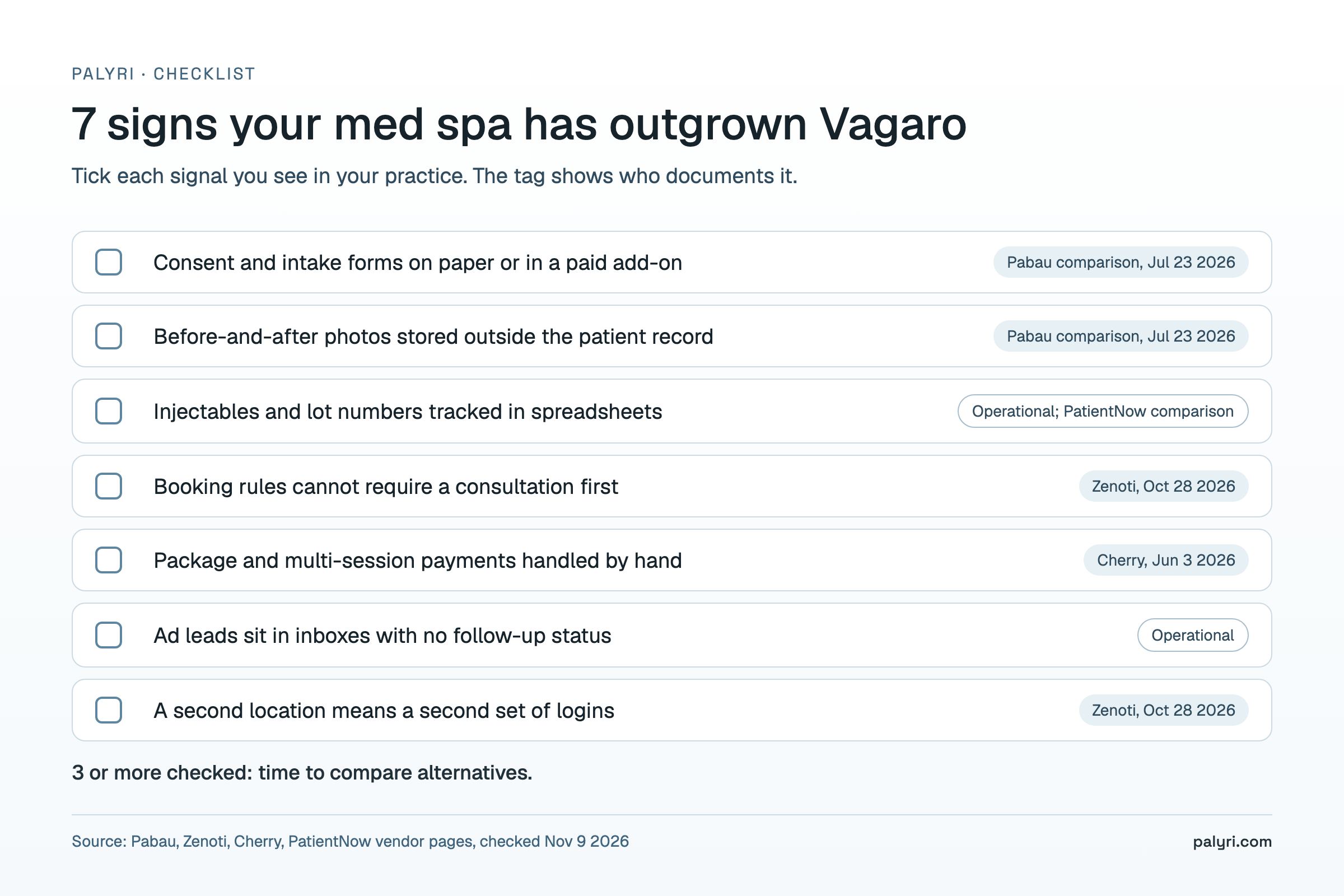
Here is what sits behind each signal.
- Consent and intake forms live on paper or in an add-on. Pabau's comparison says Vagaro "provides a very basic SOAP-style notes field, with intake, consent and advanced SOAP templates available through its paid Forms add-on." Vagaro's pricing page lists SOAP notes as included; it does not show a price for Forms.
- Before-and-after photos are outside the patient record. Pabau's page states that Vagaro "doesn't offer clinic-grade before-and-after photo tracking."
- Injectables and lot numbers sit in a spreadsheet. PatientNow's comparison argues that med spas will notice "the absence of features like injection tracking, clinical documentation, and treatment-specific workflows." Check your own process: if a provider looks up units or lot numbers outside the system, that is the gap.
- You need "consultation first" booking rules. Zenoti's Vagaro roundup (October 28, 2026) lists, among common switch triggers, that "the online booking rules would not say 'consultation first.'"
- Package and series payments are done by hand. Cherry's article (updated June 3, 2026) says that while Vagaro is a solid choice for scheduling and POS, "its payment features aren't built for the larger, multi-session procedures common in medical aesthetics."
- Ad leads have no follow-up status. This is operational. If a Meta lead form submission lands in an email inbox and nobody can tell whether it was called, booked or lost, the problem is not booking software; it is a missing lead pipeline. Our guide to a 7-day lead follow-up cadence shows what that pipeline should do.
- A second location became a second set of logins. Zenoti names this too: "the second location turned into a second set of logins." Vagaro's own page says its multi-location setup syncs data across locations and supports single sign-on, so test whether that covers your second site before switching.
One or two signals can often be fixed with an add-on. Three or more usually means the tool and the practice are pulling in different directions.
What Vagaro costs as you add providers (Vagaro pricing)
Vagaro prices per bookable calendar. The pricing page FAQ says: "Each bookable calendar license you add to a business location costs $10 (US), up to seven licenses." Vagaro adds that once you reach seven licenses, more employees cost nothing extra. It also offers a "30-day free trial" and states you can "cancel anytime with no cancellation fees."
We could not capture a reliable USD base price on the day we checked, so check it on vagaro.com/pro/pricing. For more than one location, Vagaro says each added location has its own cost based on the features you choose, with no extra multi-location fee, and it offers custom solutions for multi-location businesses (vagaro.com, checked November 9, 2026).
Example, assuming the base price covers one bookable calendar, as the pricing selector shows: the arithmetic below uses only the $10 per added calendar fee. It shows what calendars add on top of your one-location base price, before any add-ons.
The calendar fee is predictable. What grows less predictably is the add-on stack. Pabau's comparison says a branded app, the Forms add-on for intake and consent, advanced SOAP templates and text marketing are paid add-ons. Vagaro's page does not show their prices, so price each one in your trial account.
That is also the first switch trigger Zenoti names: "the monthly bill grew with every feature they added." When you compare, put Vagaro's base plus calendars plus every add-on you actually use next to the alternative's full quote. Our breakdowns of what Boulevard costs a med spa, Mangomint plans and add-ons and why Zenoti pricing is quote-only give you the other side of that sum.
Vagaro alternatives for med spas, by the gap you need to close
Most Vagaro competitors fall into three types, and a fourth option is not a replacement at all. Pick the column that matches your loudest signal from the checklist above. Confirm specific features in a demo, because vendors change plans often.
| Criterion | Vagaro | Clinical platform (Aesthetic Record, PatientNow, Pabau, MeevoMD) | Spa operations suite (Boulevard, Mangomint, Zenoti) | Lead CRM layer (Palyri or a generic CRM) |
|---|---|---|---|---|
| Main job | Booking, POS, reminders for salons, spas, wellness | Clinical records and treatment workflows | Front-desk operations and booking at scale | Turning ad leads into booked consults |
| Clinical charting | SOAP notes included; advanced templates in paid Forms add-on (per Pabau's comparison) | Core reason to choose this type; test injectables and lot tracking in the demo | Varies by vendor; verify on their docs | No (Palyri is not an EMR) |
| Consents and intake forms | SOAP notes included; intake and consent forms via a paid Forms add-on (per Pabau's comparison) | Expected; check e-signature and form storage | Varies by vendor | No |
| Before-and-after photos | No clinic-grade photo tracking (per Pabau's comparison) | Expected; check photo storage in the patient record | Varies by vendor | No |
| "Consultation first" booking rules | Named as a switch trigger by Zenoti | Varies by vendor | A typical reason practices pick this type; test it in the demo | No own booking engine |
| Packages, memberships, series | Memberships, packages, gift certificates included; Cherry says payments are not built for multi-session procedures | Varies by vendor | Check membership and package handling in the demo | No payments |
| Multi-location | Each location priced separately by features; custom multi-location solutions | Varies by vendor | Zenoti: custom quote; see our pricing posts for Boulevard and Mangomint | n/a (no booking) |
| Ad-lead pipeline (lead, contacted, consult booked, showed) | Not a lead pipeline; APIs and webhooks to connect a CRM (multi-location section of the pricing page) | Not the main job | Not the main job | Core reason to choose this type |
| Pricing model | Per bookable calendar, $10 per added calendar; paid add-ons per Pabau's comparison | Mostly quote-based (Meevo: quote-based tiers, per Zenoti's roundup) | Zenoti: custom quote; Boulevard and Mangomint publish plans | See Palyri pricing |
Sources: vagaro.com pricing, Pabau comparison, Zenoti roundup, Cherry article, all checked November 9, 2026.
How to read the matrix:
- Charting, consents and photos are the pain: look at a clinical platform first. If you are unsure where clinical records end and patient marketing begins, our explainer on EMR vs CRM: what each should do draws the line.
- Booking rules, memberships and a second location are the pain: a spa operations suite is built for that. Zenoti's own roundup lists eight Vagaro competitors, with Zenoti first and Meevo, Boulevard, Mindbody, Square Appointments and others after it.
- Ad leads are the pain: no booking app on this list is a lead pipeline. A CRM layer tracks each lead from the Meta form to a booked and attended consult. Palyri is one option here: a CRM and lead pipeline for med spas that takes in Meta lead ads, runs follow-up sequences and reactivation texts, records the visit outcome, and sends a Meta Conversions API "Schedule" event when a consult is booked. It does not do booking, charting, consents, photos or payments, so it sits next to a booking tool, not instead of one. A generic CRM or GoHighLevel can fill the same slot; read our take if you are weighing GoHighLevel as the add-on layer.
Replace Vagaro or keep it and add a layer?
Both are valid. A full switch makes sense when the gaps are inside the booking and records core. Adding a layer makes sense when Vagaro still runs the front desk well and the gap is outside it, usually clinical records or ad leads.
| Factor | Full switch away from Vagaro | Keep Vagaro + add an EMR or lead CRM |
|---|---|---|
| Migration effort | High: patients, history, services, packages, booking links all move | Low to medium: only the new layer is set up |
| Staff retraining | Whole team, including front desk | Only the people who use the new layer |
| Double data entry risk | Low once live: one system | Real: decide which system owns each field |
| Systems to log into | One | Two |
| Cost picture | New full quote replaces Vagaro base, calendars and add-ons | Vagaro bill stays, plus the layer's price |
| Best when | Three or more core signals: forms, photos, booking rules, multi-location | One or two signals, outside booking: charting or ad leads |
A quick test: list the signals you checked. If most of them are about what happens before the patient books (lead response, follow-up, show rate), keep the booking tool and add a lead layer. If most are about what happens in the treatment room, the records system is the problem.
To put a number on the lead side before deciding, use the ROI calculator to estimate what unanswered ad leads cost you.
How to switch from Vagaro without losing patients
If the decision is a full switch, the risk is not the new software. It is the gap week where reminders stop, booking links point nowhere and a patient's history is half in each system. The checklist below is a sequence to work through, not a guarantee of any outcome.
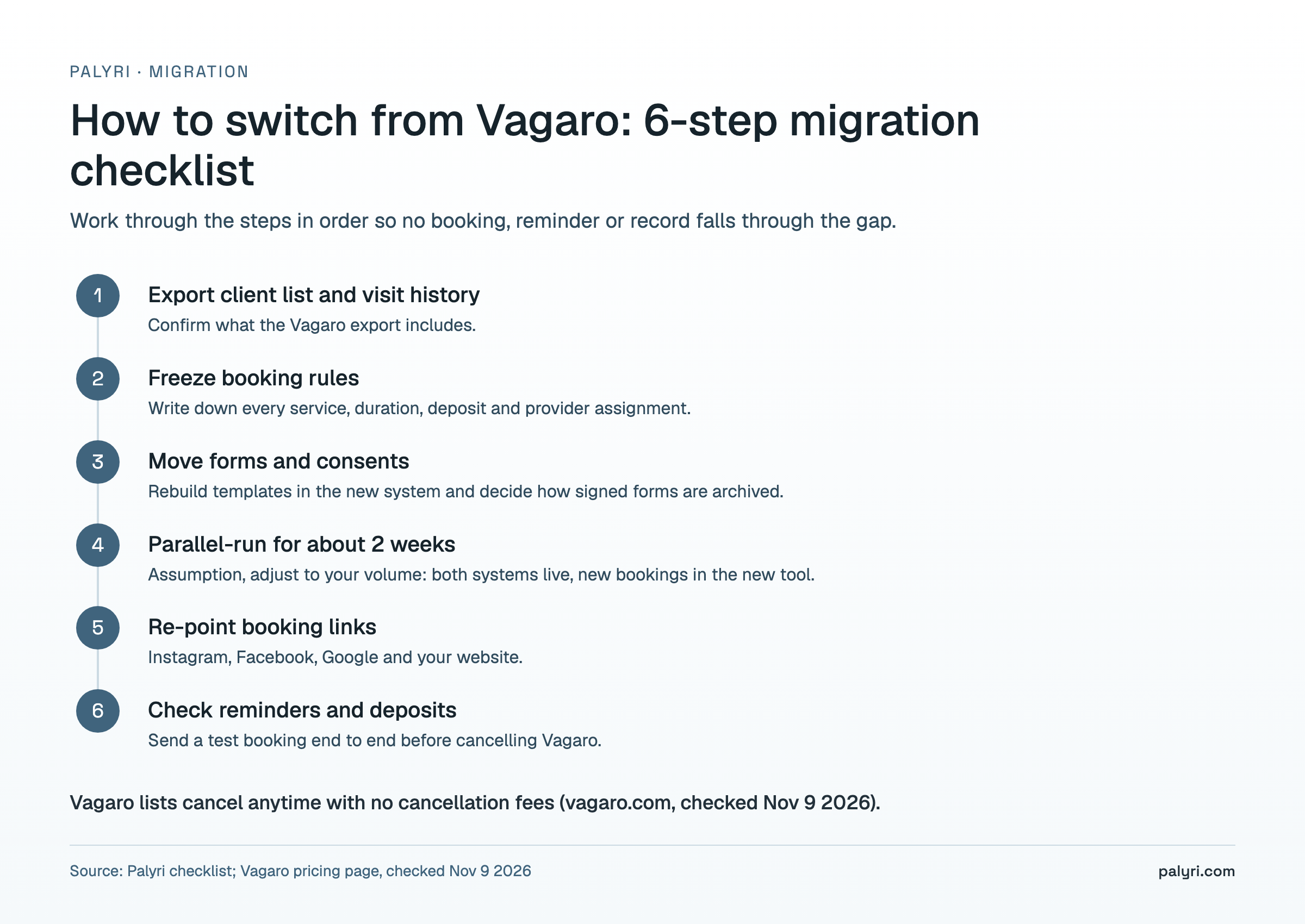
- Export the client list and visit history. Do this first, and check what the export actually contains (contact details, visit history, notes, packages). Anything missing needs a manual plan.
- Freeze and document booking rules. Write down every service, duration, buffer, deposit and provider assignment. This is the spec your new tool must match.
- Move forms and consents. Rebuild intake and consent templates in the new system and decide where previously signed forms will be archived.
- Parallel-run for a short window. Two weeks is an assumption, not a rule; adjust to how far ahead your patients book. New bookings go into the new tool while existing appointments finish in Vagaro.
- Re-point every booking link. Vagaro offers online booking on Instagram, Facebook and Apple Maps, so each of those links, plus your website and Google profile, has to change on the same day.
- Test reminders and deposits end to end. Make a test booking, confirm the reminder arrives and the deposit is taken, then cancel Vagaro. The pricing page states you can "cancel anytime with no cancellation fees," so there is no reason to cancel before the test passes.
If you are adding a lead layer instead of switching, the checklist shrinks to two steps: connect your ad lead forms to the new CRM, and agree on who updates the lead status after each call.
When to stay on Vagaro
Not every med spa should leave. If none of the seven signals apply, or only one does and an add-on fixes it, a switch adds cost and retraining for little gain.
FAQ
What is the best Vagaro alternative for a med spa?
There is no single best Vagaro alternative, because the right one depends on the gap you are trying to close. If charting, consent forms and before-and-after photos are the problem, look at clinical platforms such as PatientNow, Pabau, MeevoMD or Aesthetic Record. If booking rules, memberships and multiple locations are the problem, look at spa operations suites such as Boulevard, Mangomint or Zenoti. If ad leads go unanswered, you may not need to replace Vagaro at all: a lead CRM next to it can track each lead to a booked consult.
Does Vagaro have charting and consent forms?
Vagaro includes SOAP notes in every plan, according to its pricing page checked November 9, 2026. Pabau's comparison page, last updated July 23, 2026, describes Vagaro's notes as a very basic SOAP-style field, with intake, consent and advanced SOAP templates in a paid Forms add-on, and says Vagaro lacks clinic-grade before-and-after photo tracking. Pabau is a competitor, so test the Forms add-on yourself during Vagaro's 30-day free trial before you decide it falls short.
How much does Vagaro cost per month for a med spa?
Vagaro prices per bookable calendar. Its pricing page states that each calendar license you add to a location costs $10 (US), up to seven licenses, and offers a 30-day free trial with no cancellation fees. As an example, a med spa with seven calendars pays $60 a month in added calendar fees on top of the one-location base price. Past seven licenses, more employees cost nothing extra. Text marketing, forms and a branded app are sold as paid add-ons, according to Pabau's comparison, and each added location is priced by its features, with no extra multi-location fee. Check the base price on vagaro.com, since it was not shown in USD when we checked.
What are Vagaro's main competitors?
For med spas, the main Vagaro competitors fall into two groups. Spa and salon operations platforms include Zenoti, Boulevard, Mangomint, Meevo, Mindbody, Square Appointments, GlossGenius and Fresha; Zenoti's October 28, 2026 roundup lists most of these. Clinical platforms built for aesthetics include PatientNow, Pabau, MeevoMD and Aesthetic Record. Most are written by one of these vendors, so use them for facts and make the ranking yourself.
Can I keep Vagaro and use a separate CRM for leads?
Yes. This setup fits when the front desk works well but leads from Meta or Google go untracked. Vagaro's pricing page, in its multi-location section, says it offers APIs and webhooks to connect with your CRM and other tools. The trade-off is two systems, so decide which one owns each field: the CRM owns the lead until the consult is booked, Vagaro owns the appointment. Palyri is one CRM option for this; it has no verified Vagaro integration, so plan how booked status gets recorded.
How hard is it to switch from Vagaro?
The risk is the transition window. A clean switch means exporting your client list and history, documenting every booking rule, rebuilding forms and consents, running both systems in parallel for a short period, re-pointing booking links on Instagram, Facebook, Google and your website, and testing reminders and deposits before you cancel. Vagaro states you can cancel anytime with no cancellation fees, so there is no pressure to cut over early.
Want to implement this in your clinic?
Book a free Palyri demo. We'll show how it works on your clinic's data.
Book a demoPalyri blog author
Writes for the Palyri blog about getting clients from ads, handling leads and front-desk work in aesthetic clinics and beauty salons.